SPILKAMMERET's 1993 call invited the international mail art network to reinterpret the 22 major arcana of the tarot deck. The response — some 30 entries from artists in 14 countries — exceeded organizer K. Frank Jensen's expectations, prompting him to extend the project into a continuing, open-ended call. The documentation, distributed not only to contributors but to leading tarot researchers and collectors worldwide, preserves a remarkable cross-section of early-1990s photocopy, collage, rubber stamp, and early digital ("Compu-Art") mail art practice applied to a five-centuries-old esoteric image system.
SPILKAMMERET, a Roskilde-based archive specializing in tarot and cartomancy is holding what is claimed to be the world's largest archive of 20th-century tarot and cartomancy material — about 3,500 card decks and 1,500 books.
Because the response exceeded expectations, Jensen declared the project an ongoing/running call rather than a one-off, inviting further contributions for future documentation. The accompanying introduction situates the tarot's major arcana imagery within its Renaissance Italian origins (cards for the game of Tarocchino/Tarot/Tarock) and its later adoption — from the mid-18th century onward — for esoteric and divinatory purposes, citing French scholar Antoine Court de Gébelin's influential reinterpretation of the deck as a secret symbolic system.
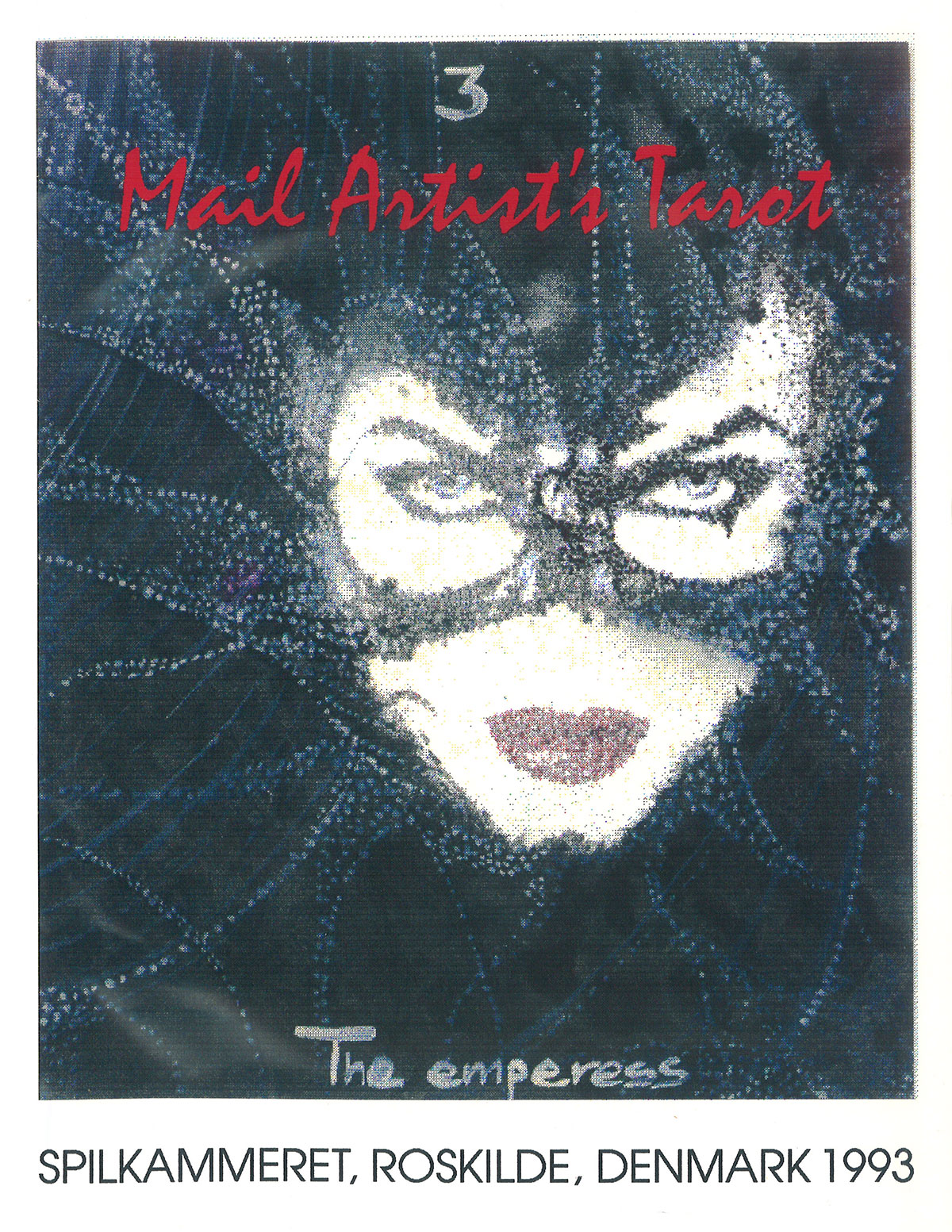
Cover. The Empress, illustration by Laura Gianfreda, Italy.

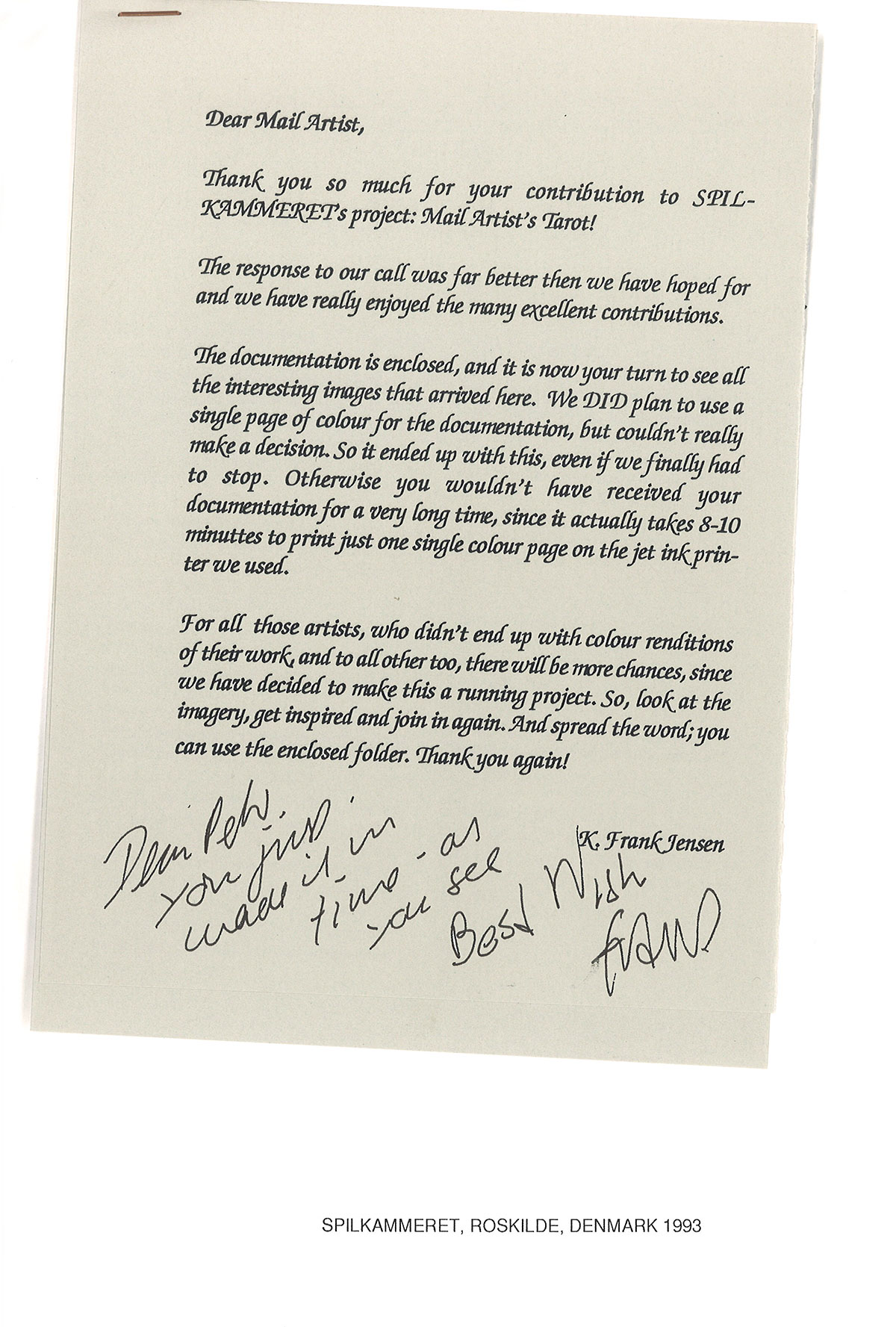
Letter. Personal cover letter from K. Frank Jensen to contributor Peter Küstermann, accompanying the documentation. This catalogue is a kind donation by Peter.

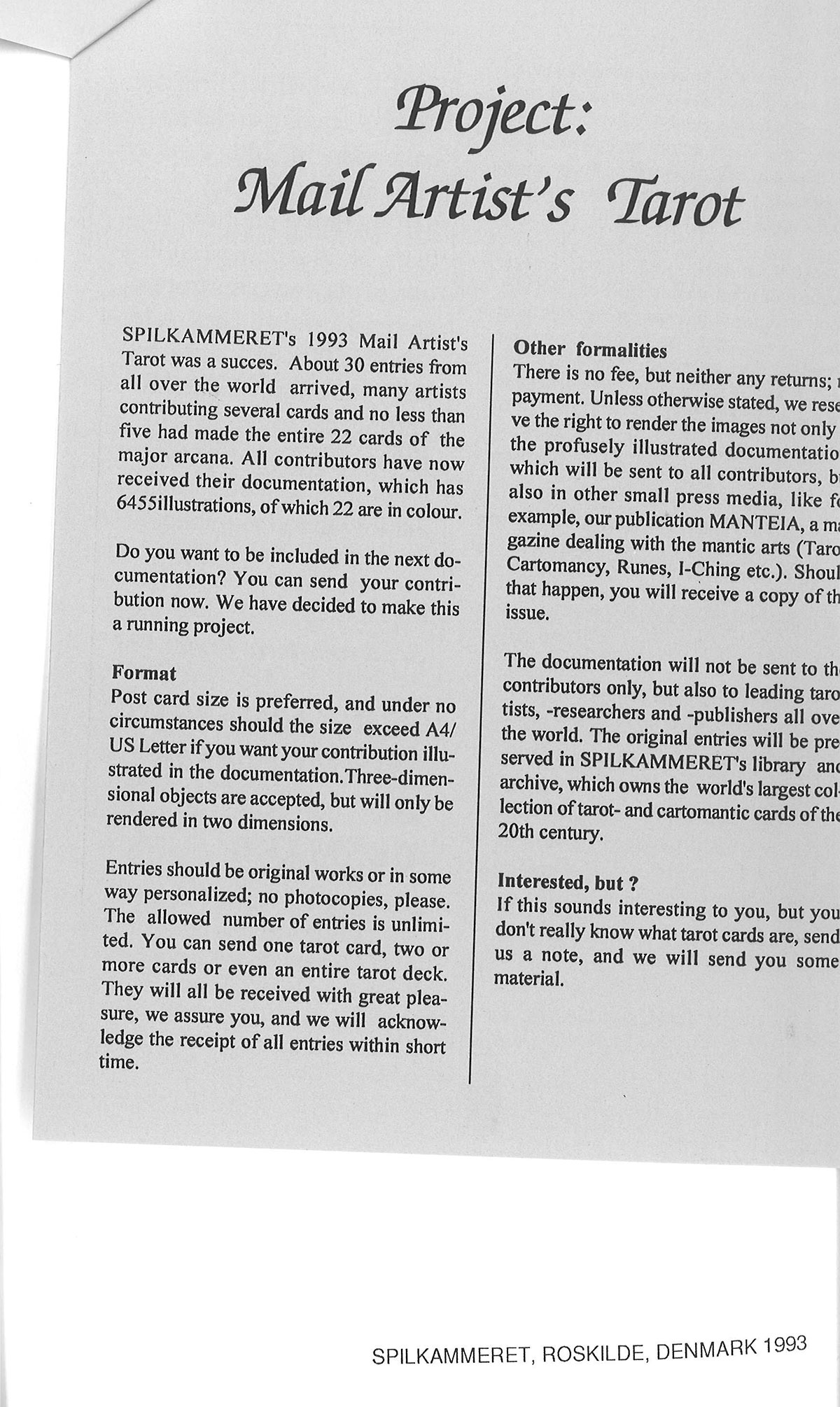
Project introduction text describing the 1993 results (about 30 entries, 645 illustrations, 22 in colour) and submission guidelines.

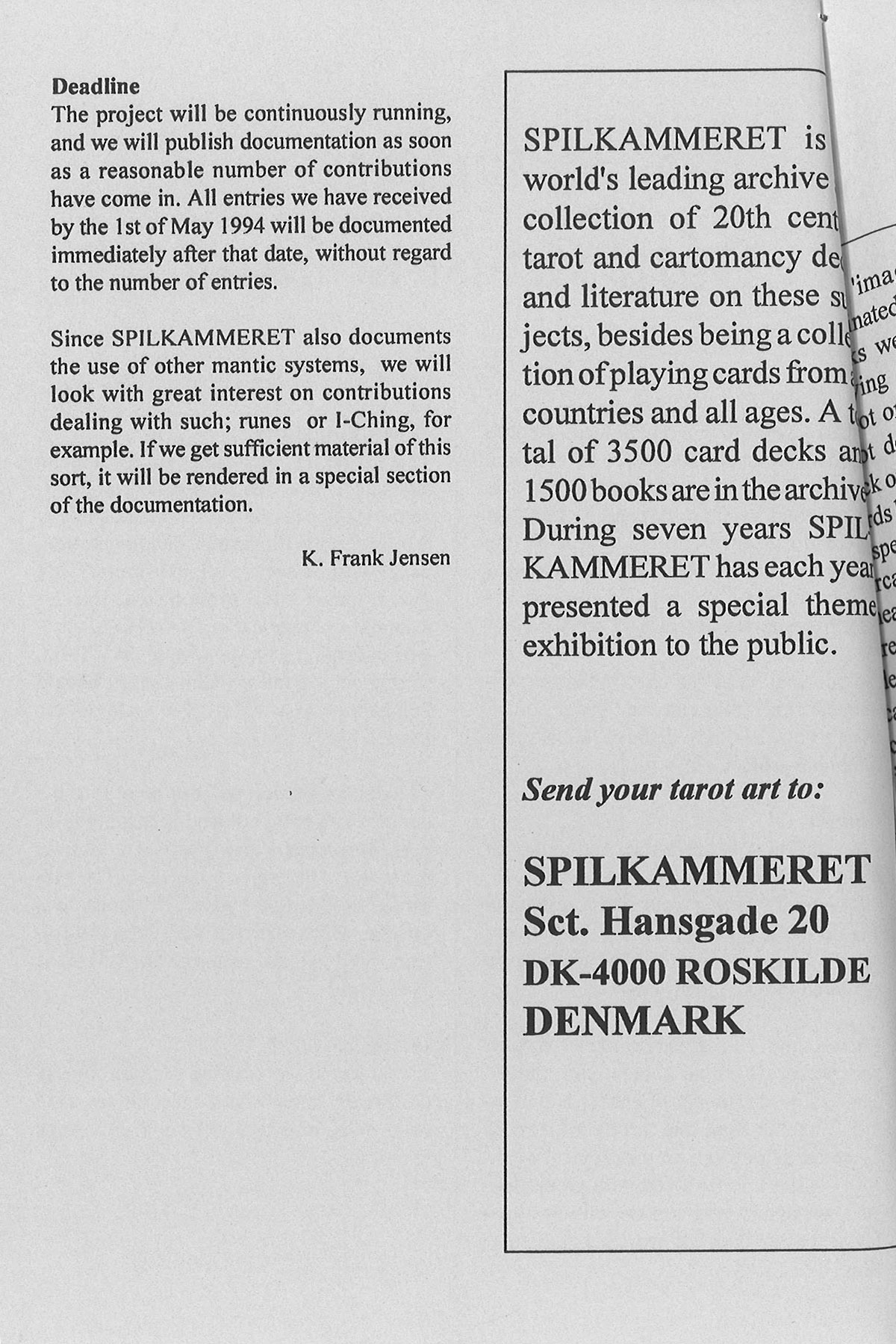
Call. Continuation of the project announcement, deadline notice, and introductory text on the history of tarot imagery.

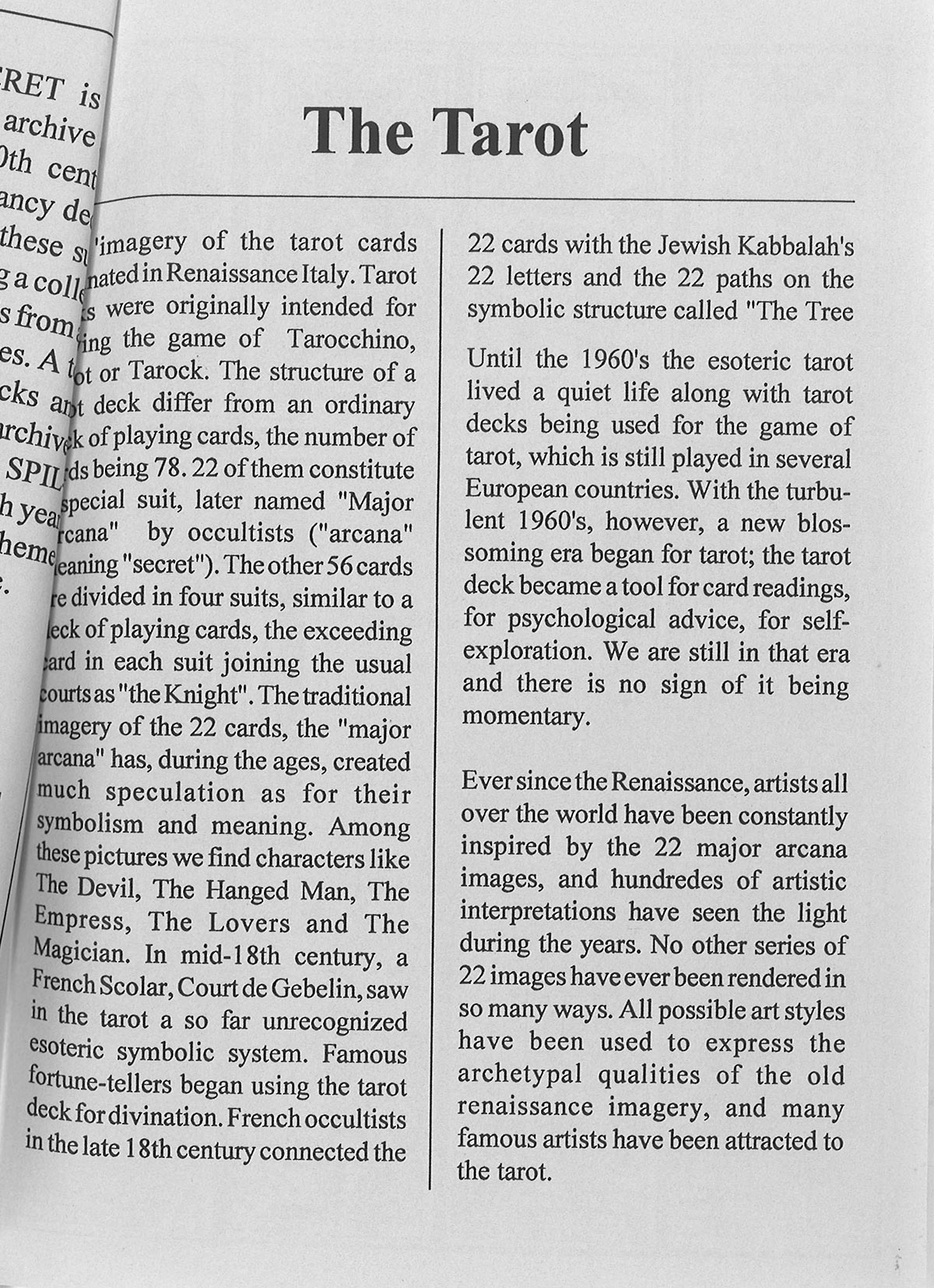
"The Tarot" — essay on the historical and esoteric background of the major arcana.

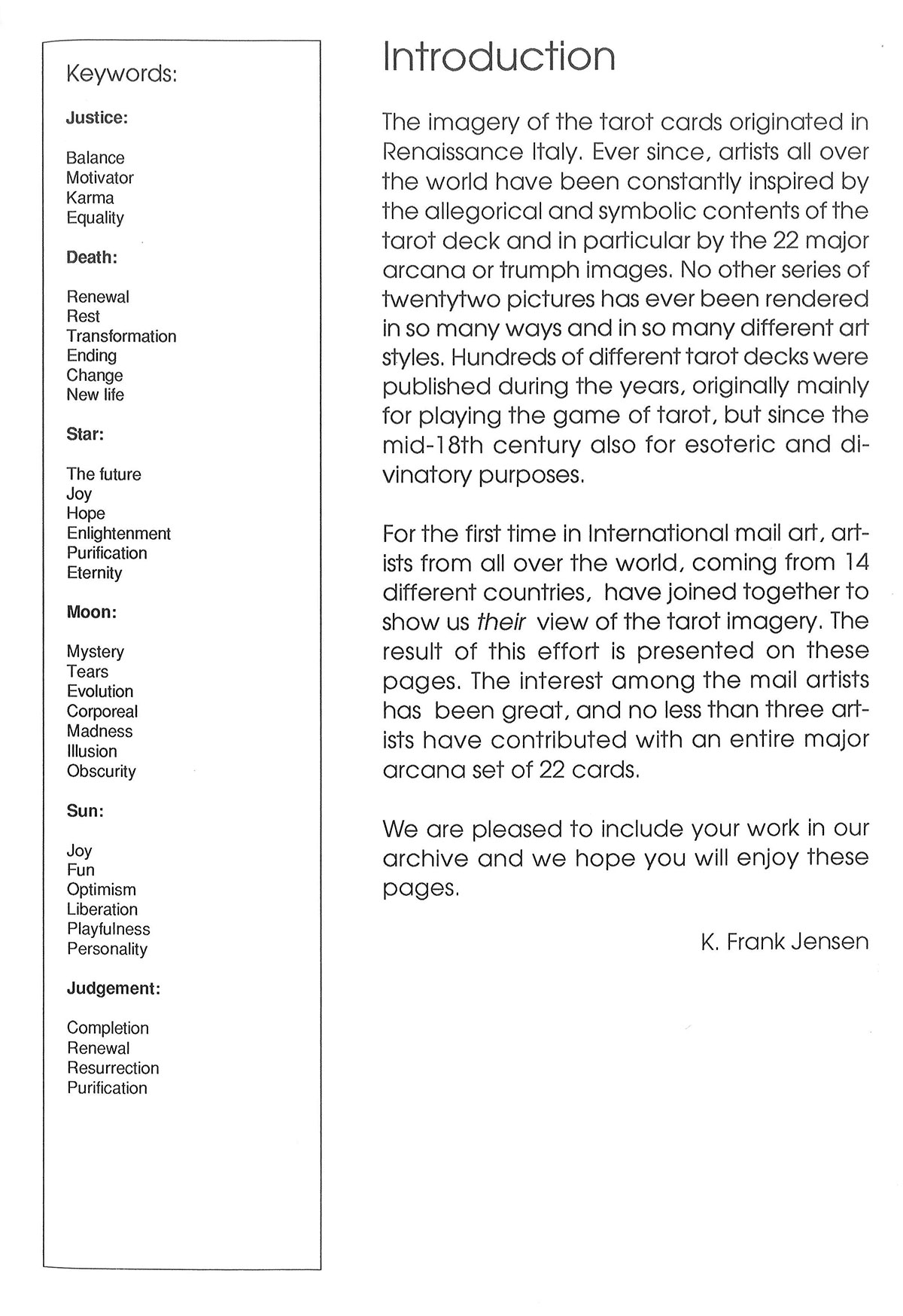
Introduction by K. Frank Jensen, with keyword glosses for Justice, Death, Star, Moon, Sun, and Judgement.

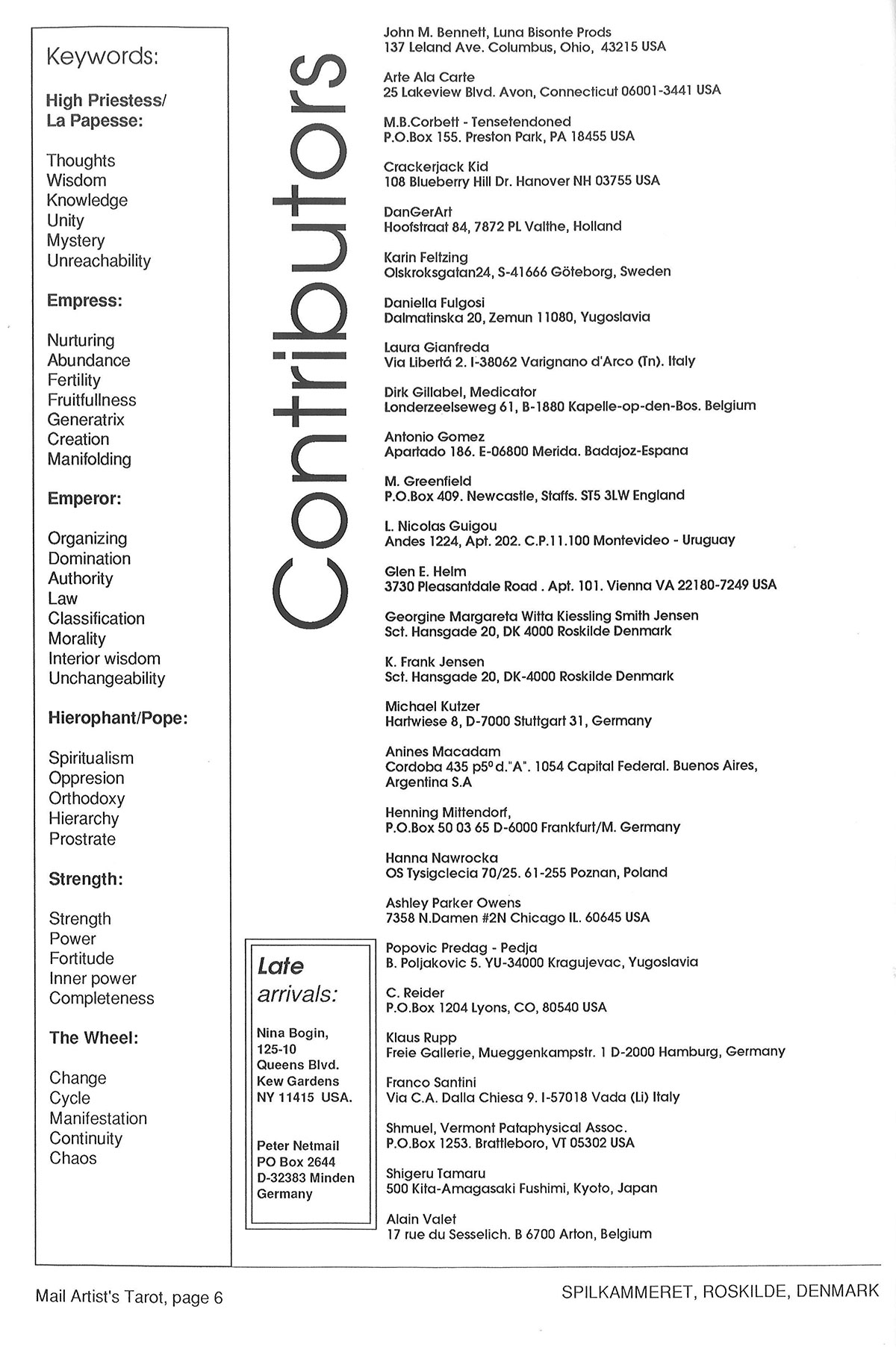
List of participants. Contributors page with addresses, including John M. Bennett, Crackerjack Kid, Karin Feltzing, Daniella Fulgosi, Laura Gianfreda, K. Frank Jensen, Klaus Rupp, Shigeru Tamaru, and others.

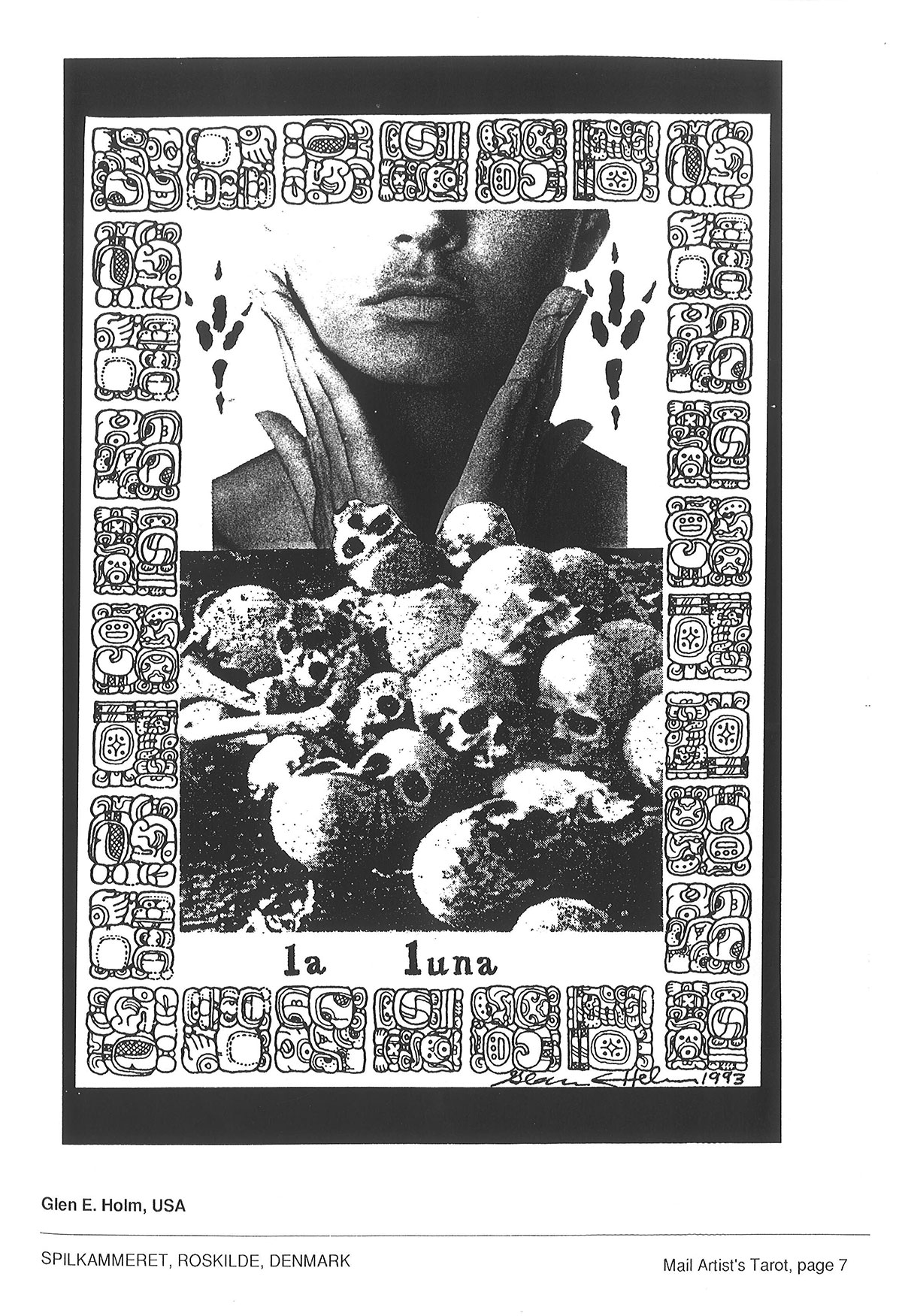
Work by Glen E. Holm, USA. "La Luna" card, framed with Maya glyph borders.

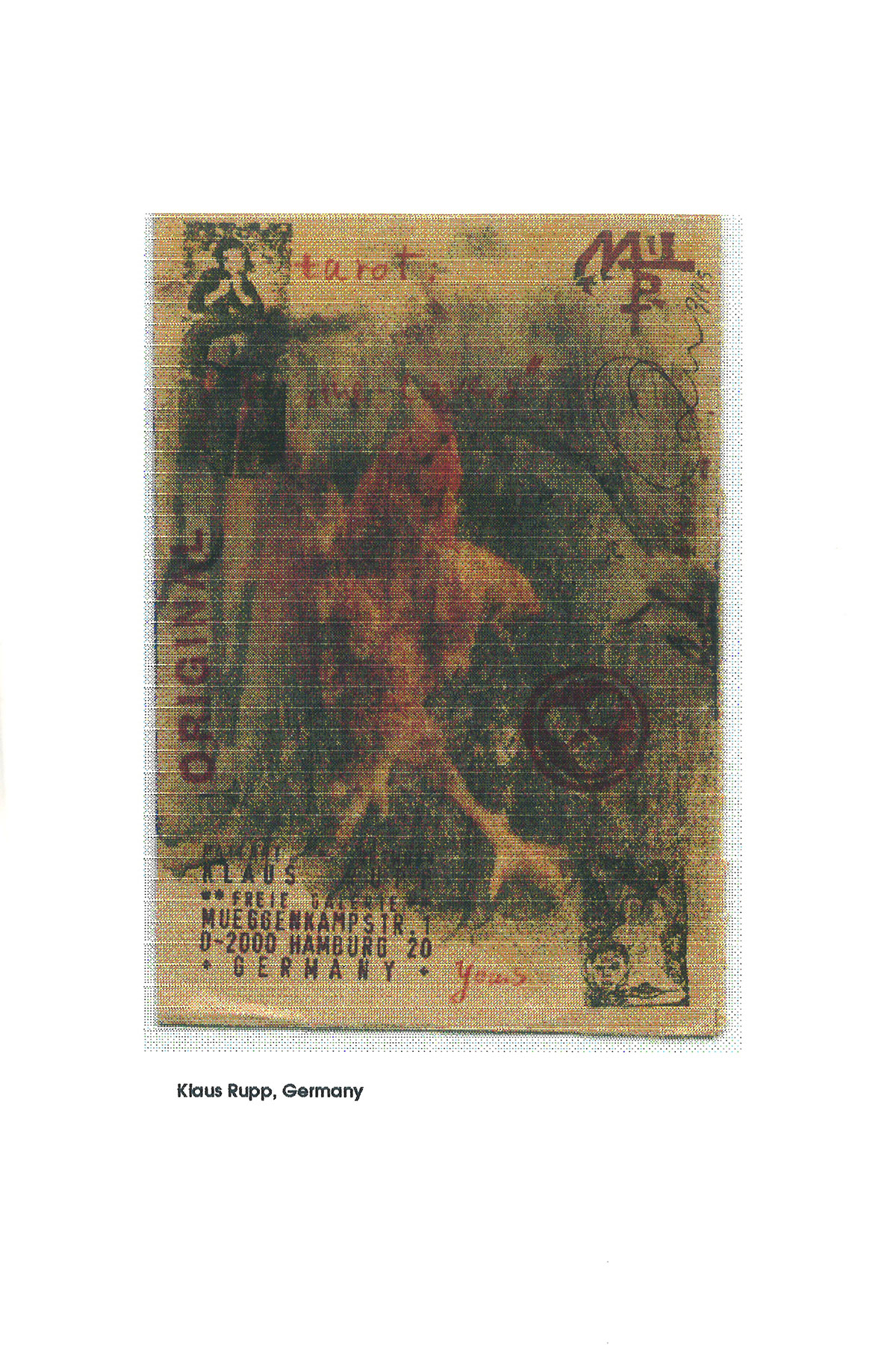
Work by Klaus Rupp, Germany. Collage-based tarot card incorporating a rooster motif and gallery address stamp.

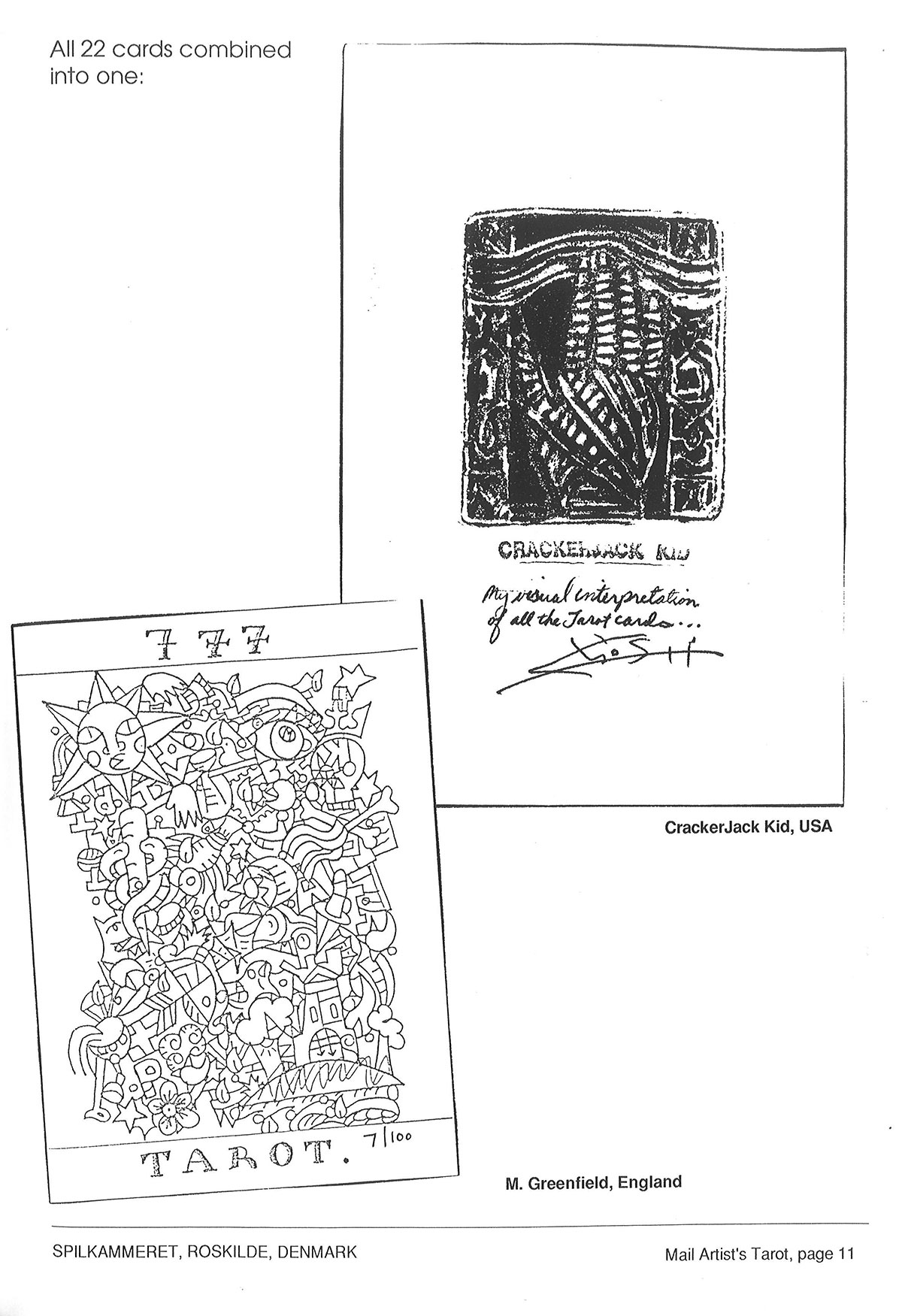
Work by CrackerJack Kid, USA, and M. Greenfield, England. A combined "all 22 cards into one" composite design and a hand-numbered limited-edition print titled "777 TAROT".

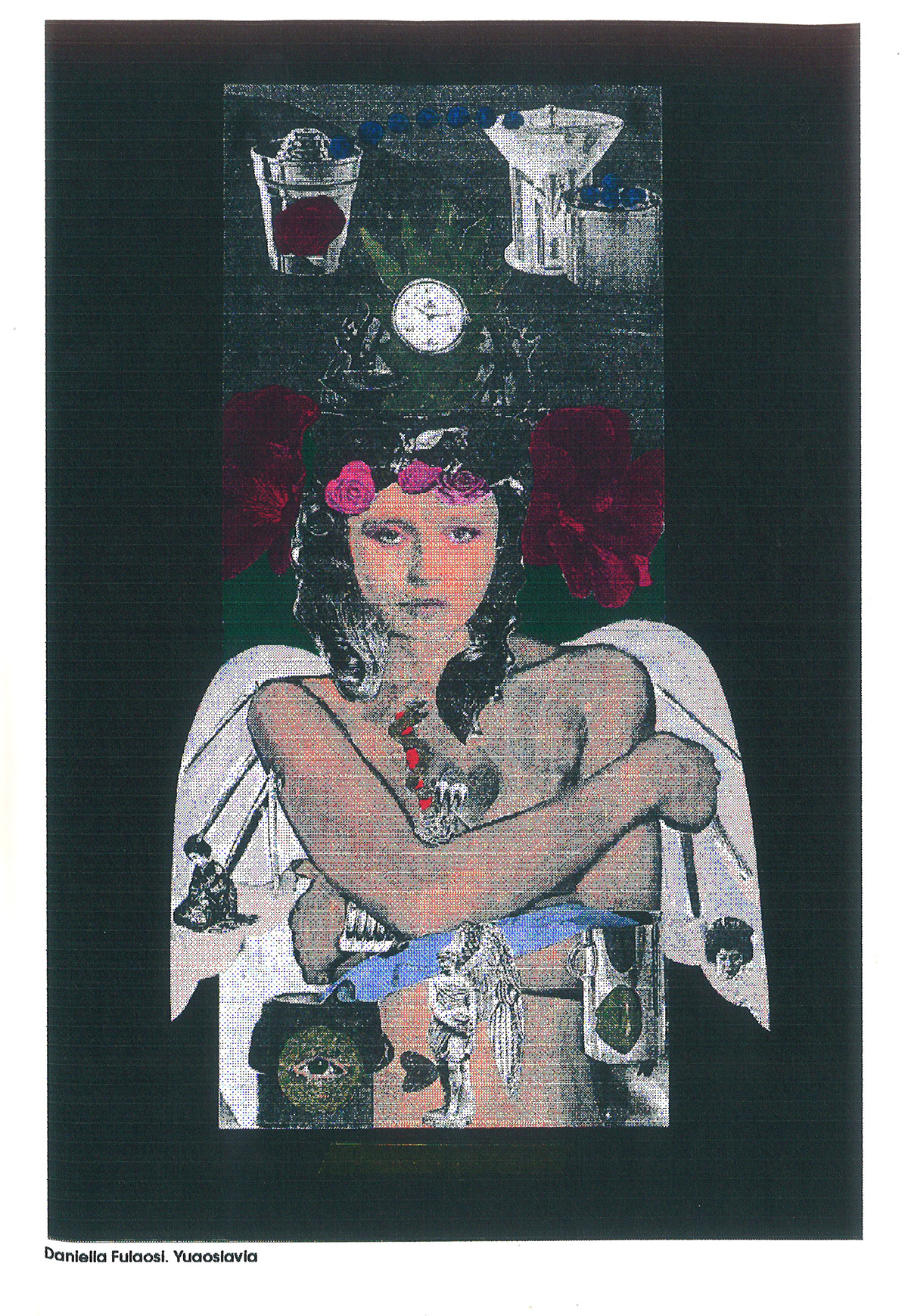
Work by Daniela Fulgosi, Yugoslavia. Colour collage card incorporating clock, rose, and figure imagery.

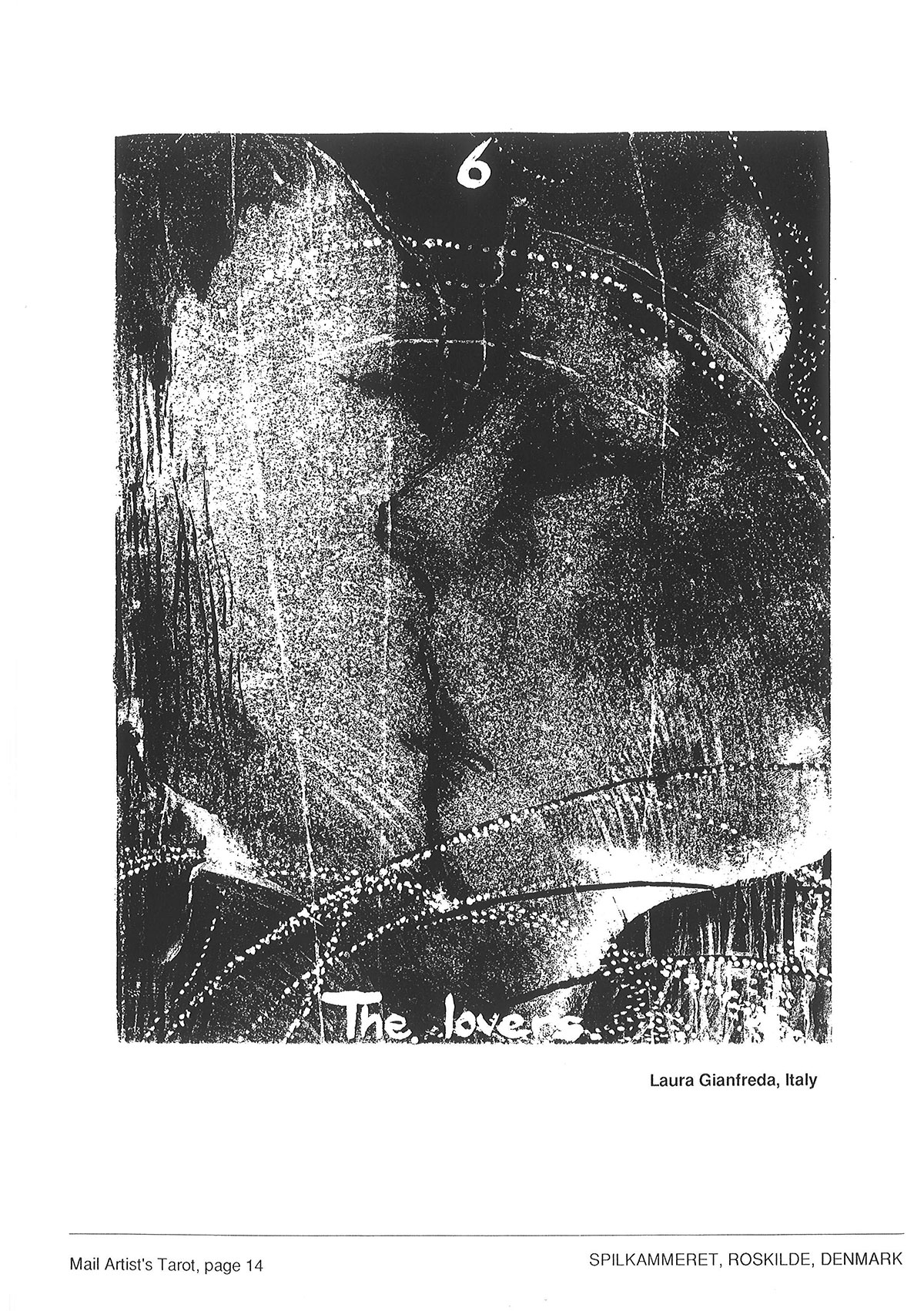
Work by Laura Gianfreda, Italy. "The Lovers" card.

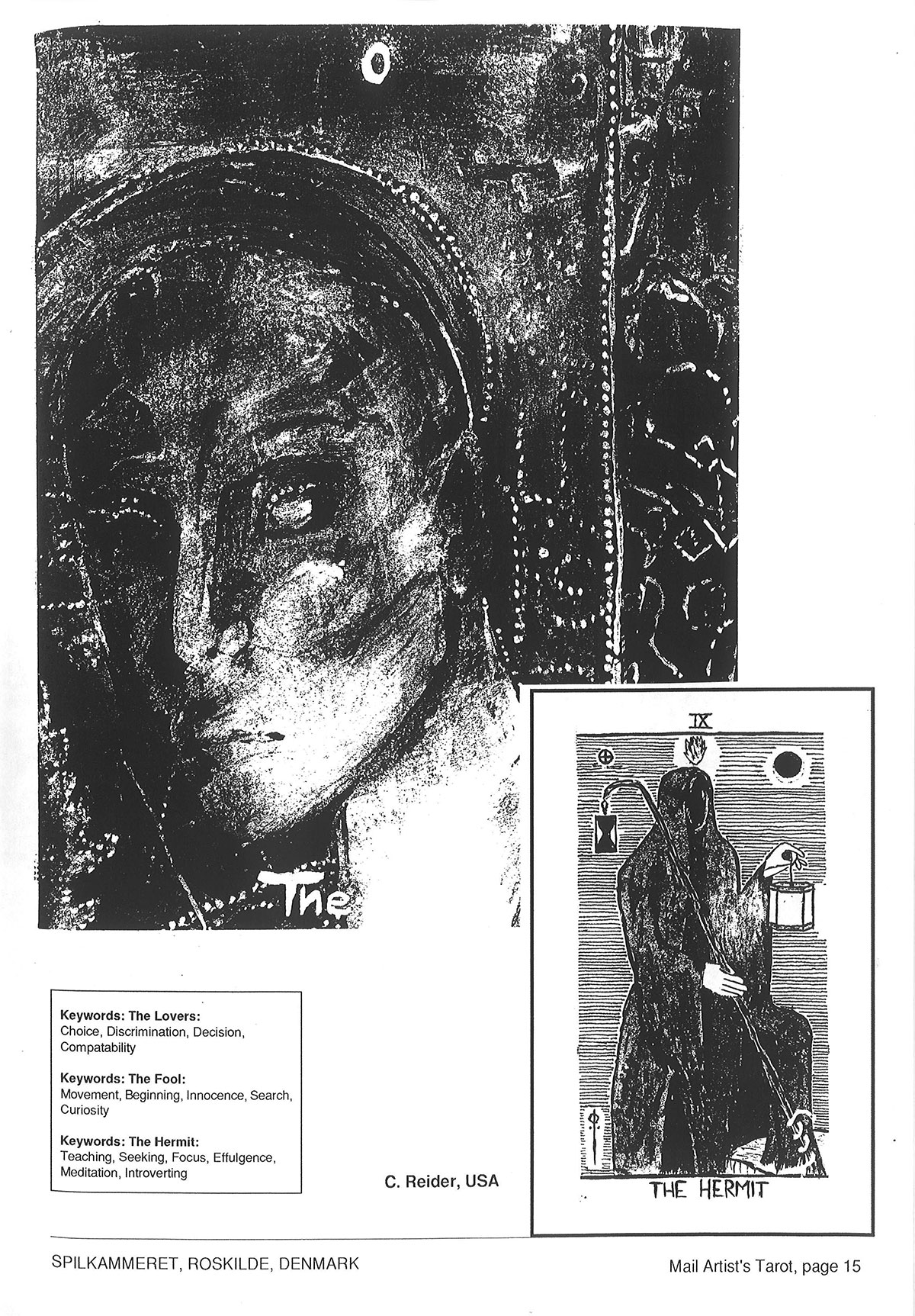
Works by C. Reider, USA. "The Hermit" and related cards, with keyword glosses for The Lovers, The Fool, and The Hermit.

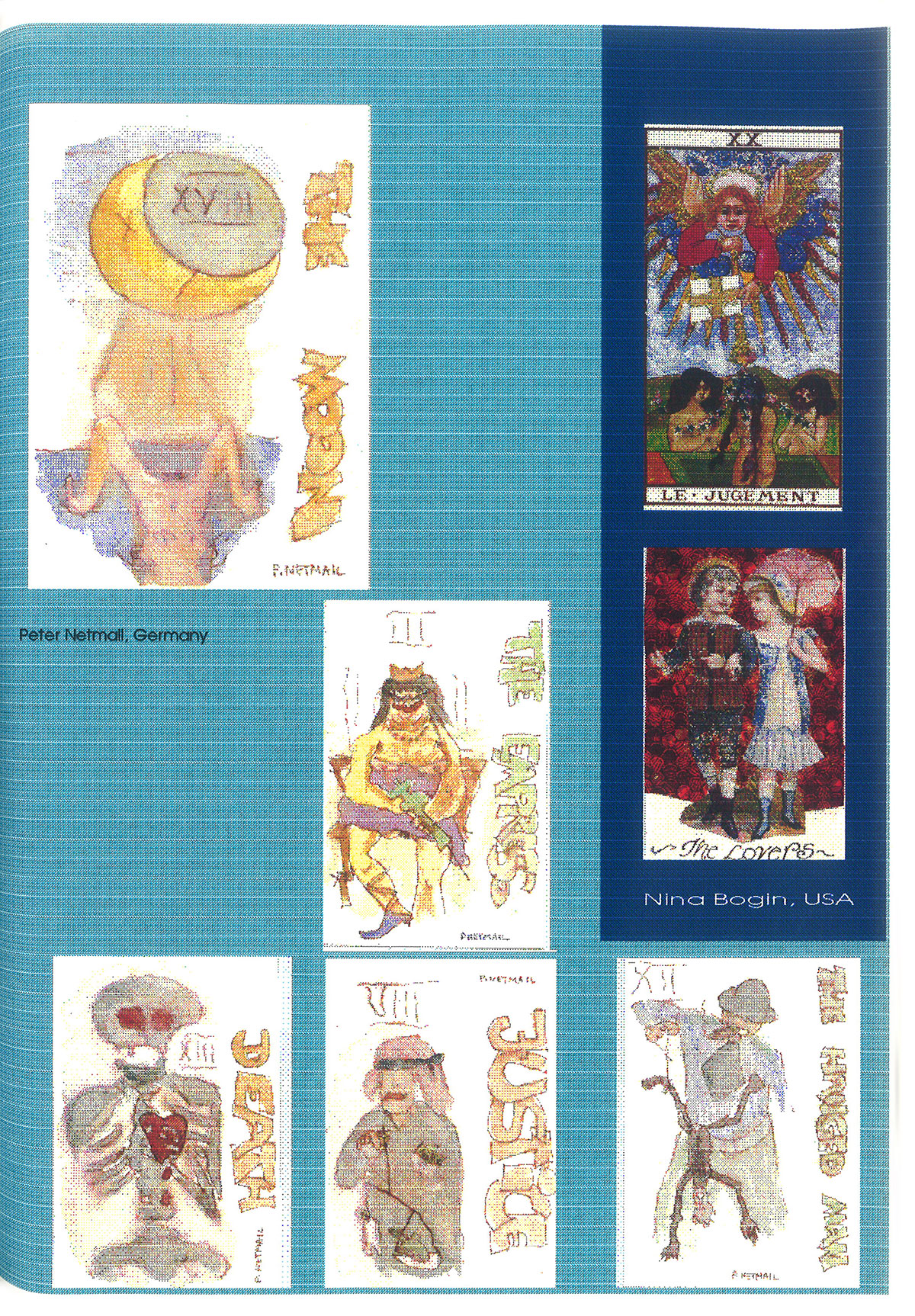
Works by Peter Netmail, Germany, and Nina Bogin, USA. Colour cards including The Moon, The Empress, Death, Justice, The Hanged Man (Netmail) and Judgement, The Lovers (Bogin).

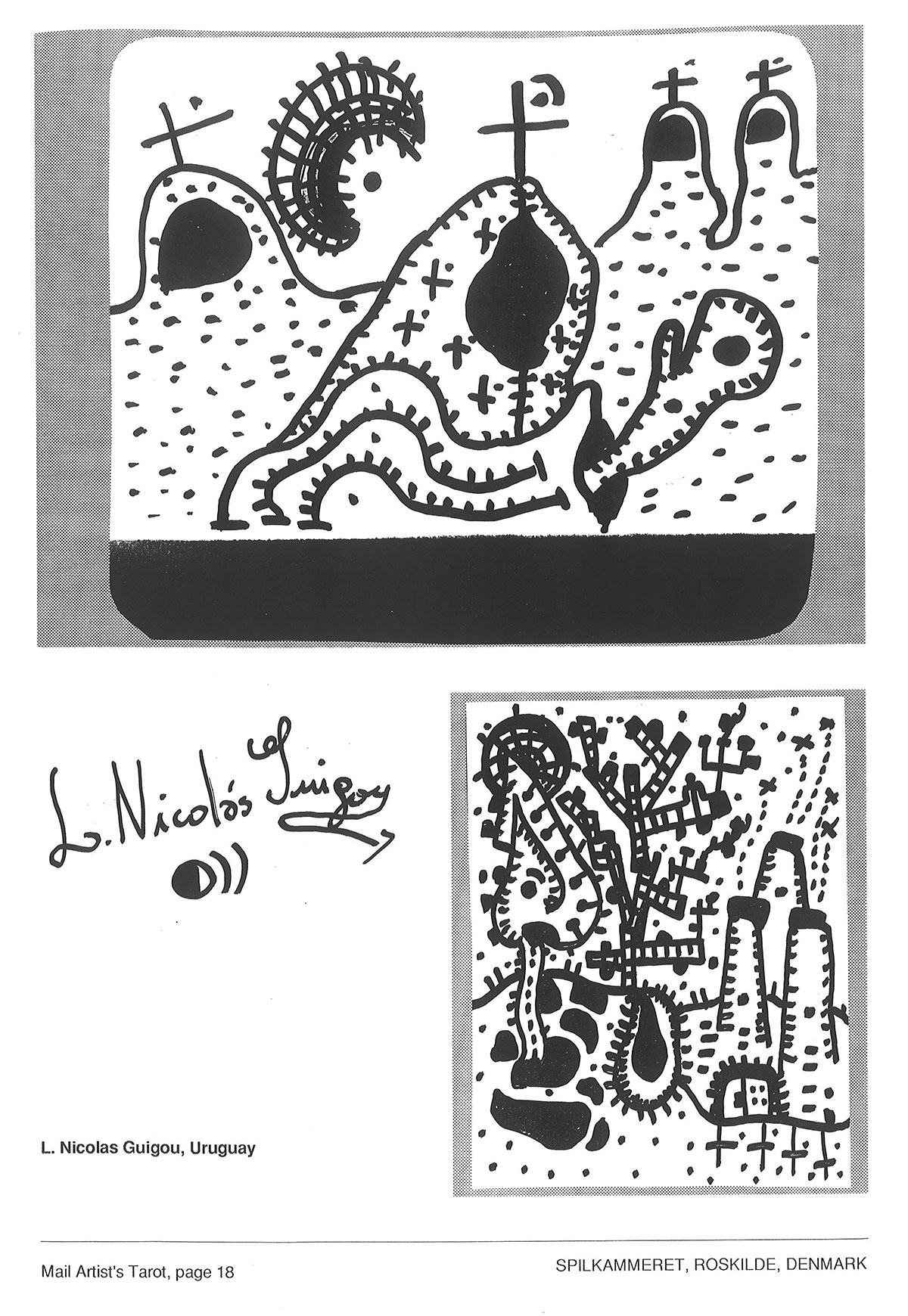
Works by L. Nicolas Guigou, Uruguay. Two abstract line-drawn cards with hand signature.

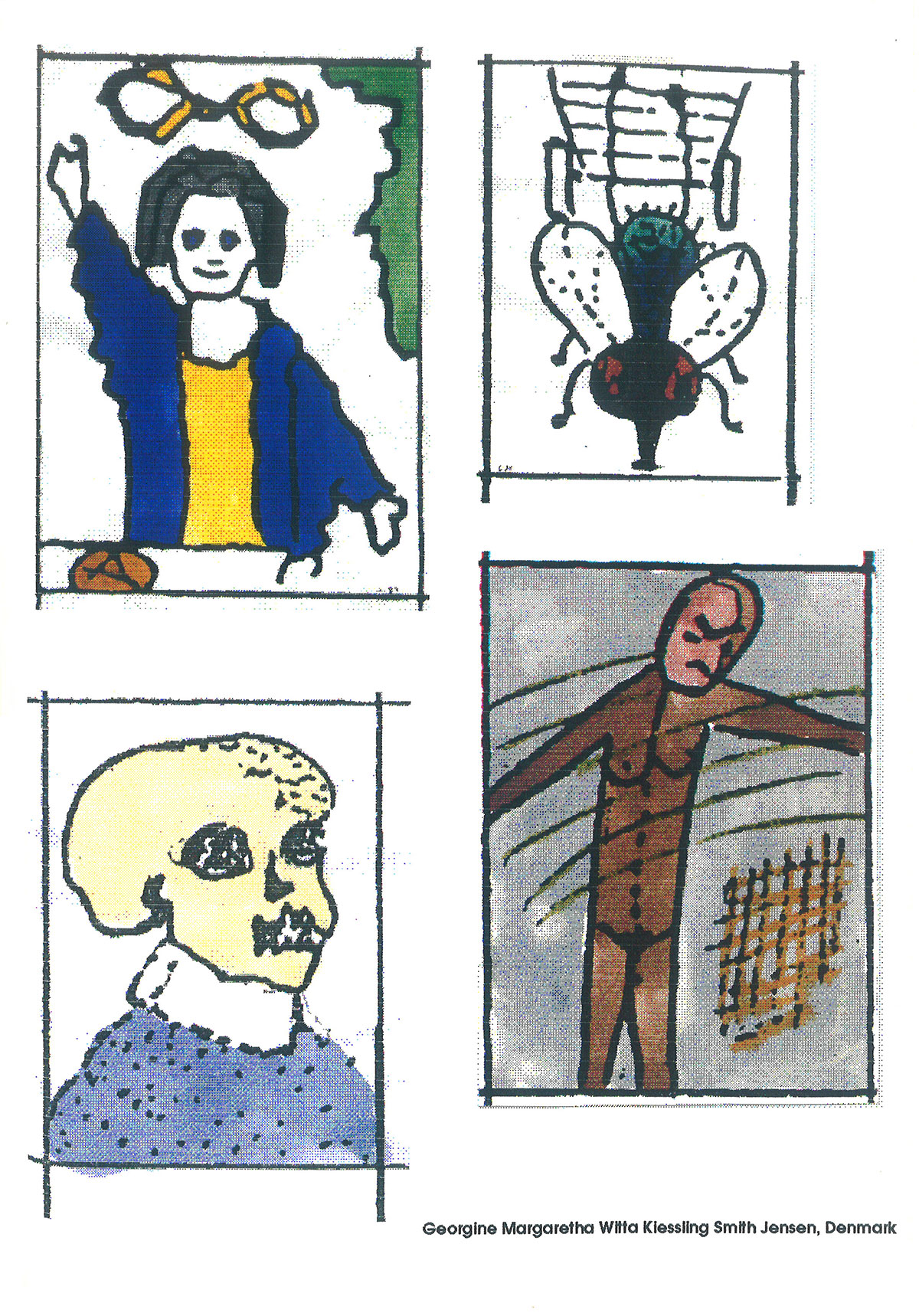
Works by Georgine Margaretha Witta Kiessling Smith Jensen, Denmark. Four colour cards including a figure, a fly, a skull, and a crucified figure.

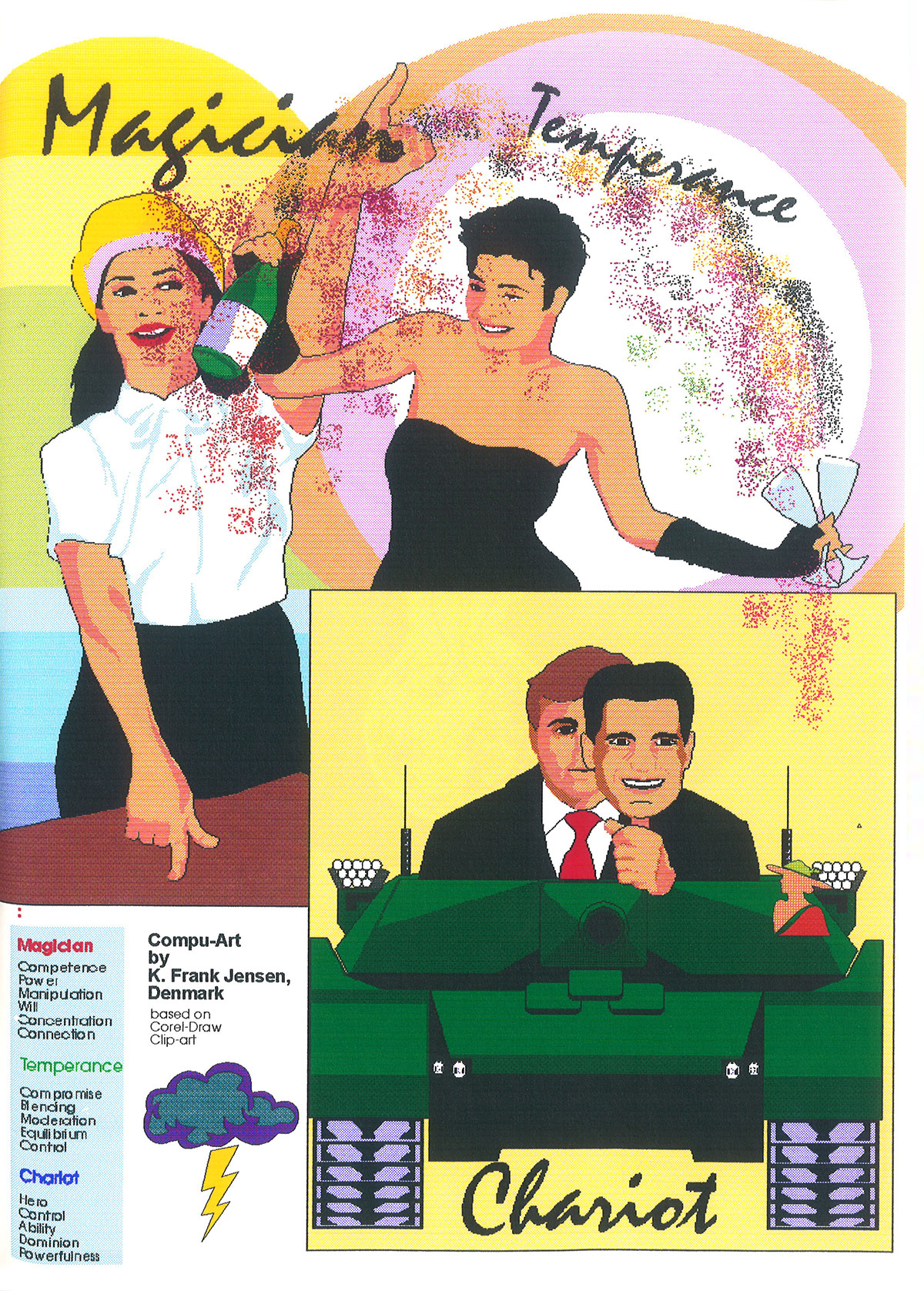
Works by K. Frank Jensen, Denmark. "Magician," "Temperance," and "Chariot" cards, credited as Compu-Art based on Corel-Draw clip-art.

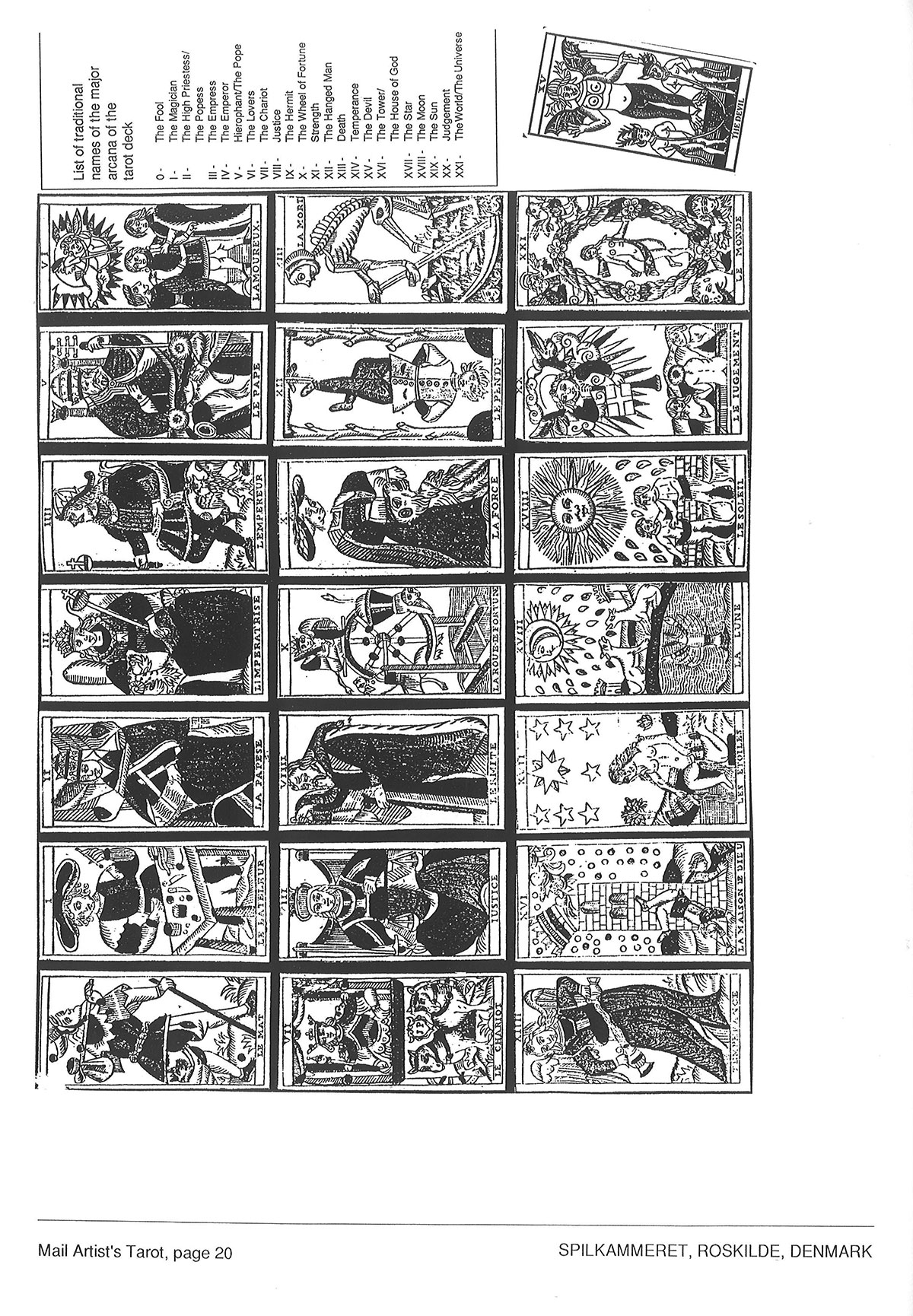
Reference page listing the traditional names of the 22 major arcana, alongside a reproduced historical French Tarot de Marseille-style deck sheet for comparison.