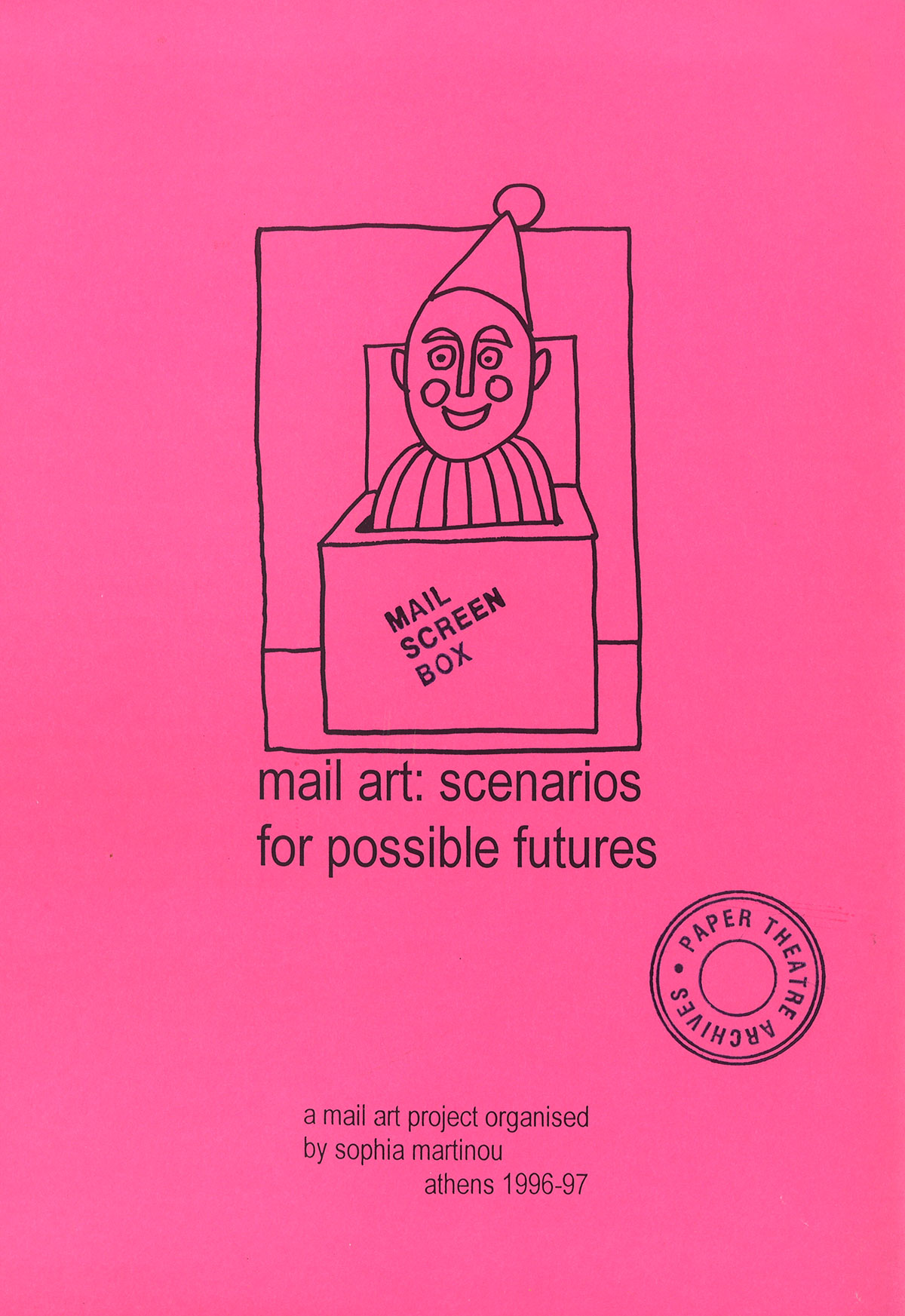
Cover
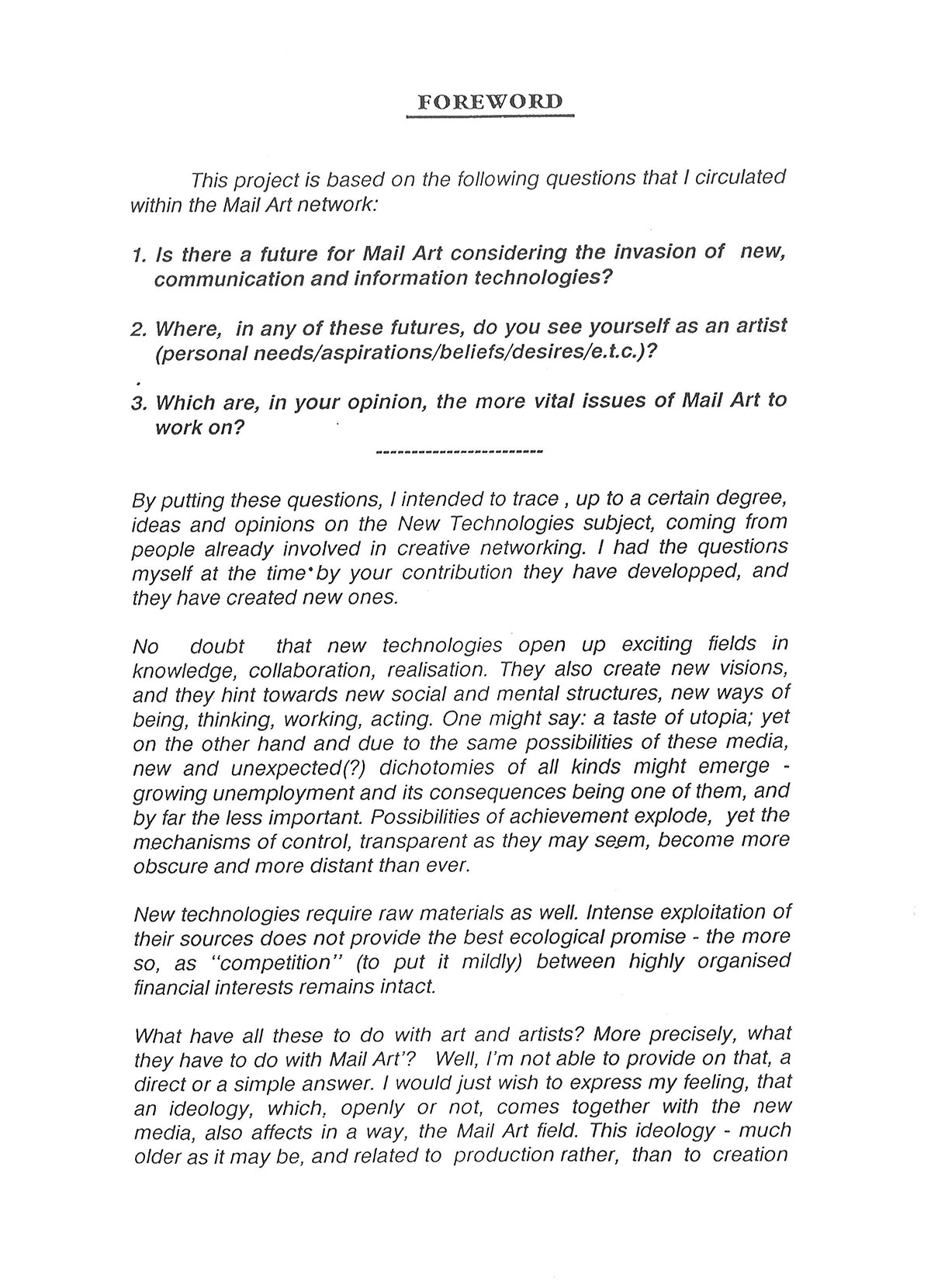
Foreword by Sophia Martinou, setting out the three questions circulated within the mail art network and reflecting on new technologies, creative networking, and the ideology of production versus creation.
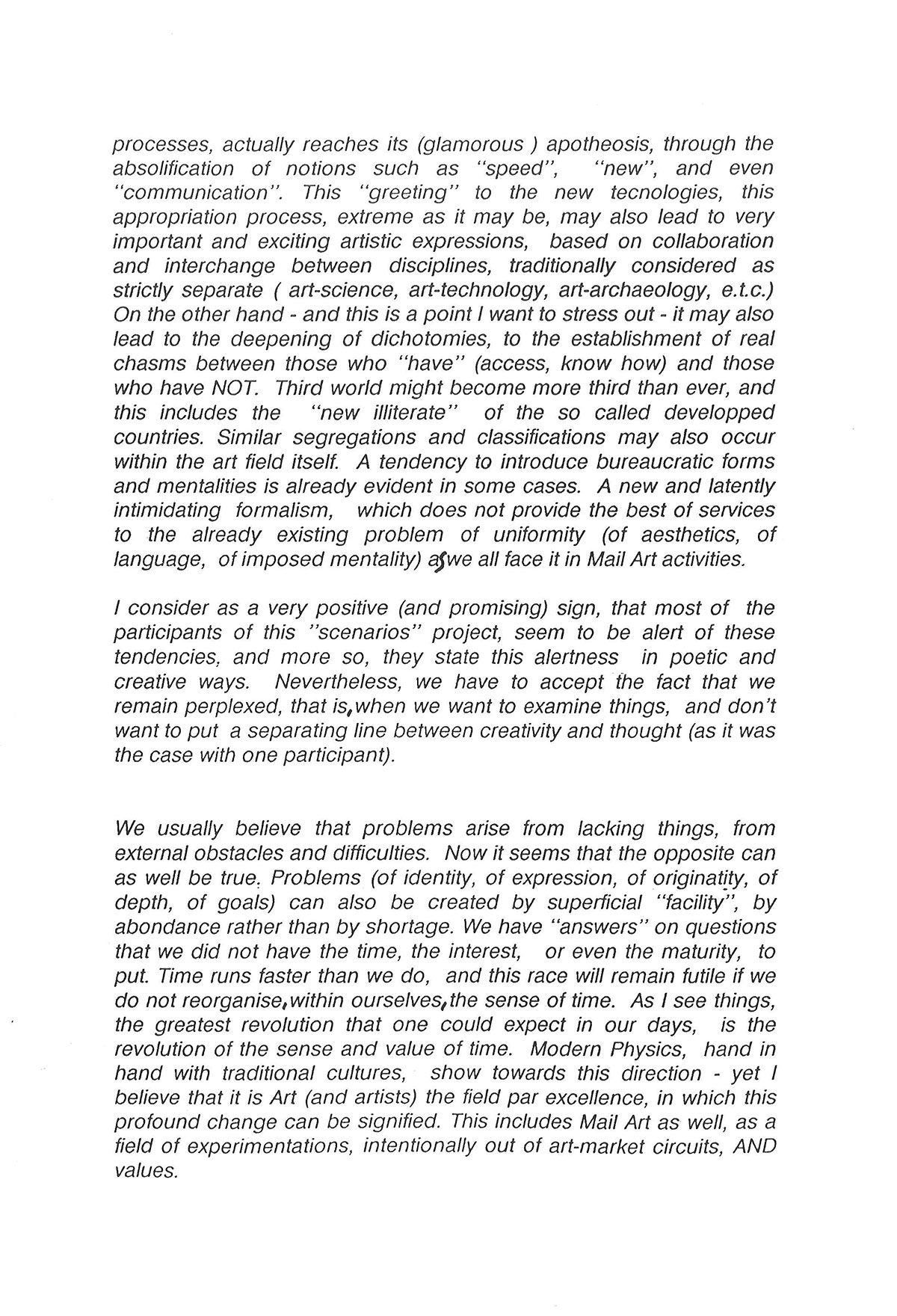
Foreword by Sophia Martinou (continuation). Martinou reflects on the risks of new technological formalism deepening global inequalities, and notes the alertness of the project's participants to these tendencies. She argues that the greatest revolution of the era is a revolution in the sense and value of time, and that mail art — as a field of experimentation outside art-market circuits — is uniquely positioned to embody this change.
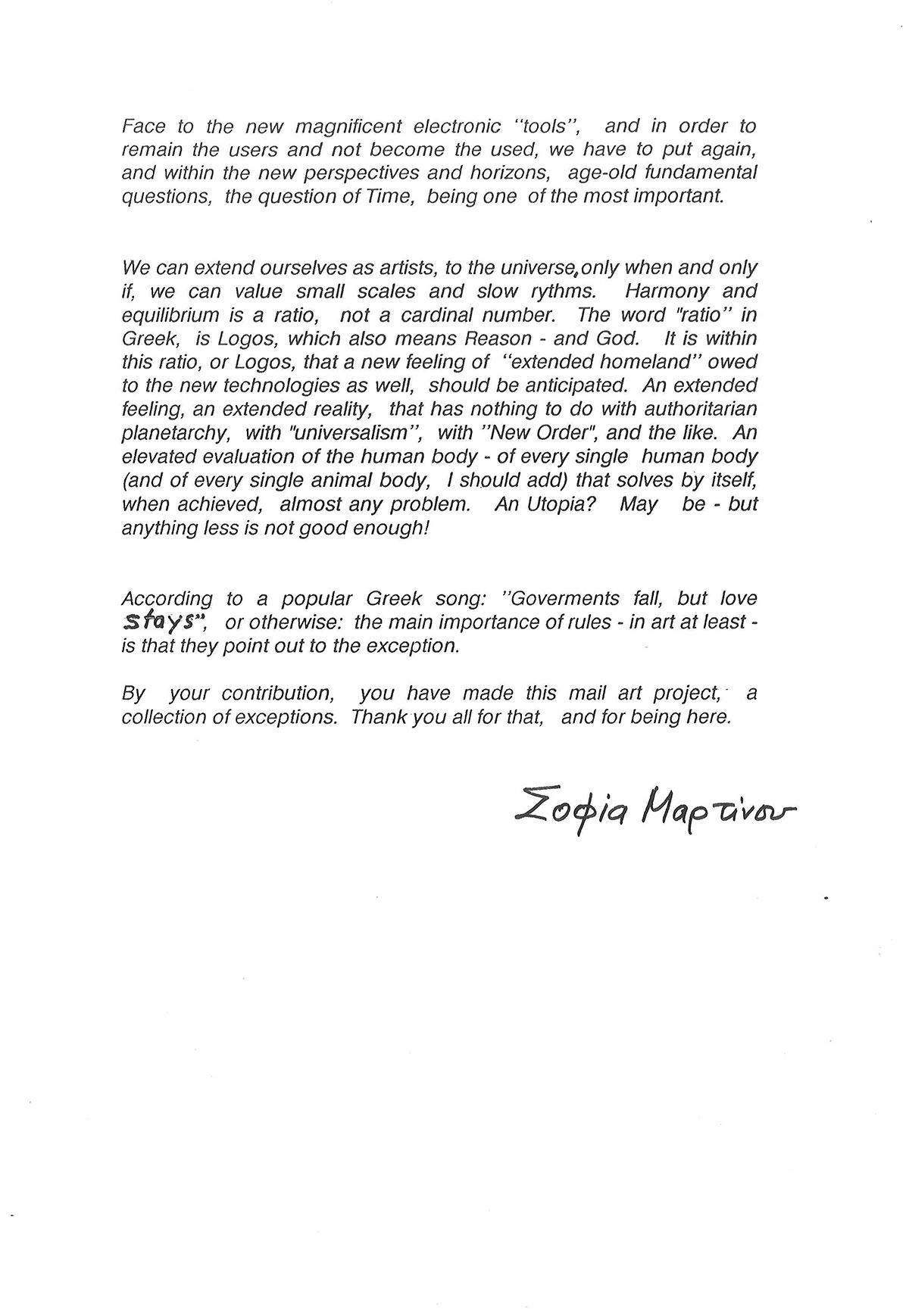
Foreword by Sophia Martinou (closing page). Martinou concludes with a reflection on the human body, utopia, and the nature of rules in art.
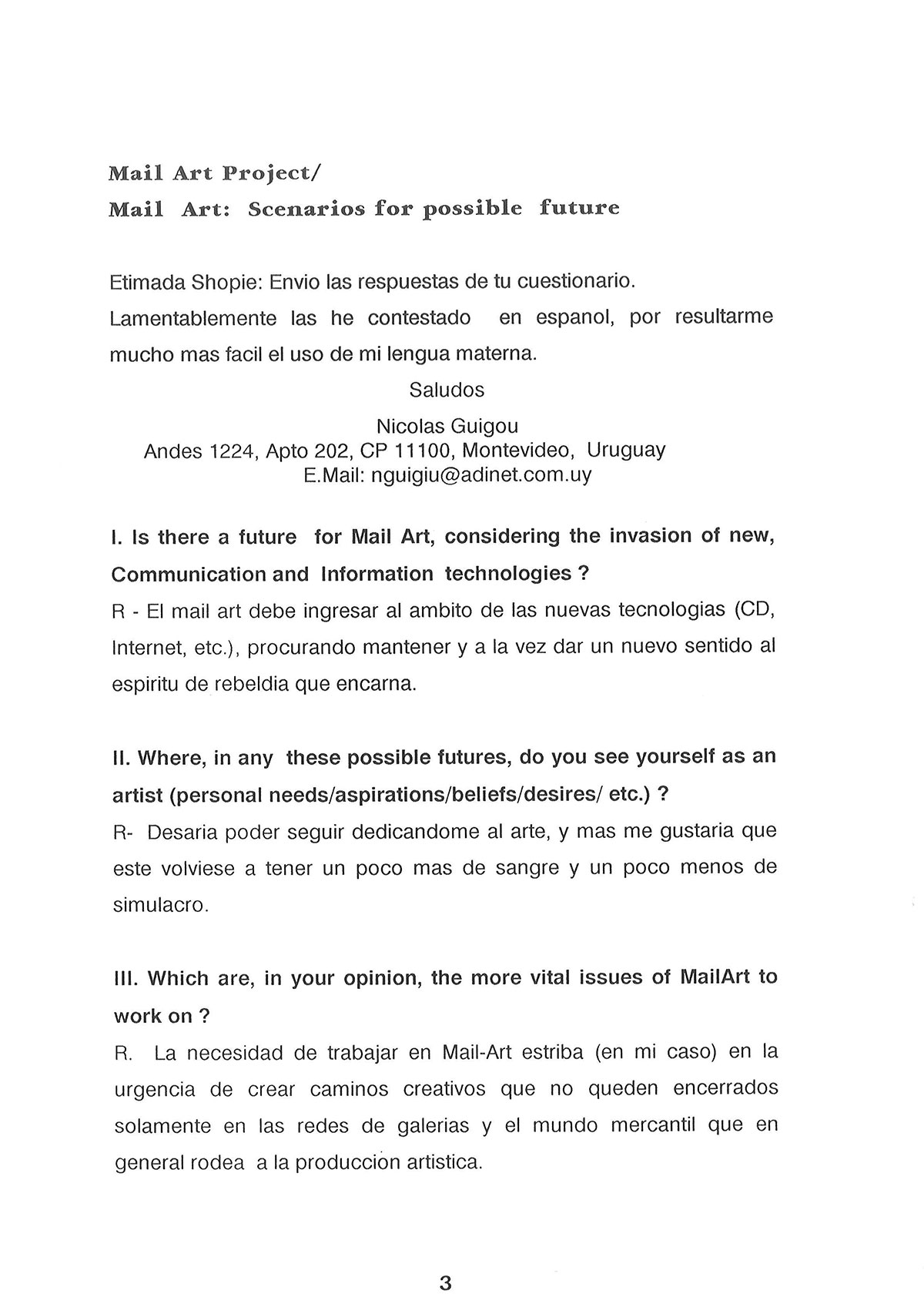
Contribution by Nicolas Guigou, Montevideo, Uruguay. Guigou responds in Spanish to all three of Martinou's questions, arguing that mail art must enter the domain of new technologies while preserving its spirit of rebellion, and that it should return to greater authenticity and less simulation.
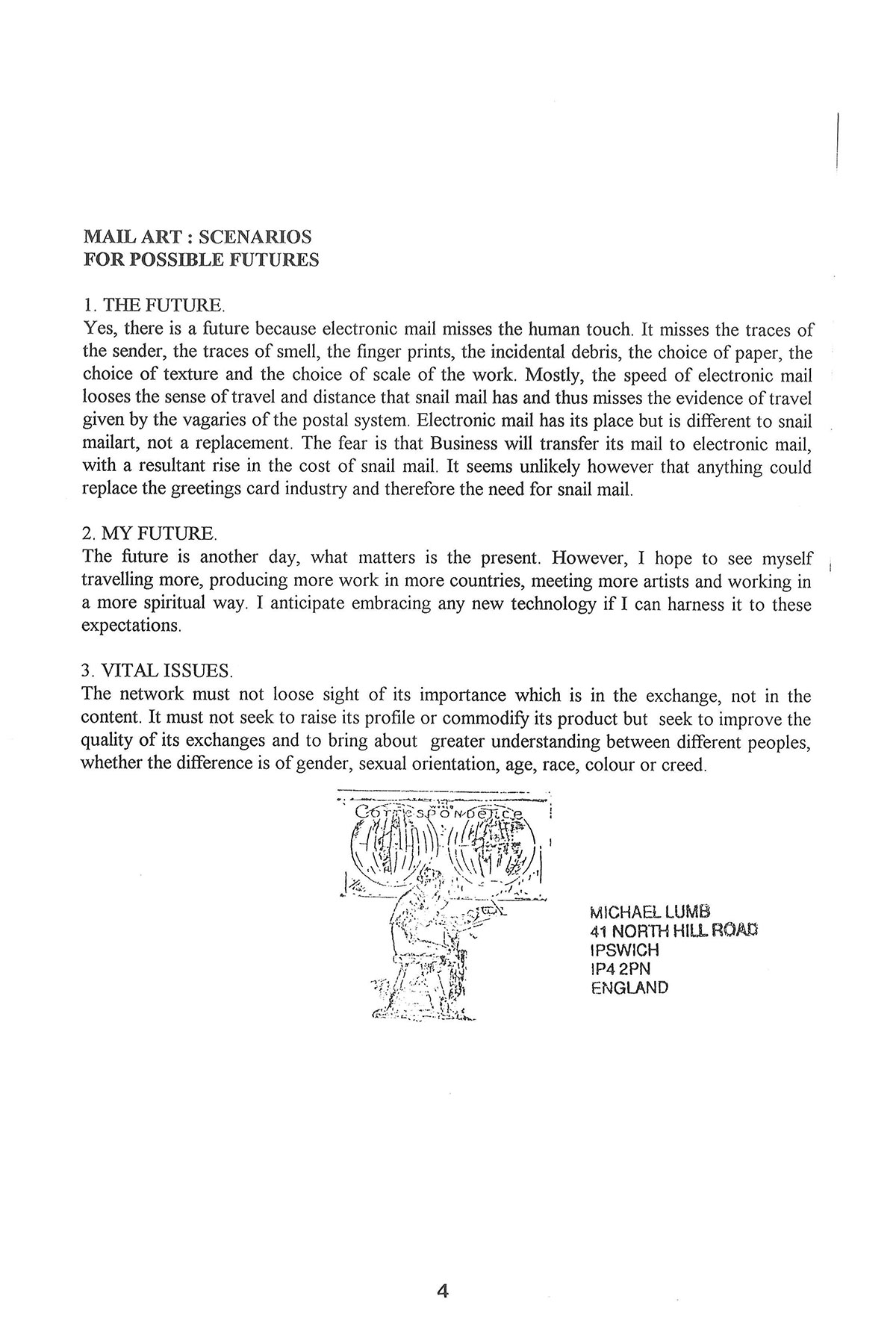
Contribution by Michael Lumb, Ipswich, England. Lumb reflects on the irreplaceable human qualities of snail mail — traces of smell, fingerprints, texture, the evidence of travel — and argues that the vital issue for the network is improving the quality of exchanges and fostering greater understanding across difference.
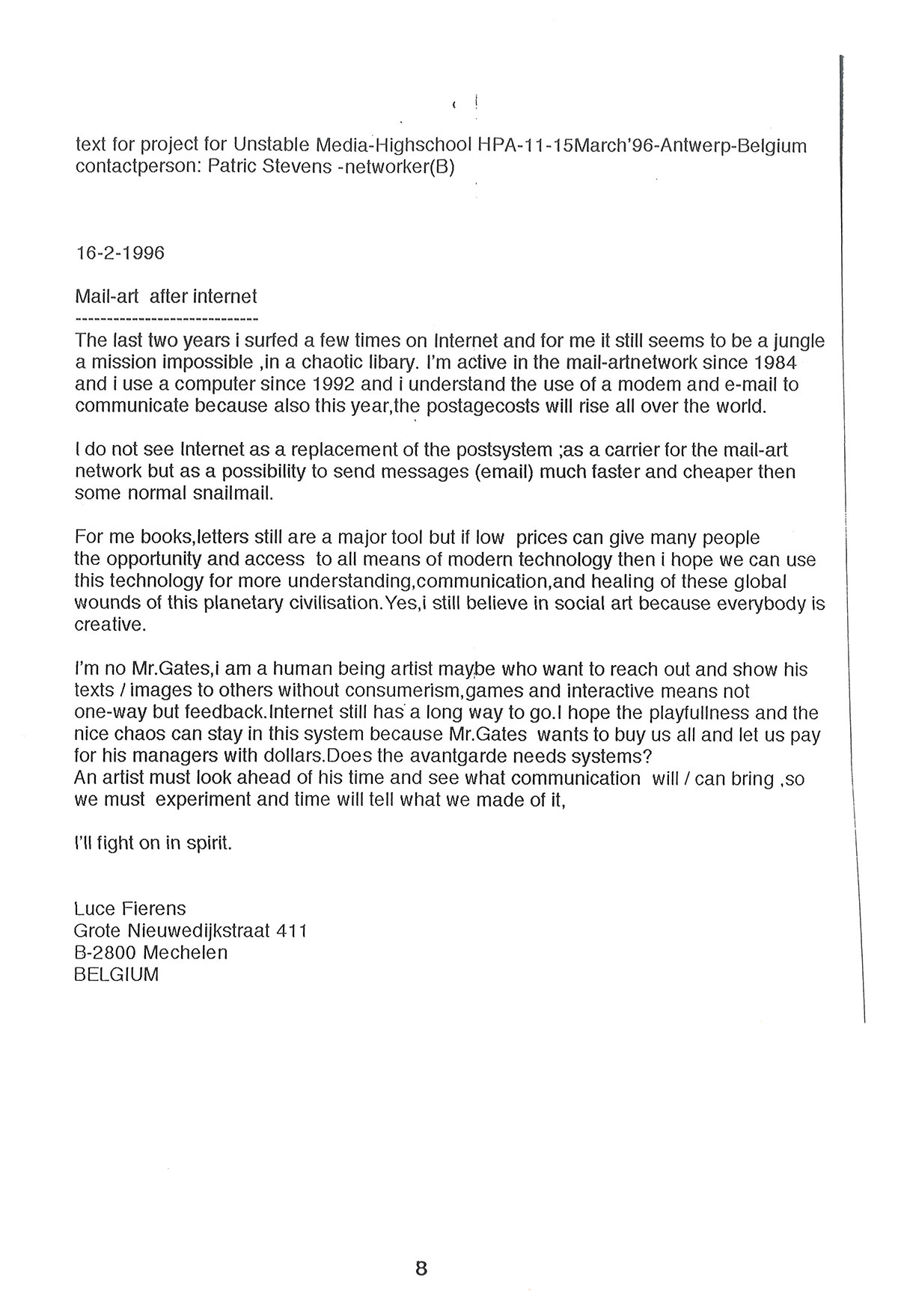
Contribution by Luce Fierens, Mechelen, Belgium, dated 16 February 1996. Fierens notes that her text was also submitted as a contribution to the "Unstable Media — Highschool HPA" project, Antwerp, March 1996 (contact person: Patric Stevens, networker, Belgium). He reflects on the Internet as a jungle and a chaotic library, advocates for social art and human-to-human communication, and expresses hope that playfulness and creative chaos can survive the commercialisation of digital networks.
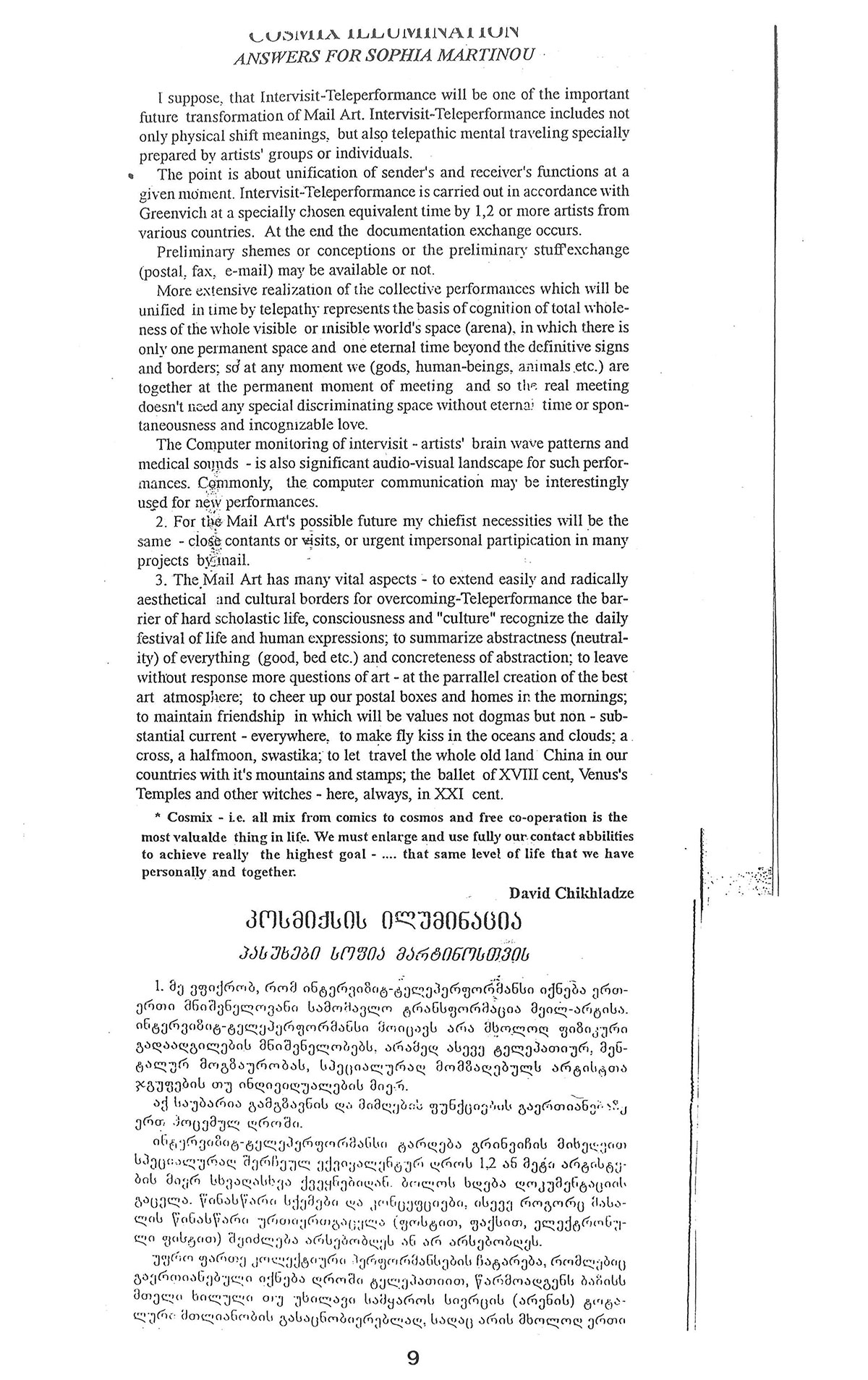
Contribution by David Chikhladze titled "Cosmix Illumination / Answers for Sophia Martinou," printed in English with Georgian-language translation below. Chikhladze reflects on Intervisit-Teleperformance as a significant future transformation of mail art, proposing collective telepathic performances coordinated across time zones and documented through the exchange of brain-wave monitoring data.
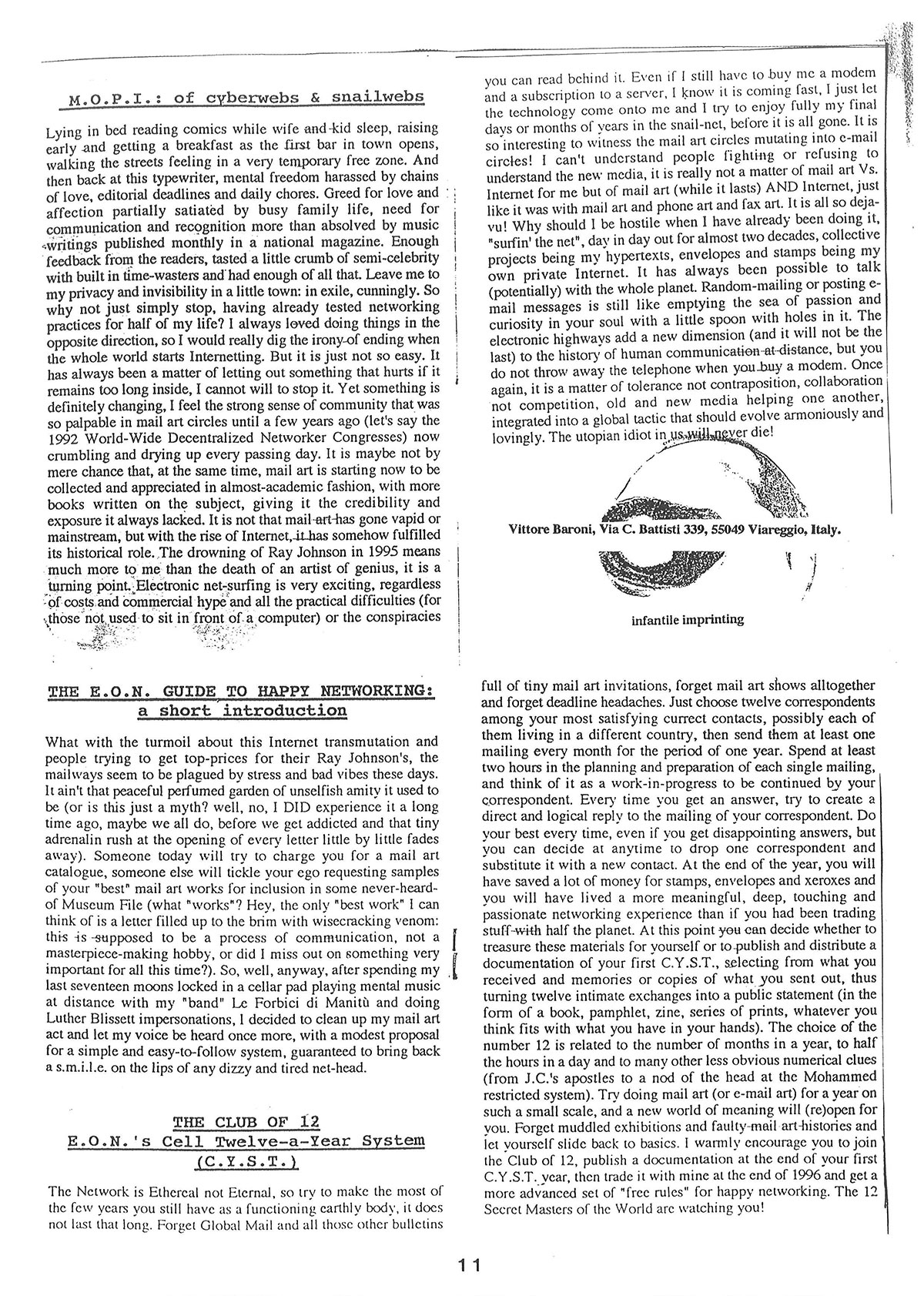
Two texts by Vittore Baroni, Viareggio, Italy: "M.O.P.I.: of cyberwebs & snailwebs," a personal reflection on the transition from snail mail to the internet; and "The E.O.N. Guide to Happy Networking: a short introduction / The Club of 12 / E.O.N.'s Cell Twelve-a-Year System (C.Y.S.T.)," Baroni's practical proposal for sustaining meaningful correspondence through a system of twelve active correspondents per year.
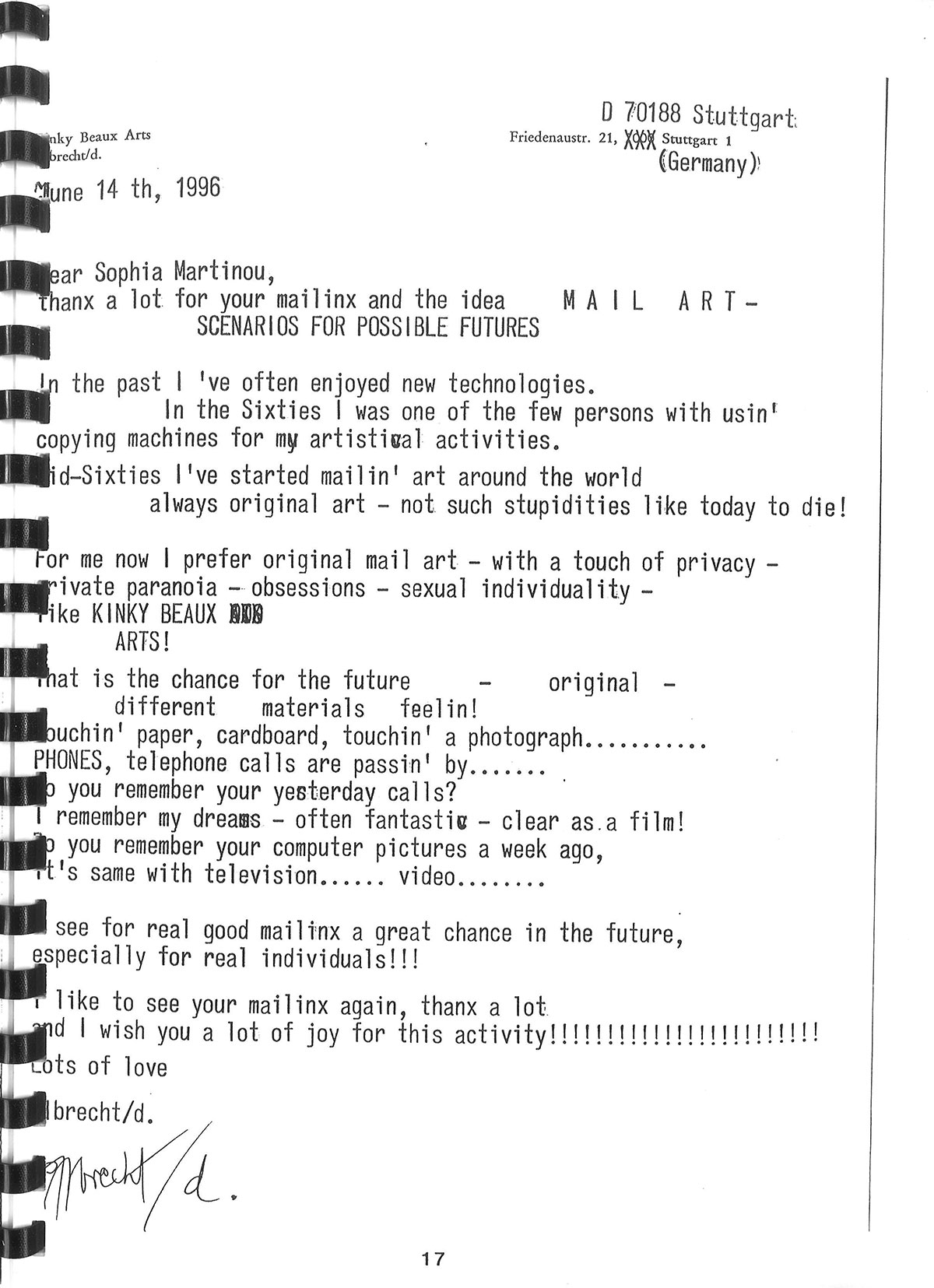
Typewritten letter dated June 14, 1996, from Albrecht/d. (Kinky Beaux Arts), Stuttgart, Germany. The contributor reflects on his history with copying machines in the 1960s, on original mail art as a medium of privacy, obsession, and individual feeling, and argues for the tactile and physical primacy of postal exchange over digital communication.
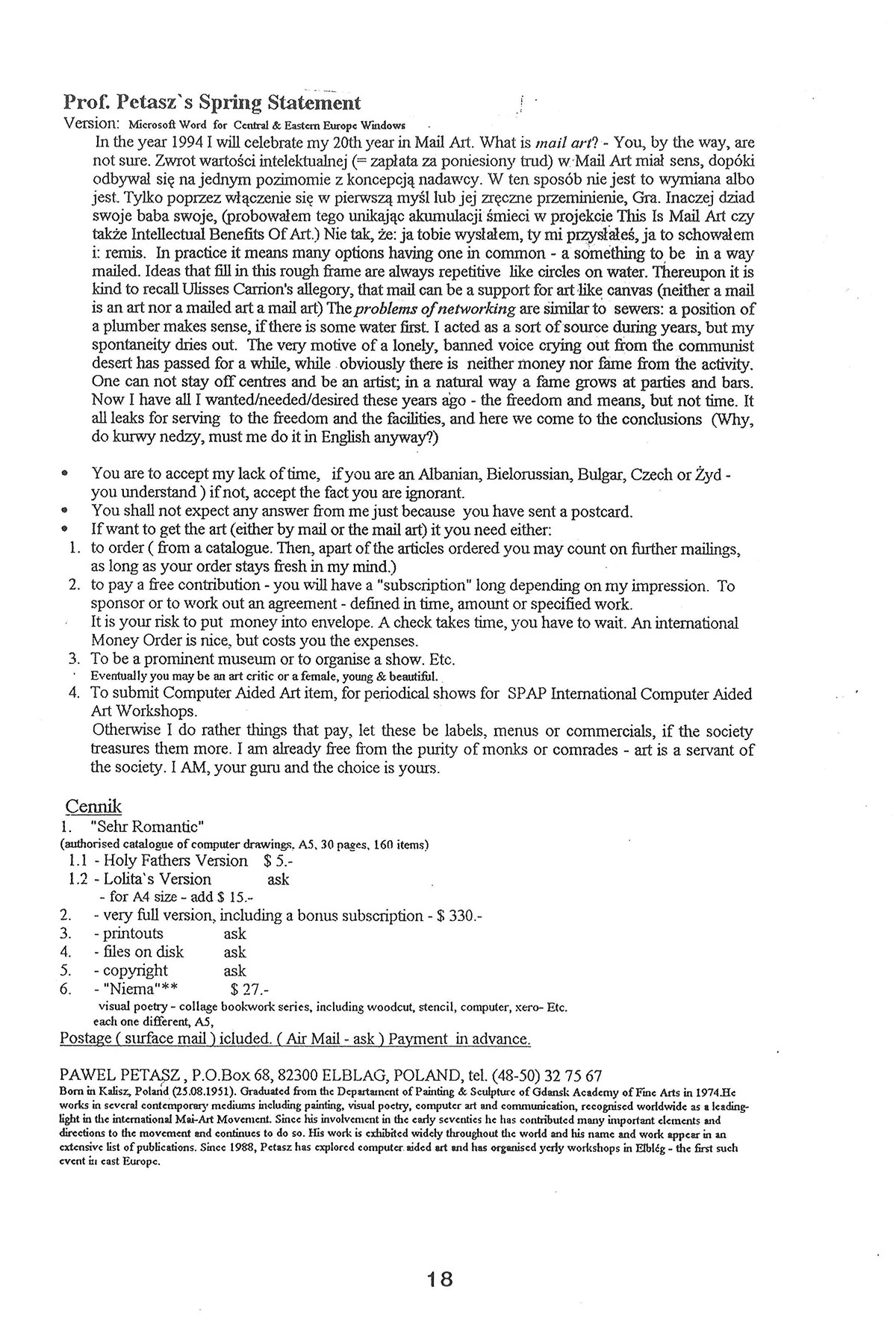
Contribution by Pawel Petasz, Elblag, Poland. Written partly in English and Polish, the text reflects on twenty years of mail art practice, the economics and ethics of the network, and Petasz's computer-aided art workshops.
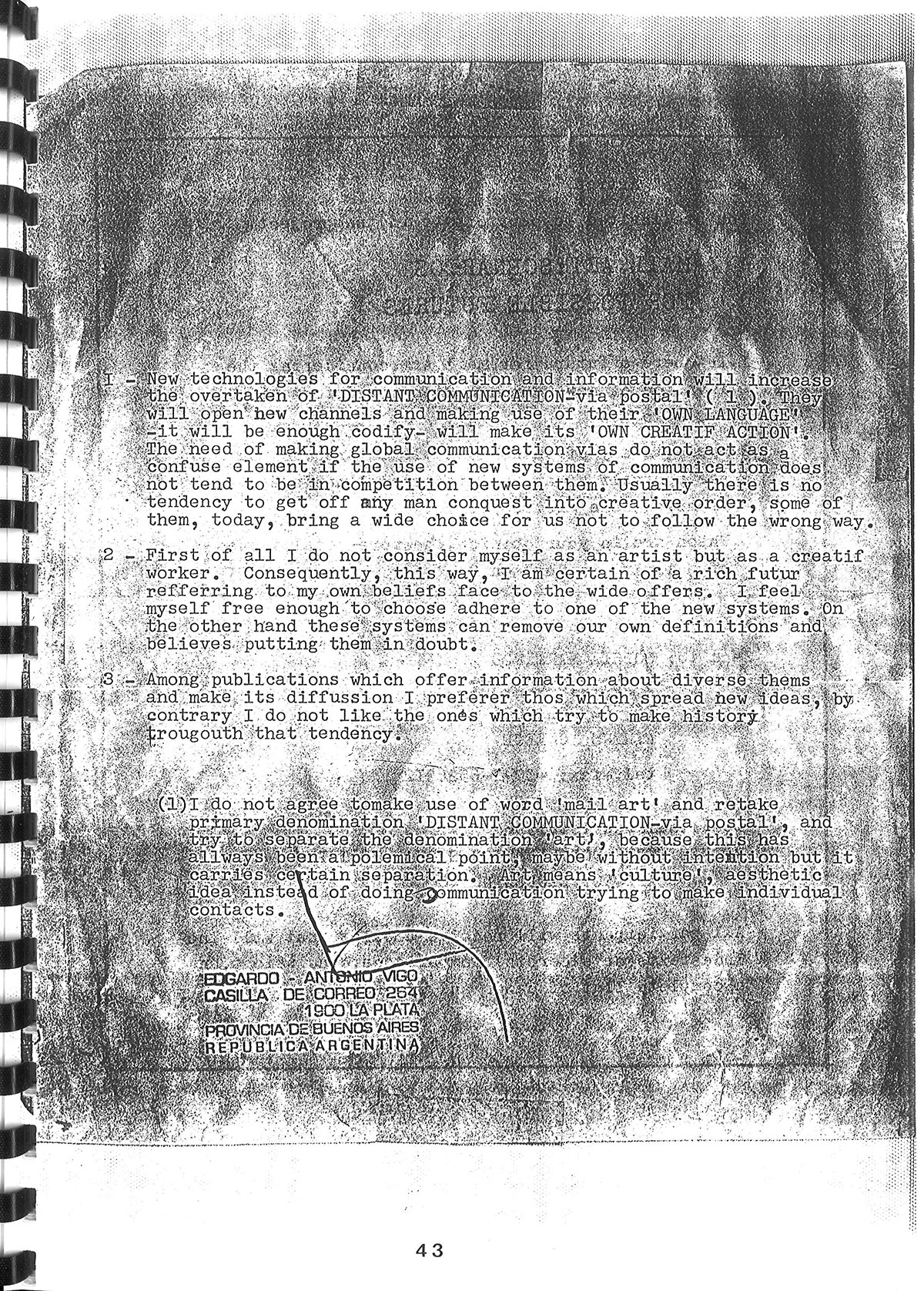
Contribution by Edgardo Antonio Vigo, La Plata, Argentina. A typewritten, heavily textured page — characteristic of Vigo's aesthetic — in which he argues for the term "Distant Communication via postal" over "mail art," and reflects on the complementary rather than competitive relationship between new communication technologies and postal art practice.
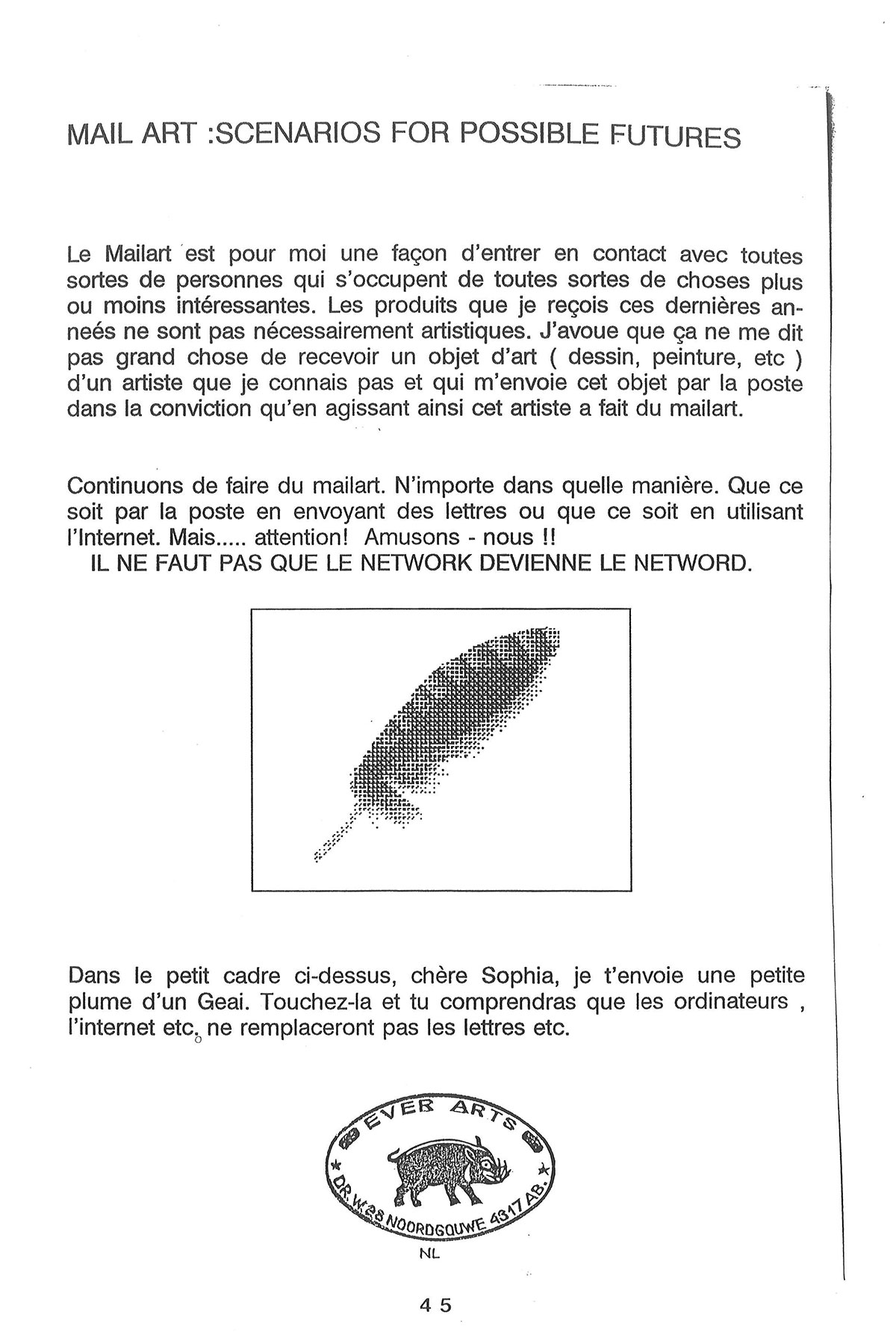
Contribution in French by Ever Arts, the Netherlands. The text argues that mail art is a mode of human contact irreplaceable by computers or the Internet, accompanied by a computer-generated image of a feather sent to Sophia as a symbolic tactile gesture.
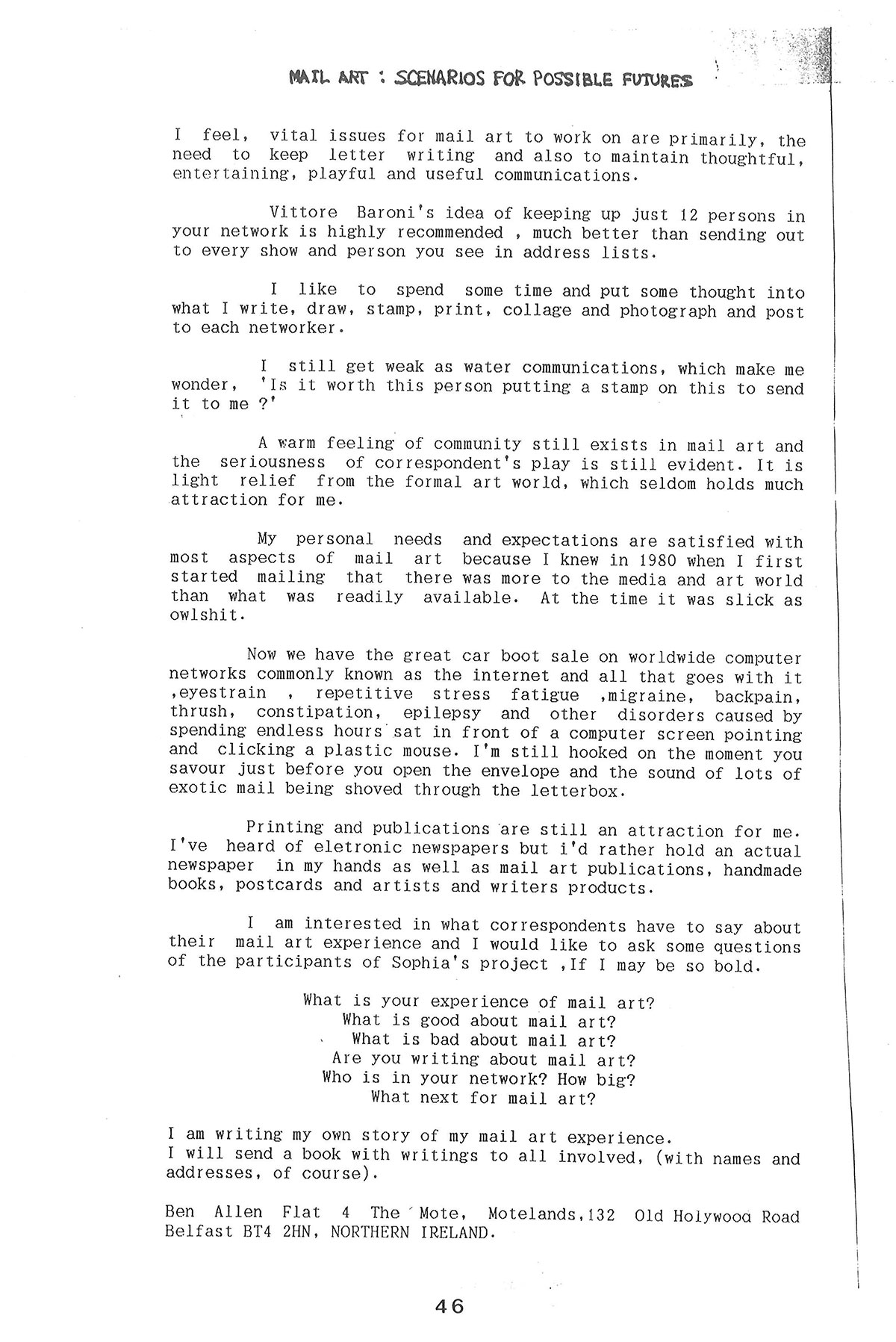
Contribution by Ben Allen, Belfast, Northern Ireland. Allen reflects on the value of thoughtful, quality correspondence over mass mailing, endorses Vittore Baroni's "Club of 12" concept, and poses a series of questions to participants about their mail art experience, announcing his intention to compile a book of mail art writings.
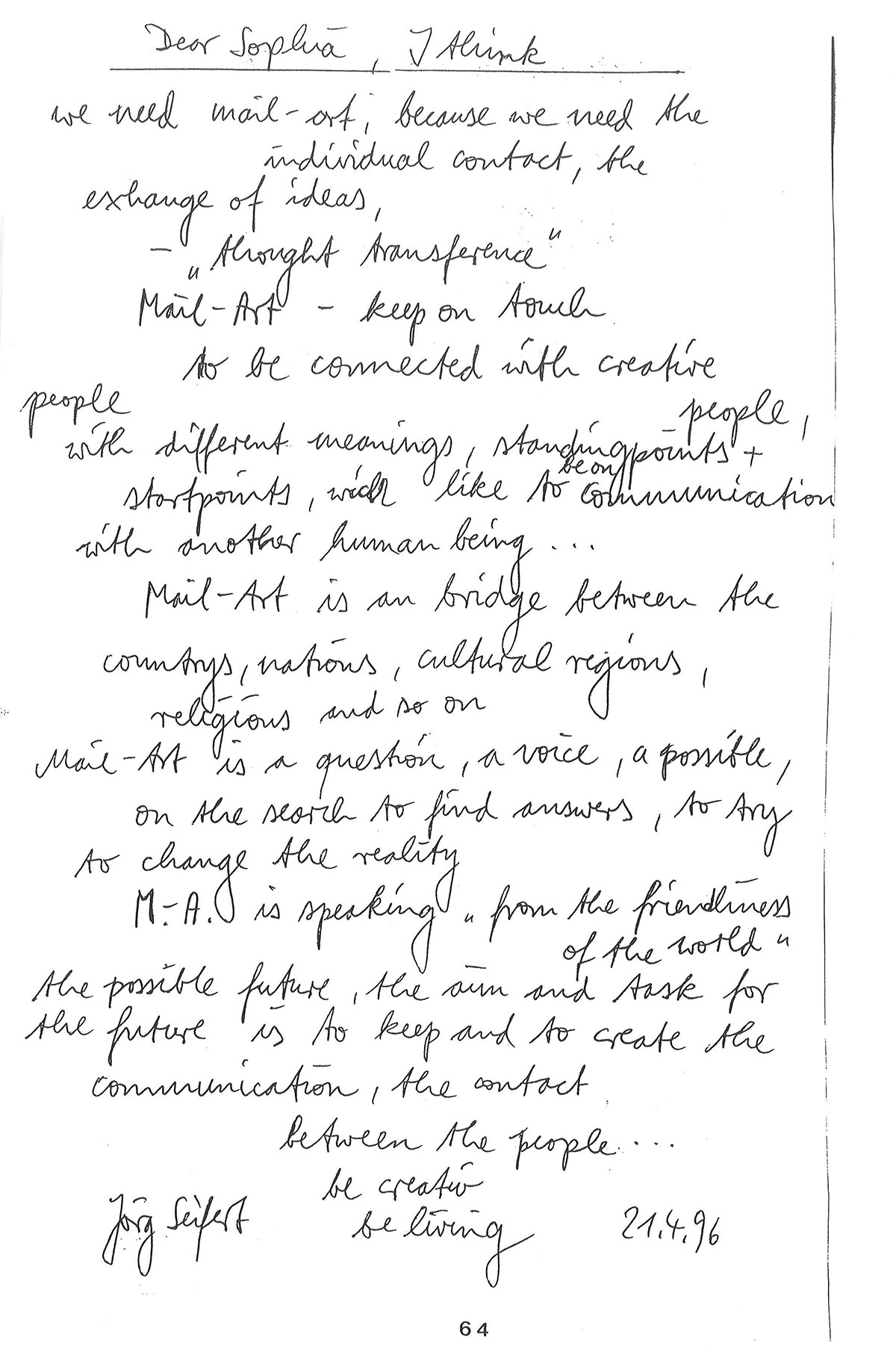
Handwritten contribution by Jörg Seifert, dated 21 April 1996, addressed "Dear Sophia." Seifert reflects on mail art as a bridge between countries, nations, cultural regions, and religions, emphasising individual contact, creative exchange, and communication as mail art's vital future.
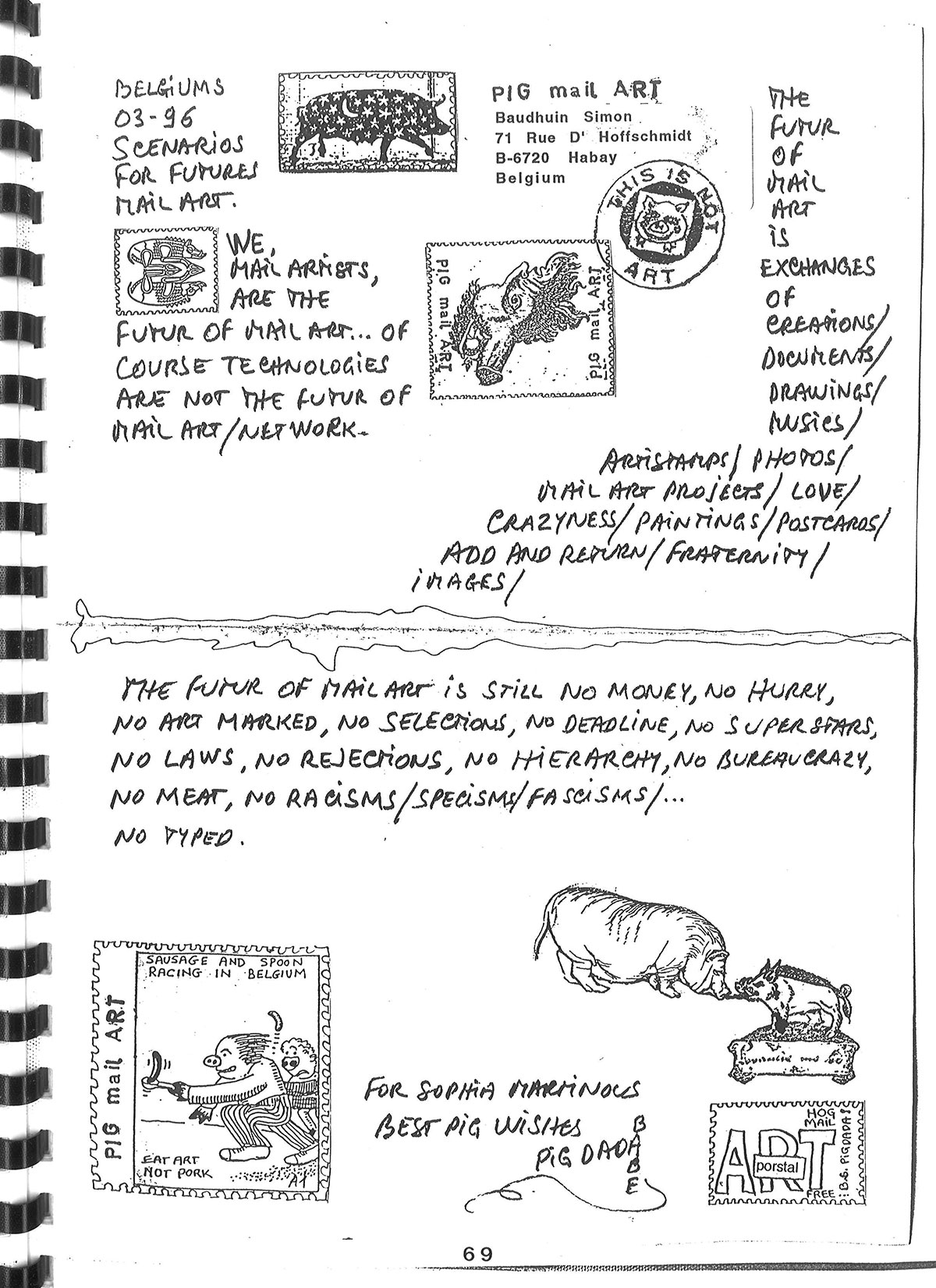
Contribution by Baudhin Simon / Pig Dada, dated March 1996. A visually rich, handwritten and collaged page featuring Pig Mail Art Artistamps, rubber stamps ("This Is Not Art"), and declarations on the future of mail art. Simon's text enumerates the core values of mail art as non-commercial, non-hierarchical exchange: no money, no hurry, no market, no selections, no hierarchy, no bureaucracy.
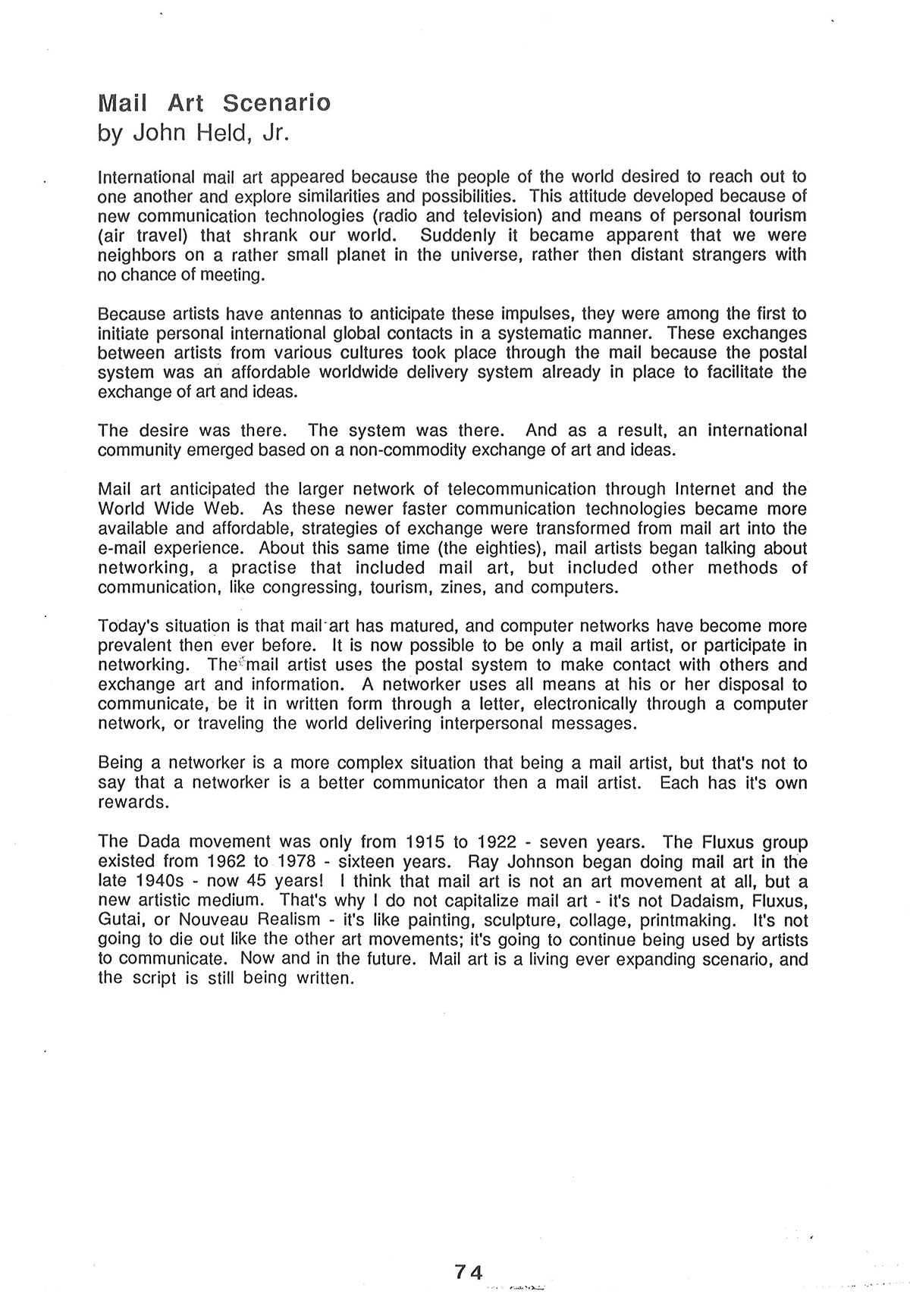
Essay titled "Mail Art Scenario" by John Held, Jr. Held traces the origins of international mail art in the post-war desire for global connectivity, discusses the transition from postal networks to internet networking, and argues that mail art is not an art movement but an enduring artistic medium — like painting, sculpture, or printmaking — that will continue to be used by artists to communicate.
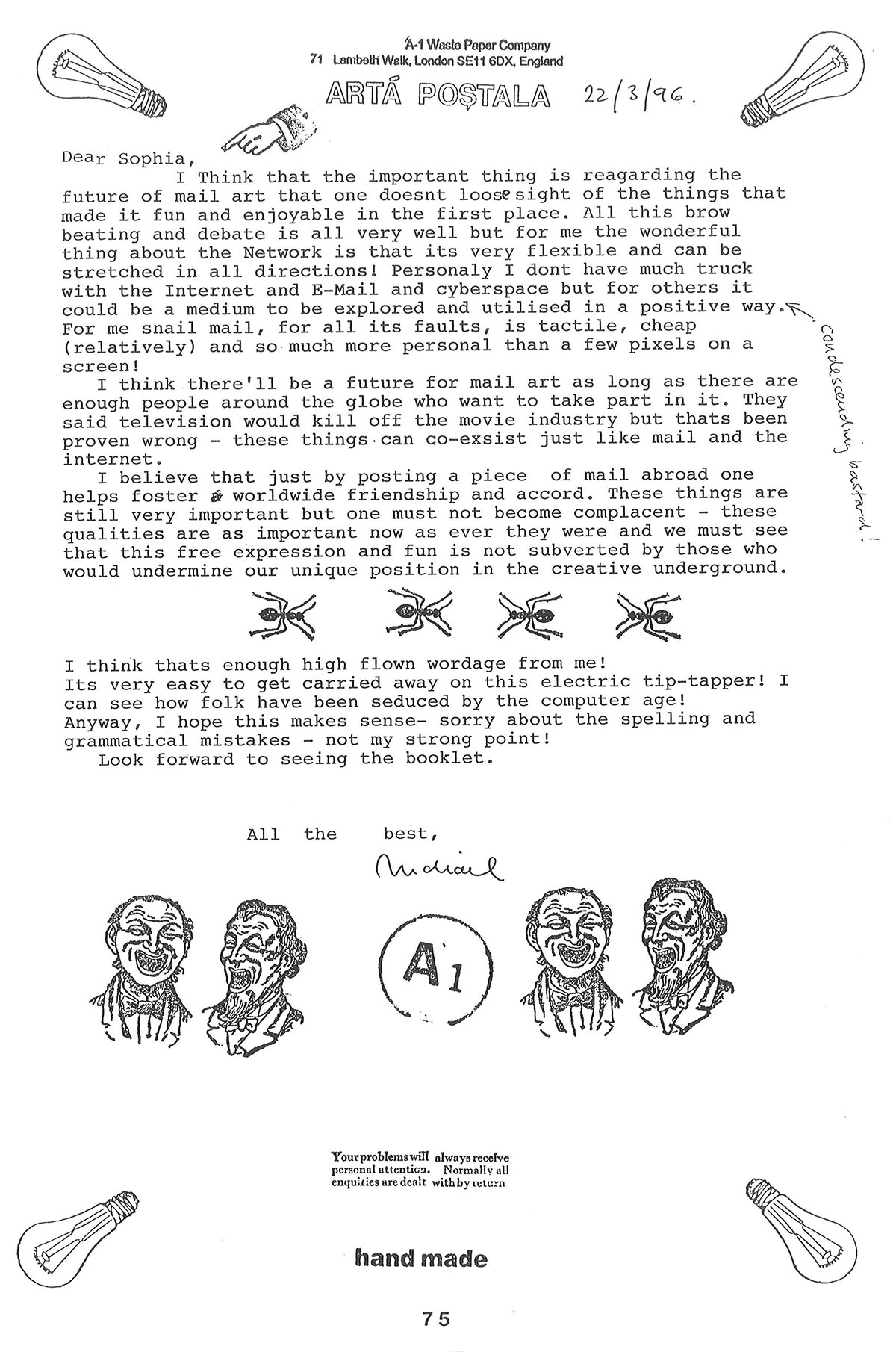
Contribution by Michael Leigh (A-1 Waste Paper Company, England), dated 22 March 1996, under the heading "Arta Postala." The typewritten letter, decorated with rubber-stamped lightbulb motifs and laughing-face illustrations, defends snail mail's tactile and personal qualities and argues that mail and the Internet can coexist.
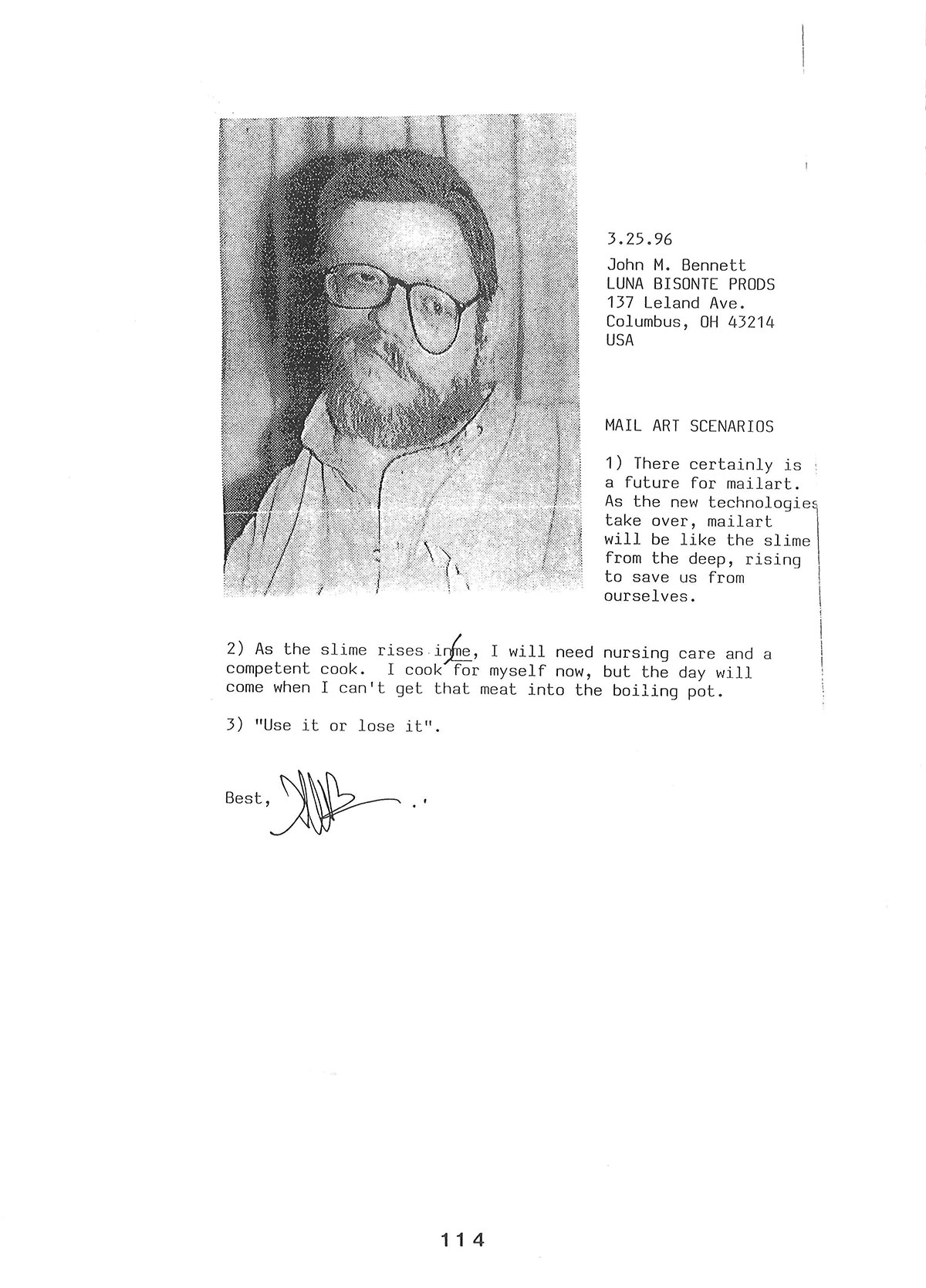
Contribution by John M. Bennett (Luna Bisonte Prods, USA), dated March 25, 1996, with a photographic portrait. Bennett offers three terse, poetic statements on the future of mail art, concluding with the phrase "Use it or lose it."
Contribution by Clemente Padin (Uruguay), titled "Mail Art: Scenarios for Possible Futures." Padin argues that mail art's future depends on maintaining art within the realm of use and communication rather than commodity exchange, opposing the ideology of individual production and the official Fine Arts system.
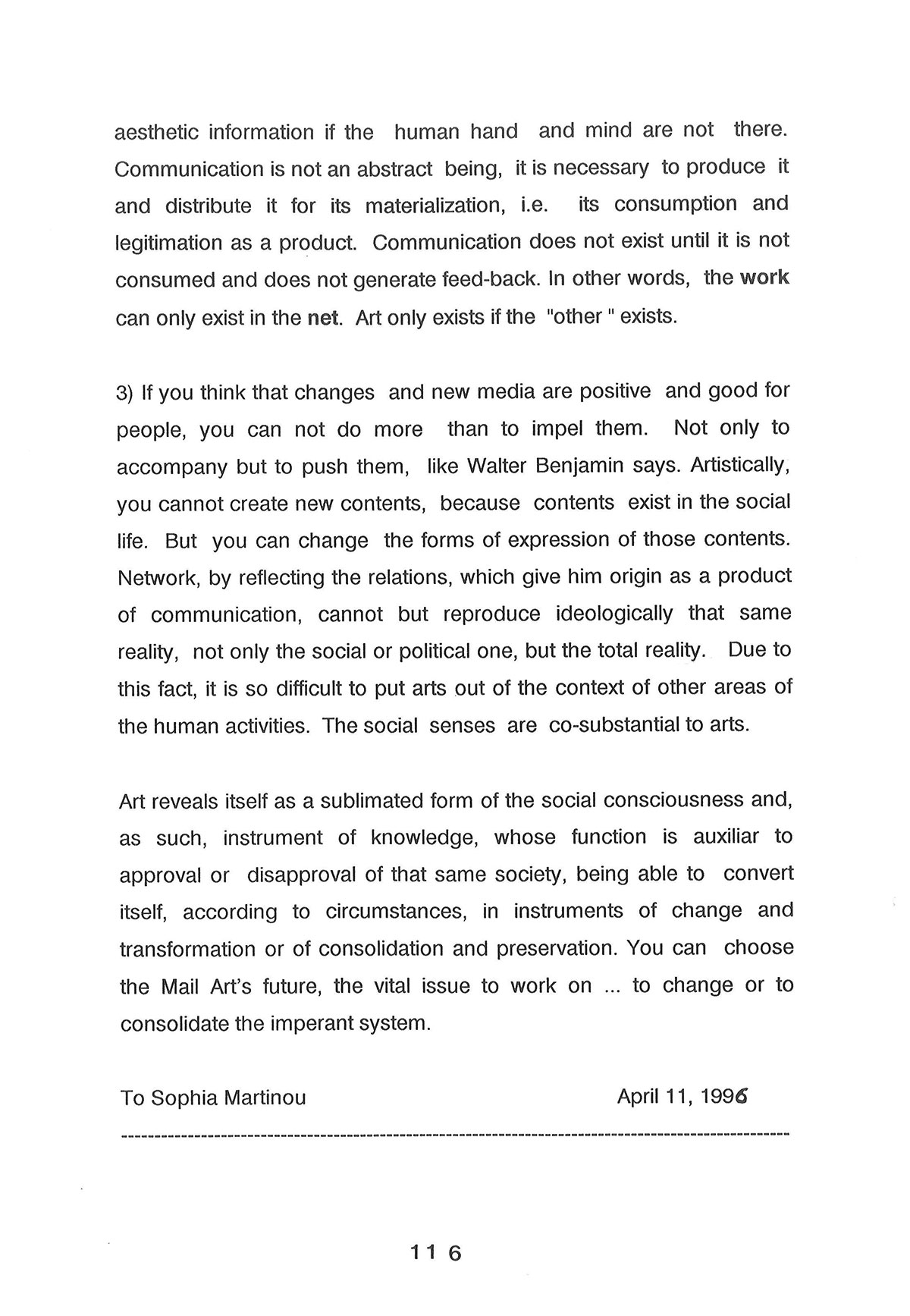
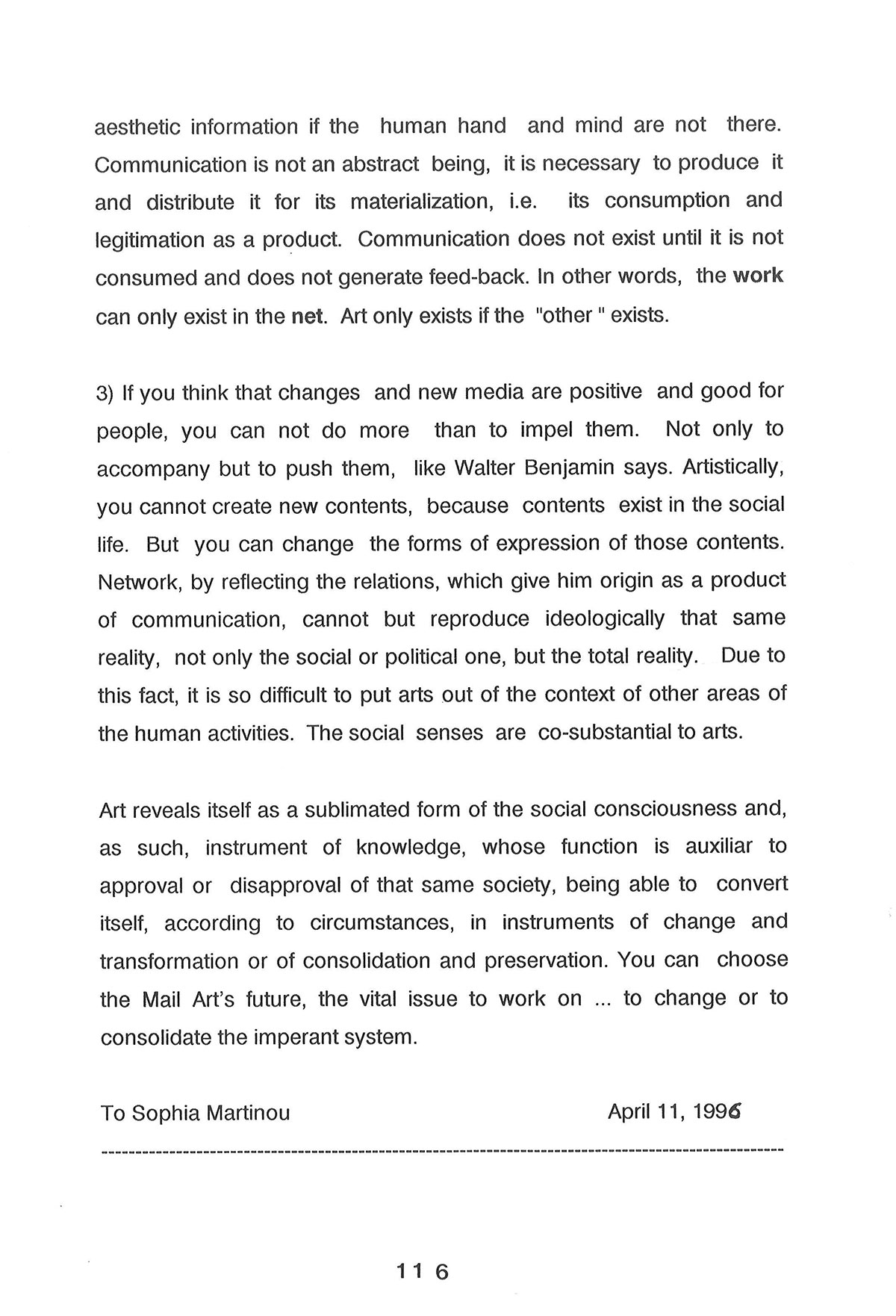
Continuation of Clemente Padin's contribution: Padin argues that art and communication are co-substantial with social life, and that the choice for mail art's future is whether to transform or consolidate the dominant system.
COMPLETE LIST OF PARTICIPANTS
(Reconstructed from the three Index pages; c. 119 contributors)
Ayah Okwabi, Nicolas Guigou, Michael Lumb, Simon Warren, Mit Mitropoulos, Luce Fierens, David Chikhladze, Thilo Götze Regenbogen, Vittore Baroni, Roberto Accorti, Pete Spence, Kevondo Nickersondo, Arturo Fallico, Albrecht/d., Pawel Petasz, Rick Cohan, Giordano Genghini, Lia Drei, Willi Mejnikov-Stargvist, Emerenciano, Giovanni StraDaDa, B. Jones, Henning Mittendorf, Robin Crozier, Sugar Irmer, Bruno Capatti, Marcello Diottallevi, Jean Pierre Naud, Lorenzo Guasti, Frieslander P.L.G., Pamela Wells, Dietrich Fricker, Ko de Jonge, Natale Cucciniello, Edgardo Antonio Vigo, Orlando N. Pacheco Acuna, Everarts, Ben Allen, Barry Edgar Pilcher, Nicola Frangione, Carlo Pittore, Dmitry Bulatov, Laurel Hall, Dawn Redwood, Willi Förster, Kimmo Framelius, The Temple/José Vanderbroucke, Rod Summers, Jörg Seifert, Michele Perfetti, Solamito Luigino, Ulrich Bergmann, Barbara Drucker, Baudhin Simon/Pig Dada, Ruggero Maggi, Reid Wood/State of Being, Serge Segay, John Held, A1 Waste Paper Company, Antoine Cupial, Nesic Dragan, Attilio Fortini, Mauricio Guerero Alarcón, Chuck Welch, Ilmar Kruusamae, Harley Terra Candella, Stangroom, Ladislaw Guderna, John Ashbaugh, Kurt Beaulieu, Willie Marlowe, Georg Lipinsky, Guido Bondioli, Dobriça Kamperelig, Emilio Morandi, Thuis Museum, Vito Mazotta, Marcel Stussi, Alan Turner, Predrag Petrovic, Don Unger, Perla Badjer, Schmuel/Int. Decorator of the Mind, Franco Santini, Arte Ala Carte, Anahi Caçeres, Hugo Pontes, Daniel Daligand, Joe Smith, Mike Walsh, Stephen Perkins, John Bennett, Clemente Padin, Bill Gaglione, Géza Perneczky
CROSS-ARCHIVE NOTES & CONNECTIONS
Several contributors to this catalog are extensively documented elsewhere in Artpool's holdings and related international archives:
Géza Perneczky (pp. 118–119) is one of the most extensively documented figures in Artpool's Mail Art Chro-No-Logy, having produced major theoretical writings on the mail art network. His presence as the final contributor in this catalog places this project in direct dialogue with Artpool's own intellectual history.
Edgardo Antonio Vigo (Argentina) is one of the foundational figures of Latin American mail art and conceptual art; his archives are held in La Plata and widely documented internationally.
Clemente Padin (Uruguay) is a central figure in Latin American mail art and networked performance art, whose work is documented in numerous international archives.
Vittore Baroni (Italy) is the organiser of numerous mail art projects documented in the Lomholt Mail Art Archive and elsewhere.
Luce Fierens (Belgium) references the parallel "Unstable Media — Highschool HPA" project (Antwerp, March 1996, contact: Patric Stevens), suggesting cross-project connections within the Belgian networker community at this period.
