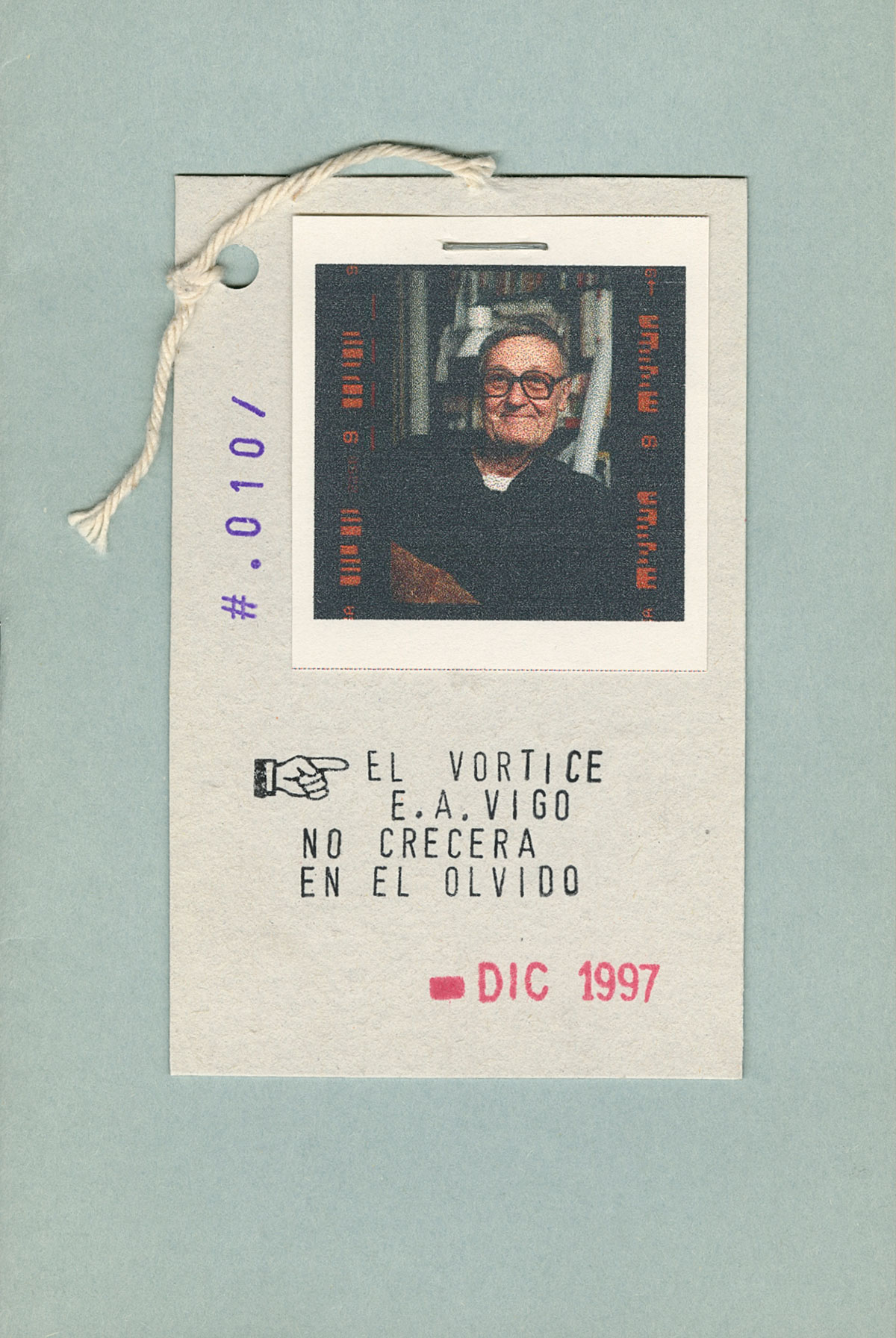
Cover of Revista Arte Vórtice No. 10 with attached tag-label. The light blue cover bears the hand-attached tag (label #.010/) with a photograph of Edgardo Antonio Vigo and the rubber-stamped text: "El Vórtice / E.A. Vigo / No Crecerá en el Olvido / DIC 1997" — a cord attaches the label to the publication through a punched eyelet. Artists identified: Edgardo Antonio Vigo (subject/portrait).
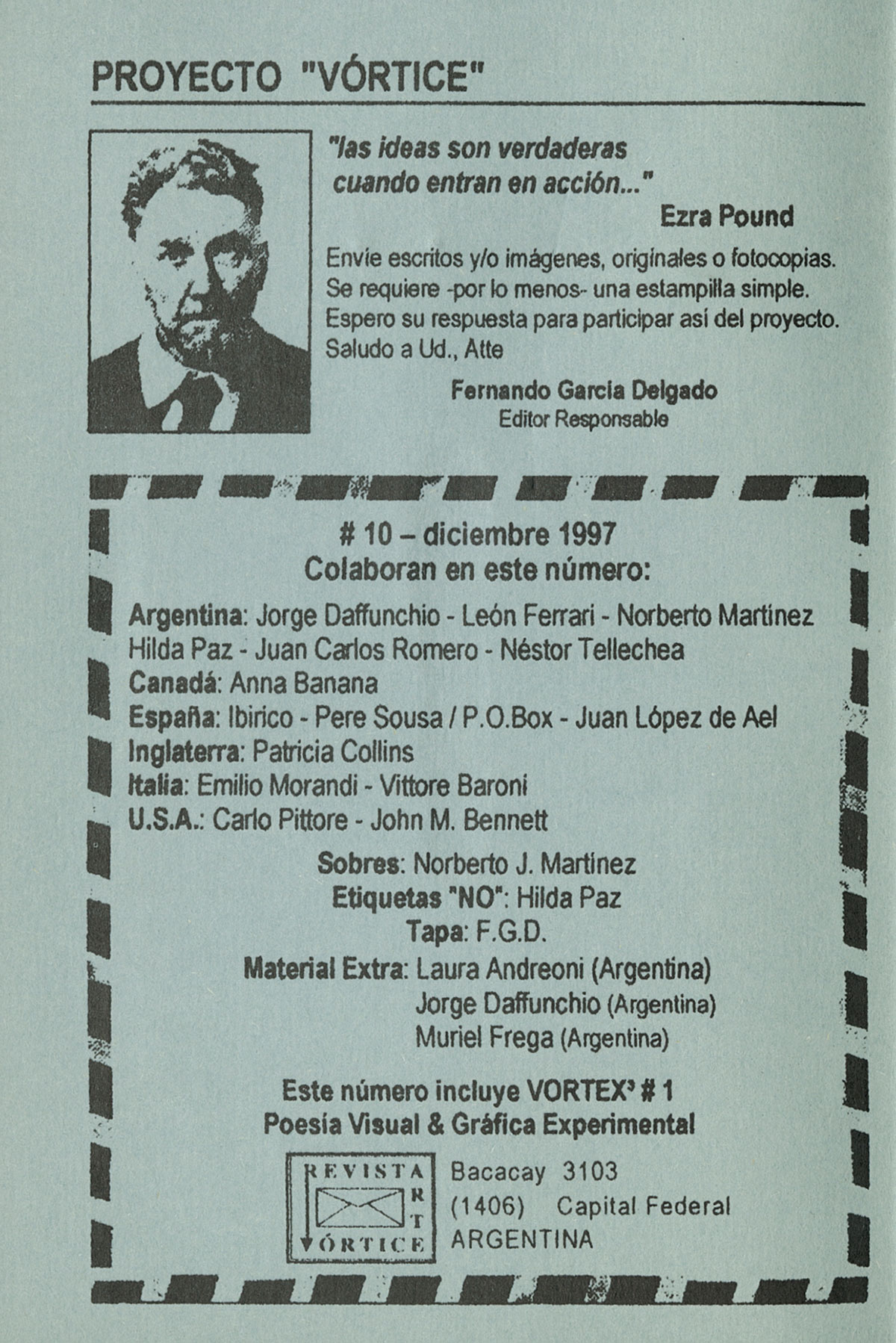
Interior title page: "Proyecto 'Vórtice'". Includes a portrait of Ezra Pound with his epigraph ("ideas are real when they enter into action"), the editor's open call for contributions, and the full list of participants of issue No. 10 (December 1997) by country, as well as credits for envelopes, "NO" labels, and cover. The Revista Arte Vórtice logo (envelope design) and address are printed at the bottom. List of participants: Jorge Daffunchio, León Ferrari, Norberto Martínez, Hilda Paz, Juan Carlos Romero, Néstor Tellechea (Argentina); Anna Banana (Canada); Ibirico, Pere Sousa, Juan López de Ael (Spain); Patricia Collins (England); Emilio Morandi, Vittore Baroni (Italy); Carlo Pittore, John M. Bennett (USA). Additional contributors: Laura Andreoni, Jorge Daffunchio, Muriel Frega (Material Extra). Cover: Fernando García Delgado.
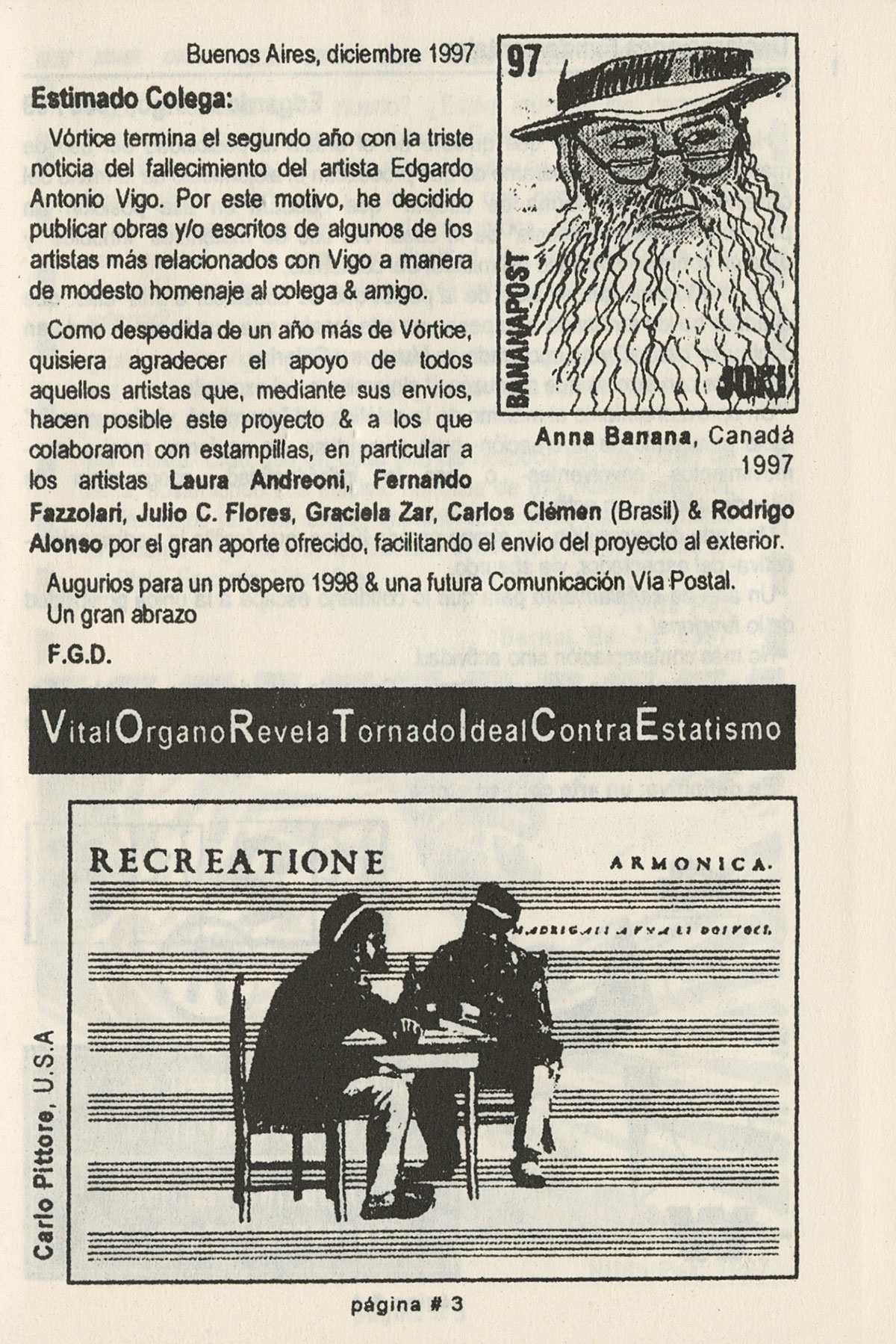
Page 3. Editorial letter from Fernando García Delgado (Buenos Aires, December 1997) announcing the death of Edgardo Antonio Vigo and the decision to dedicate this issue to him as a tribute. Includes an Artistamp by Anna Banana (Canada, 1997) from her Bananapost series, and a work by Carlo Pittore (USA): a reproduction of a historical broadside titled "Recreatione Armonica" with the typographic intervention reading "VitalOrganoRevelaT ornadoIdealContraEstatismo" — a word game embedded in the Vórtice typography. Artists identified: Anna Banana, Carlo Pittore.
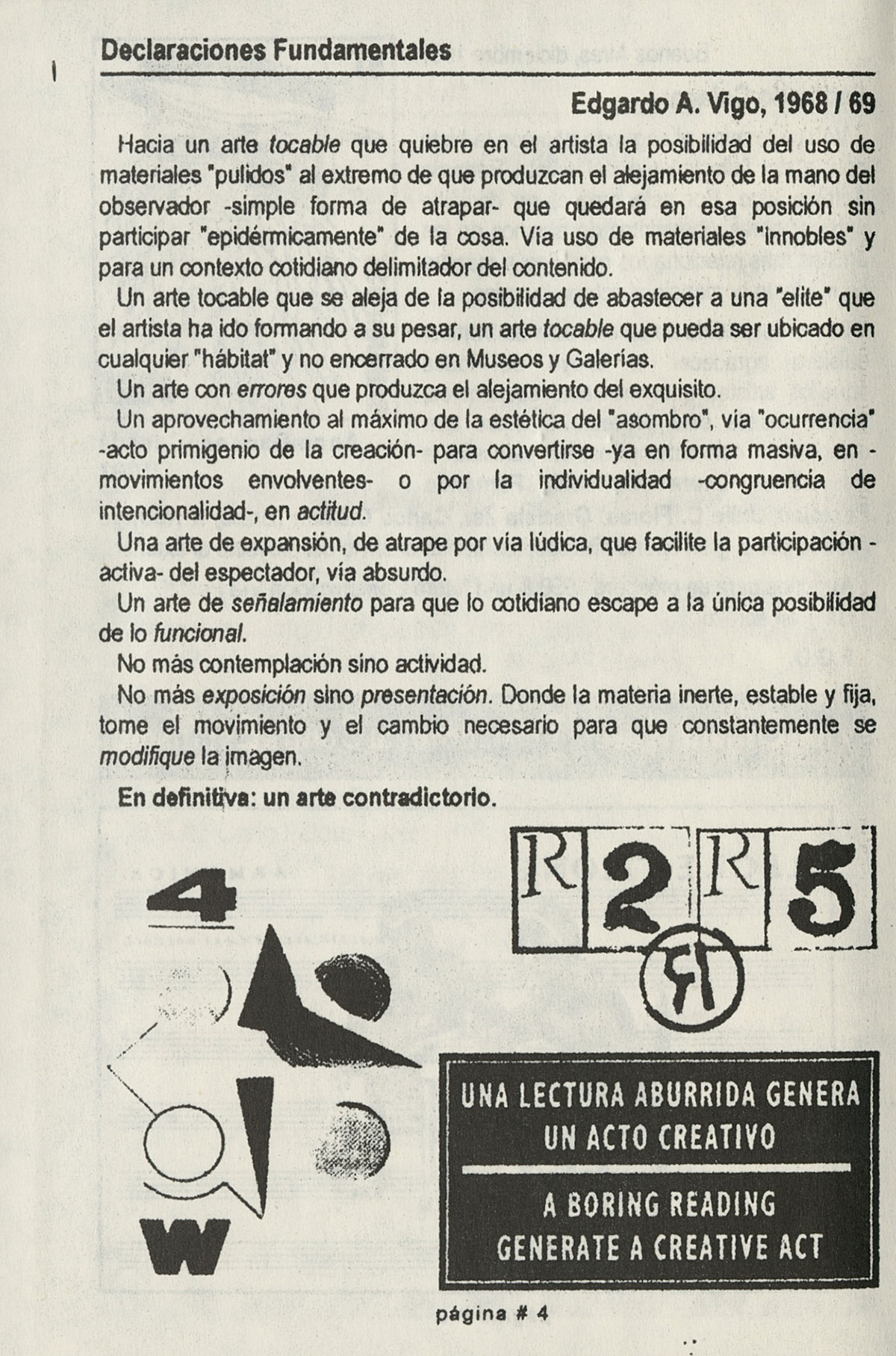
Page 4: "Declaraciones Fundamentales" — a reprint of Edgardo A. Vigo's foundational theoretical text (1968/69) on "un arte tocable" (a touchable art): a manifesto for a non-institutional, participatory, contradiction-based art practice. Accompanied by two visual works attributed to Vigo: geometric compositions and a bilingual typographic piece reading "Una Lectura Aburrida Genera un Acto Creativo / A Boring Reading Generate a Creative Act." Artists identified: Edgardo Antonio Vigo.
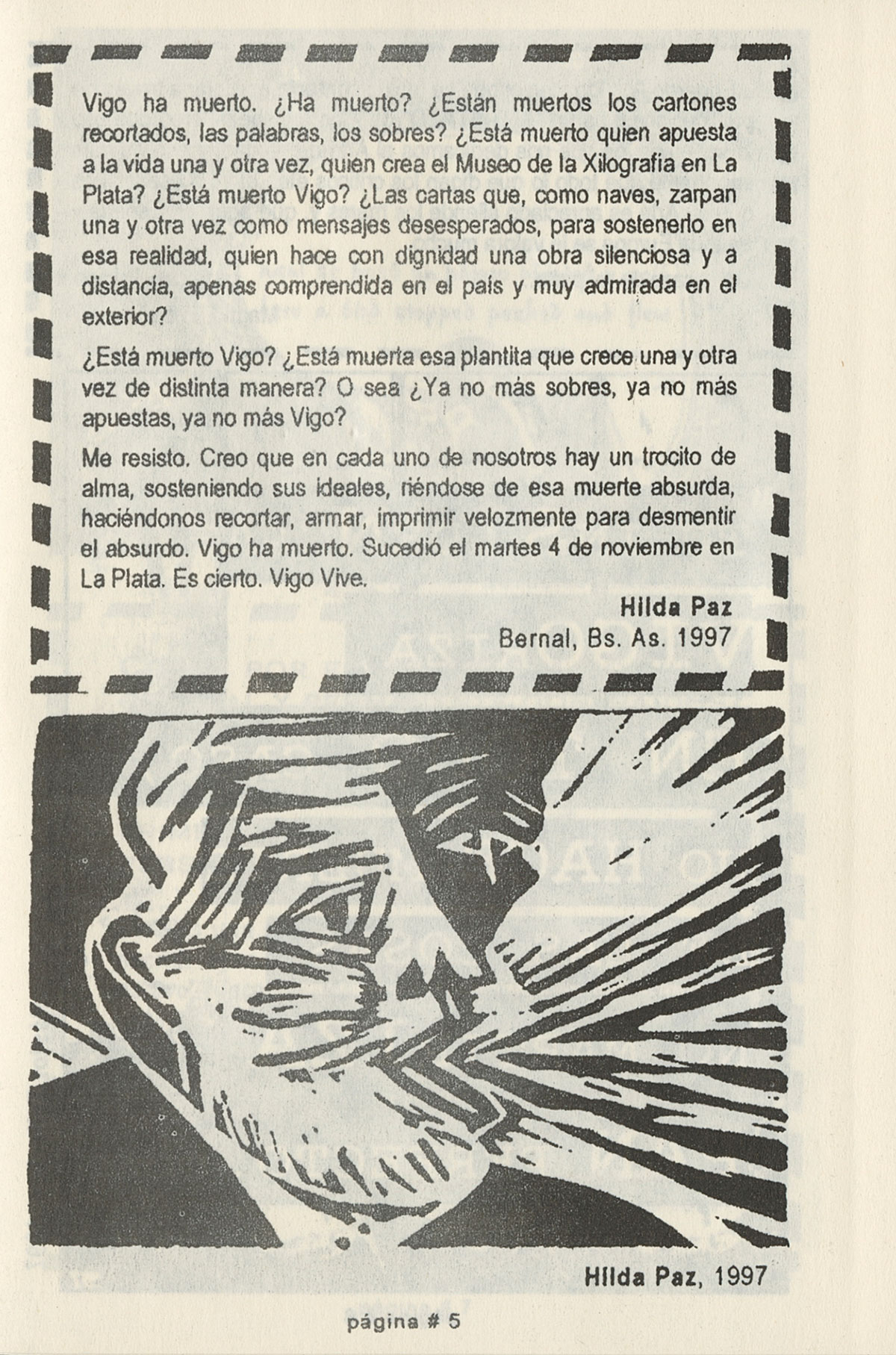
Page 5. Tribute text by Hilda Paz (Bernal, Buenos Aires, 1997): a poetic, rhetorical meditation on the death of Vigo — "Vigo ha muerto. ¿Ha muerto?" — questioning whether an artist's death means the death of their work. Accompanied by a woodcut / xylographic work by Hilda Paz (1997), a bold black-and-white print characteristic of her visual poetry practice. Artists identified: Hilda Paz.
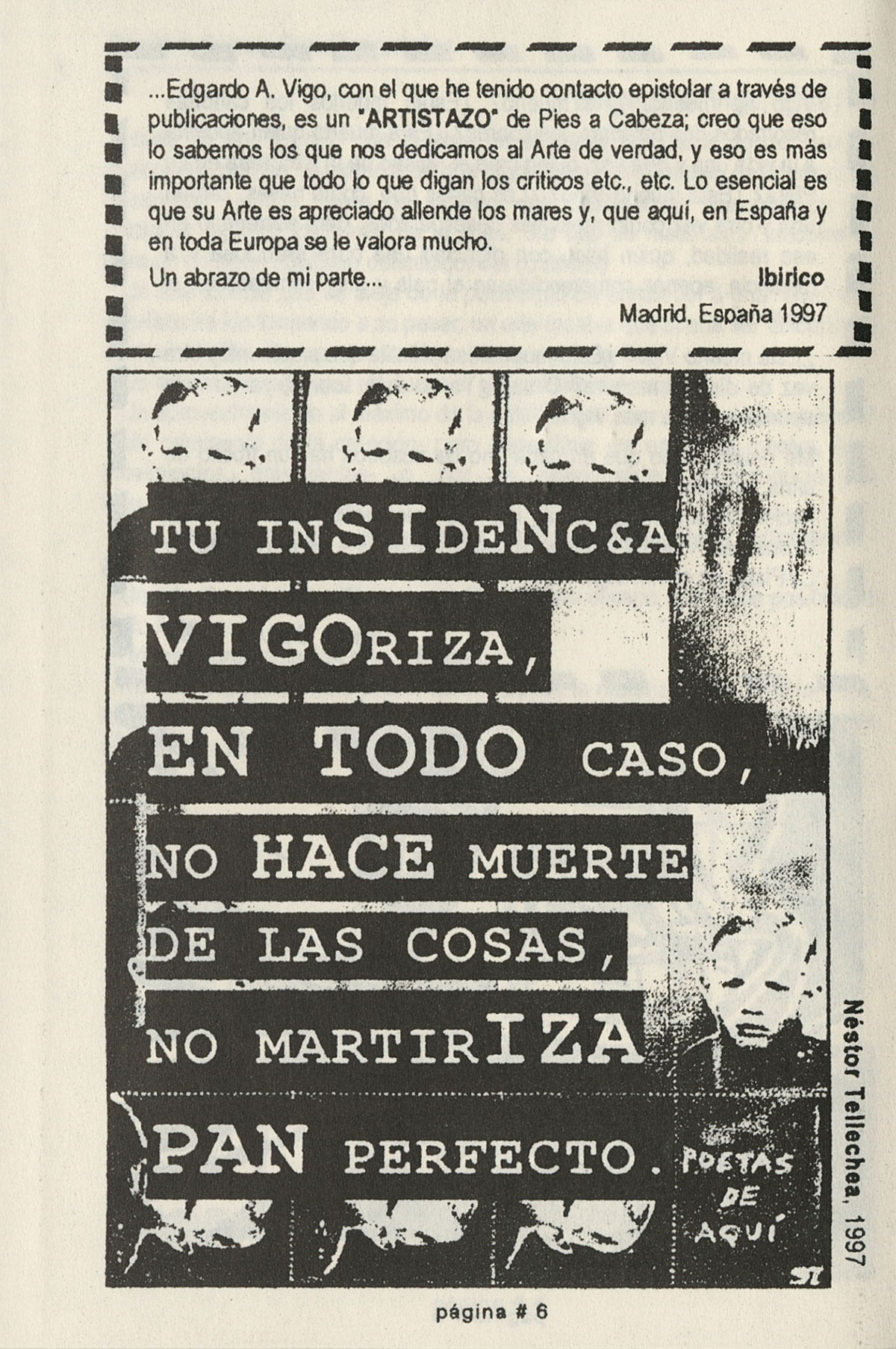
Page 6. Tribute text by Ibirico (Madrid, Spain, 1997), describing Vigo as an "ARTISTAZO de Pies a Cabeza" ("a great artist from head to toe") celebrated across Spain and Europe. Accompanied by a large-format visual poetry work by Néstor Tellechea (1997): a typographic composition playing on the words "VIGOriza" — celebrating Vigo's vitalizing influence — with imagery from his "Poetas de Aquí" project. Artists identified: Ibirico, Néstor Tellechea.
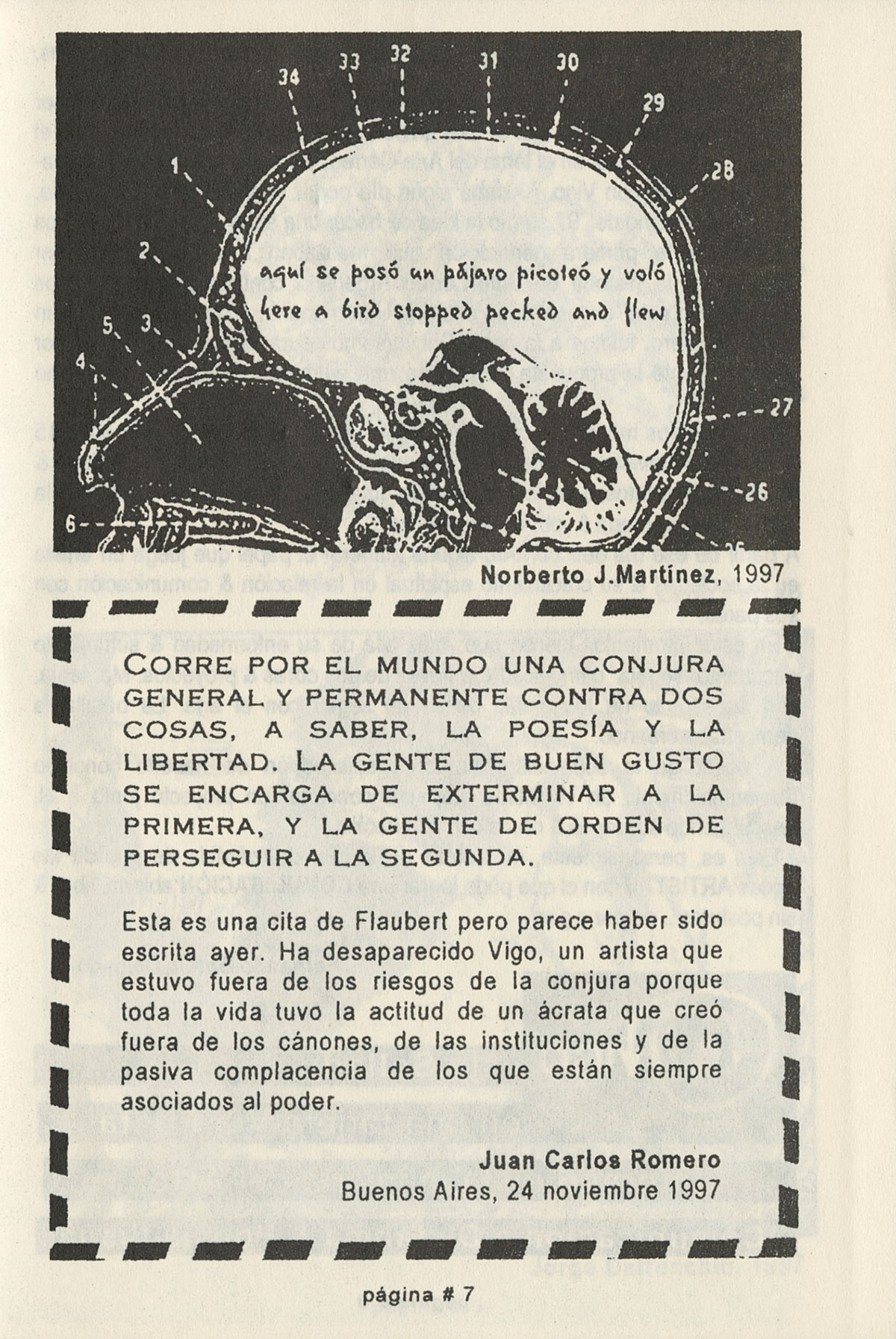
Page 7. Visual work by Norberto J. Martínez (1997): an anatomical diagram of a skull with the bilingual inscription "aquí se posó un pájaro picoteó y voló / here a bird stopped pecked and flew." Followed by a tribute text by Juan Carlos Romero (Buenos Aires, 24 November 1997), quoting Flaubert on the conspiracy against poetry and freedom, and eulogizing Vigo as an artist who lived outside institutional frameworks and complacency. Artists identified: Norberto J. Martínez, Juan Carlos Romero.
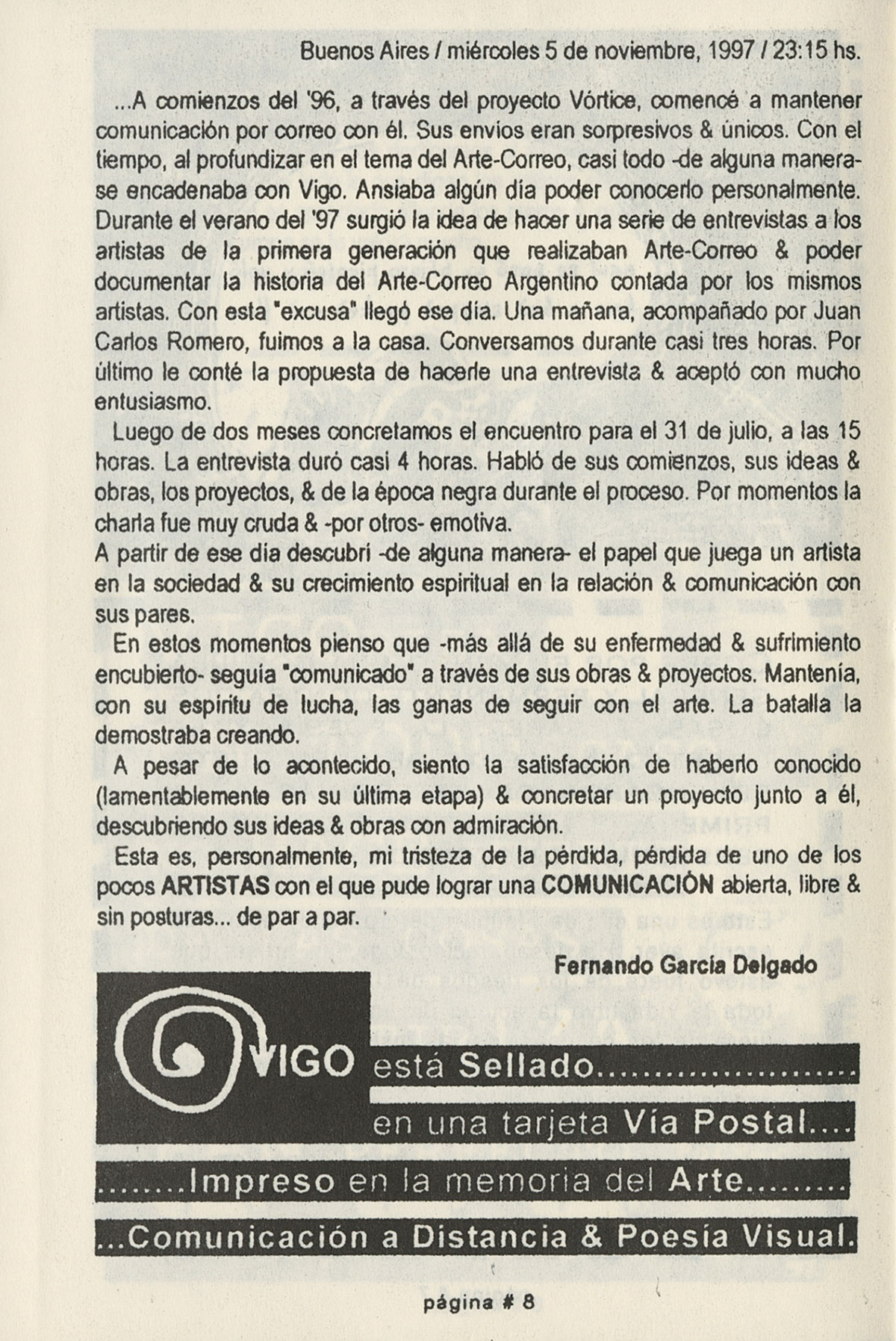
Page 8. Personal tribute essay by Fernando García Delgado (Buenos Aires, 5 November 1997, 23:15h), recounting his correspondence with Vigo since 1996 through the Vórtice project, a personal visit to Vigo's home alongside Juan Carlos Romero, and the July 31, 1997 interview. Closes with a typographic homage: "VIGO está Sellado… en una tarjeta Vía Postal… Impreso en la memoria del Arte… Comunicación a Distancia & Poesía Visual." Artists identified: Fernando García Delgado.
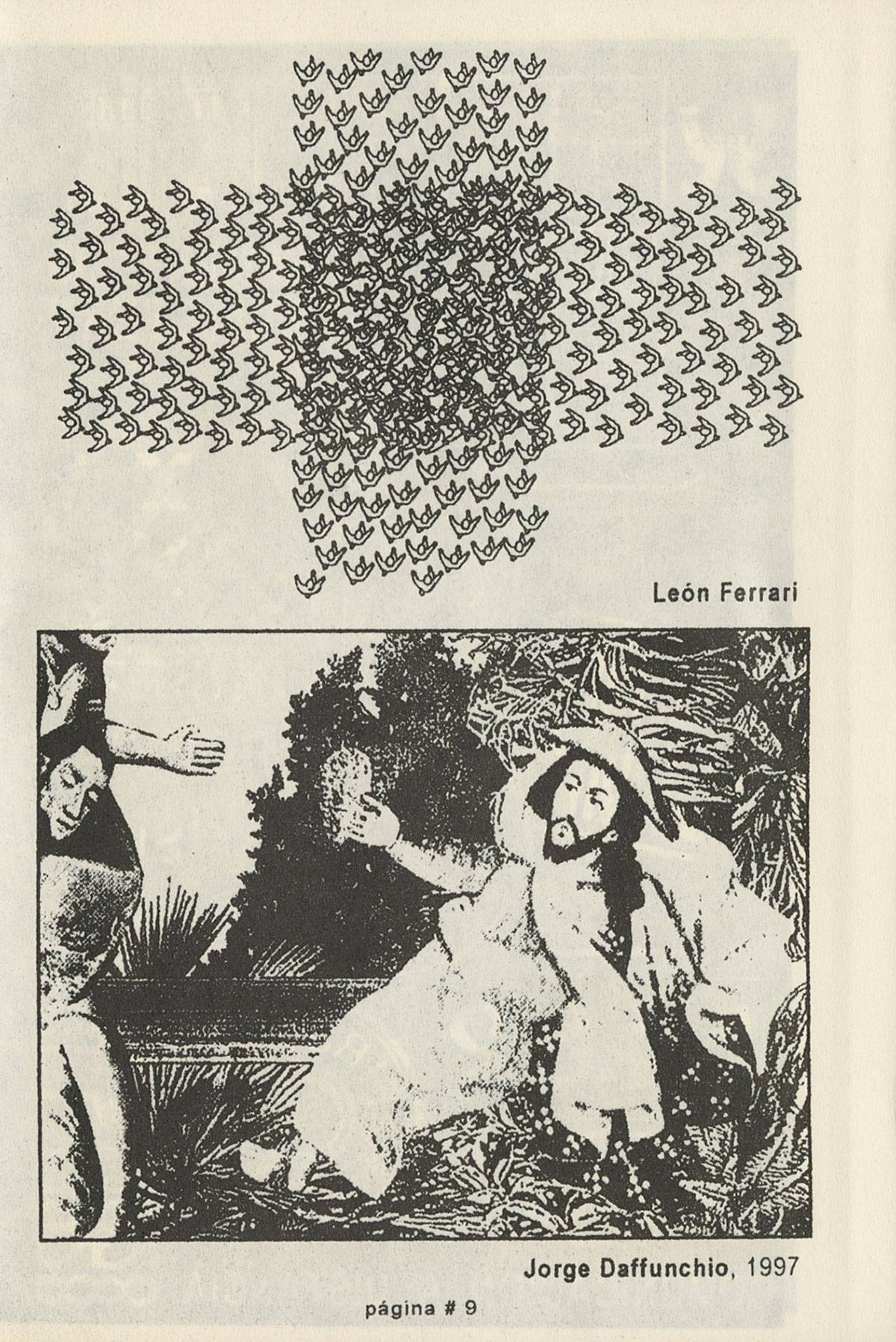
Page 9. Two tribute artworks. Top: a work by León Ferrari — a geometric/conceptual composition of repeated small bird/arrow motifs arranged in a cross pattern, intensifying in density toward the center, typical of Ferrari's systematic visual language. Bottom: a work by Jorge Daffunchio (1997) — a photomechanical reproduction of a religious scene (a figure in white robes, possibly Christ, with attendant figures), recontextualized as tribute imagery. Artists identified: León Ferrari, Jorge Daffunchio.
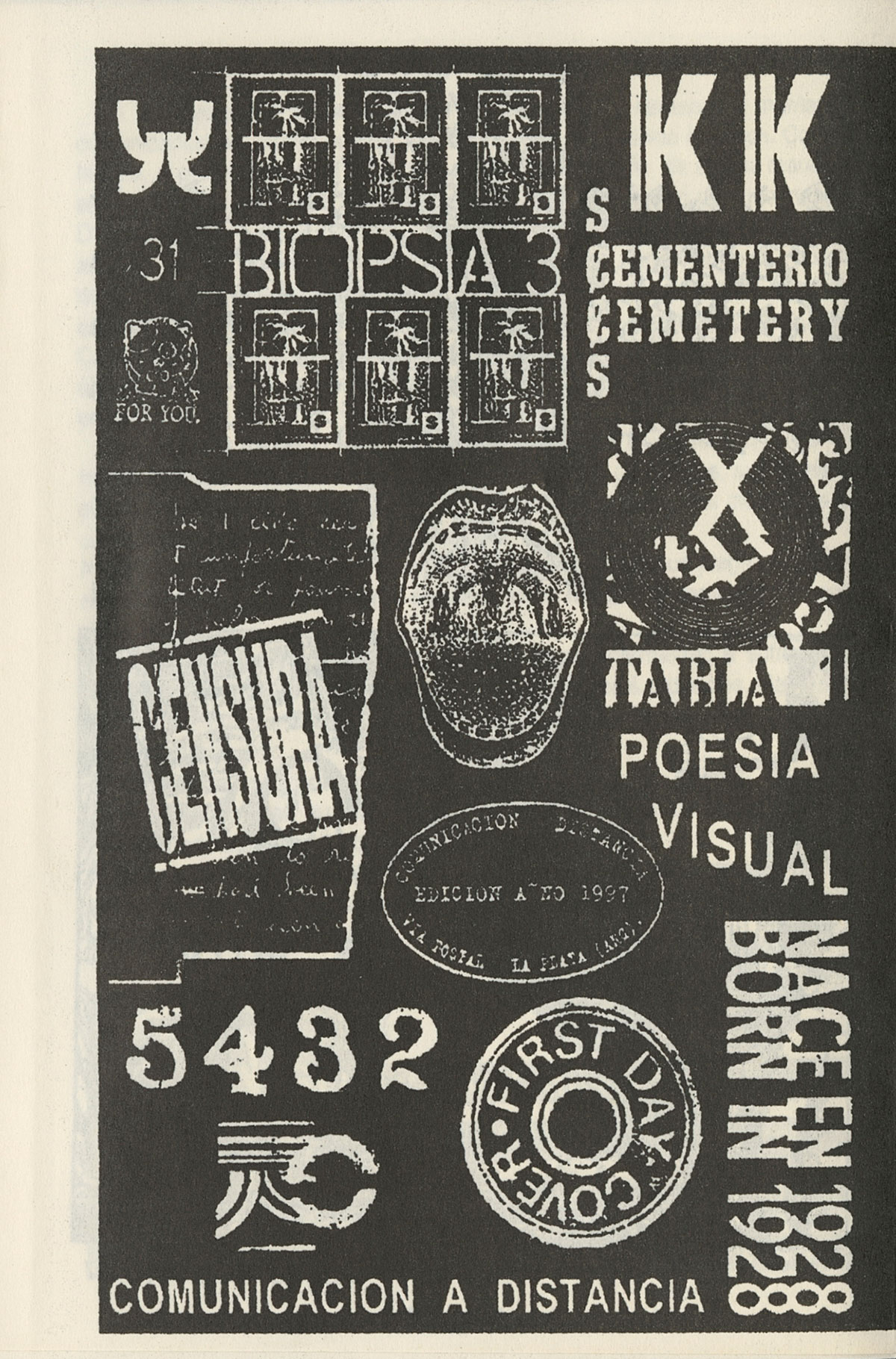
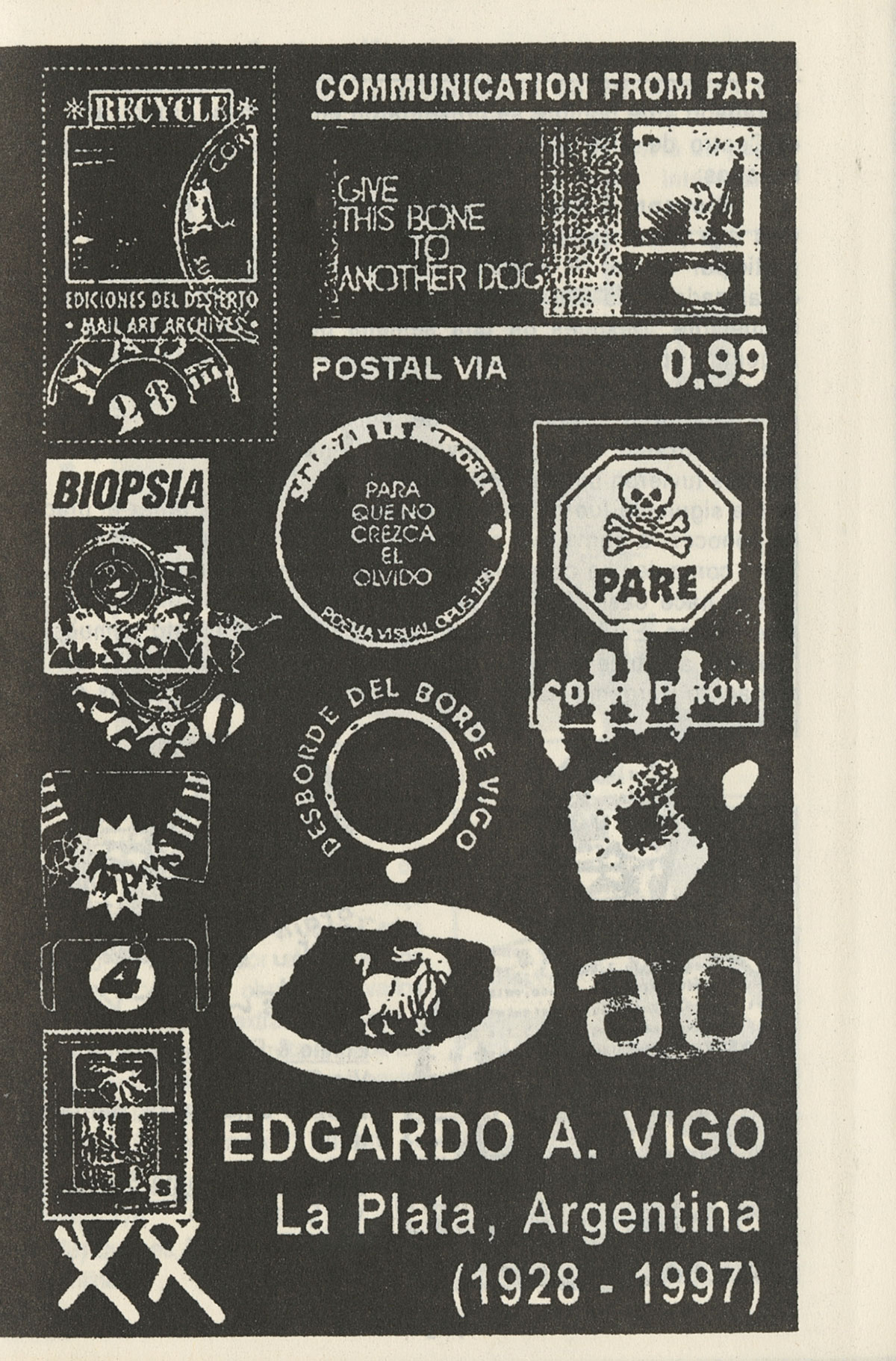
Page 10-11 (unnumbered). A full-page black-background tribute composition featuring Vigo's own Artistamp motifs, rubber stamp elements, and typographic fragments associated with his practice: "BIOPSA 3," "CEMENTERIO / CEMETERY," "CENSURA," "COMUNICACION A DISTANCIA," "TABLA POESIA VISUAL," "FIRST DAY COVER," "NACE EN 1928 / BORN IN 1928." The oval stamp reads: "COMUNICACIÓN DISTANCIA / EDICIÓN AÑO 1997 / VÍA POSTAL LA PLATA (ARG.)." This page functions as a visual biography / homage page assembling Vigo's iconographic vocabulary. Artists identified: Edgardo Antonio Vigo (attributed motifs/stamps).
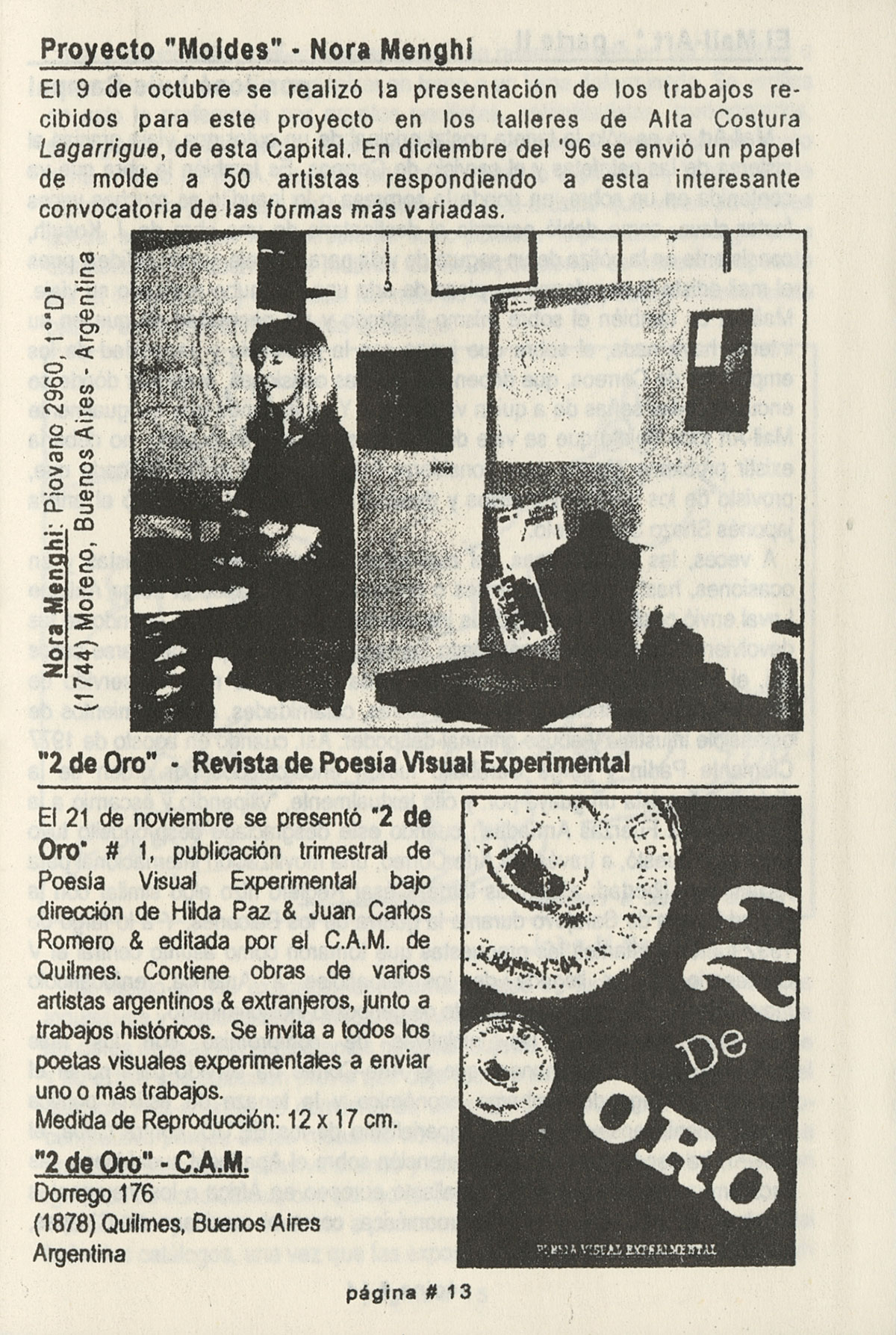
Page 13 (as numbered in the magazine). Two news items: (1) "Proyecto 'Moldes'" by Nora Menghi: a report on the presentation of works received for this mail art project on 9 October 1997 at the Alta Costura Lagarrigue workshop, Capital Federal; 50 artists were invited in December 1996. Includes a photograph of Nora Menghi at the exhibition. (2) "2 de Oro" — Revista de Poesía Visual Experimental: announcement of the first issue (#1) of the quarterly publication 2 de Oro, directed by Hilda Paz and Juan Carlos Romero and edited by the C.A.M. de Quilmes; includes a reproduction of its cover. Artists identified: Nora Menghi, Hilda Paz, Juan Carlos Romero.
Page 14. Part II of the essay "El Mail-Art" by José Luis Campal: a theoretical examination of mail art as a vehicle for political resistance and anti-institutional art practice, citing examples from Uruguay (the imprisonment of Clemente Padín and Jorge Caraballo in 1977), the Sarajevo solidarity actions of César Reglero during the Balkan wars, and the V Centenario protests of 1992. Originally presented at the IV Encuentro Internacional de Editores Independientes, Huelva, Spain, May 1997; reprinted from P.O.Box No. 30 (Merz Mail, Barcelona). Artists/persons identified: José Luis Campal (author), Clemente Padín, Jorge Caraballo, César Reglero (cited).
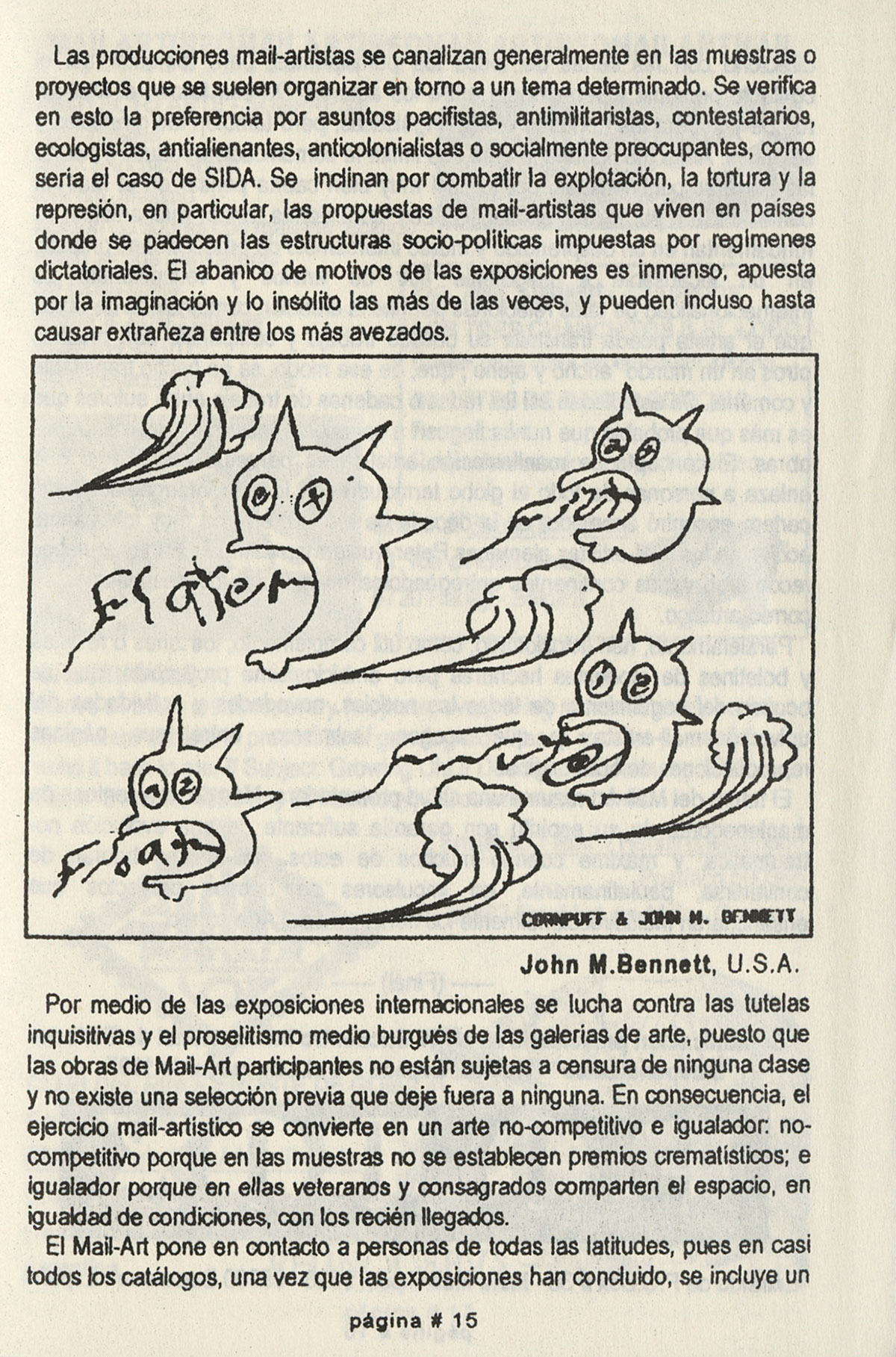
Page 15. Continuation of the Campal essay (page 15 of the catalog). Includes an artwork by John M. Bennett (USA): a loose ink drawing of cartoon creature figures signed "Cornpuff & John M. Bennett" — a playful, subversive imagery typical of Bennett's visual poetry practice. Artists identified: John M. Bennett.
Page 16. Conclusion of the Campal essay and a full-width advertisement for the publication Arte Postale — Guía del Network de la Correspondencia Creativa by Vittore Baroni (Viaraggio, Italy), 256 pages, 300 illustrations in Italian, limited edition of 1200 copies, with ordering information. Below: two artworks — one by Juan López de Ael (Spain, 1997): a collaged text/typographic work with ornamental borders; and one by Patricia Collins (England, 1997): a printed Found Object / tag piece titled "Operation Lost & Found" documenting an item ("Seven Spades") found in London on 08.09.97. Artists identified: Vittore Baroni, Juan López de Ael, Patricia Collins.
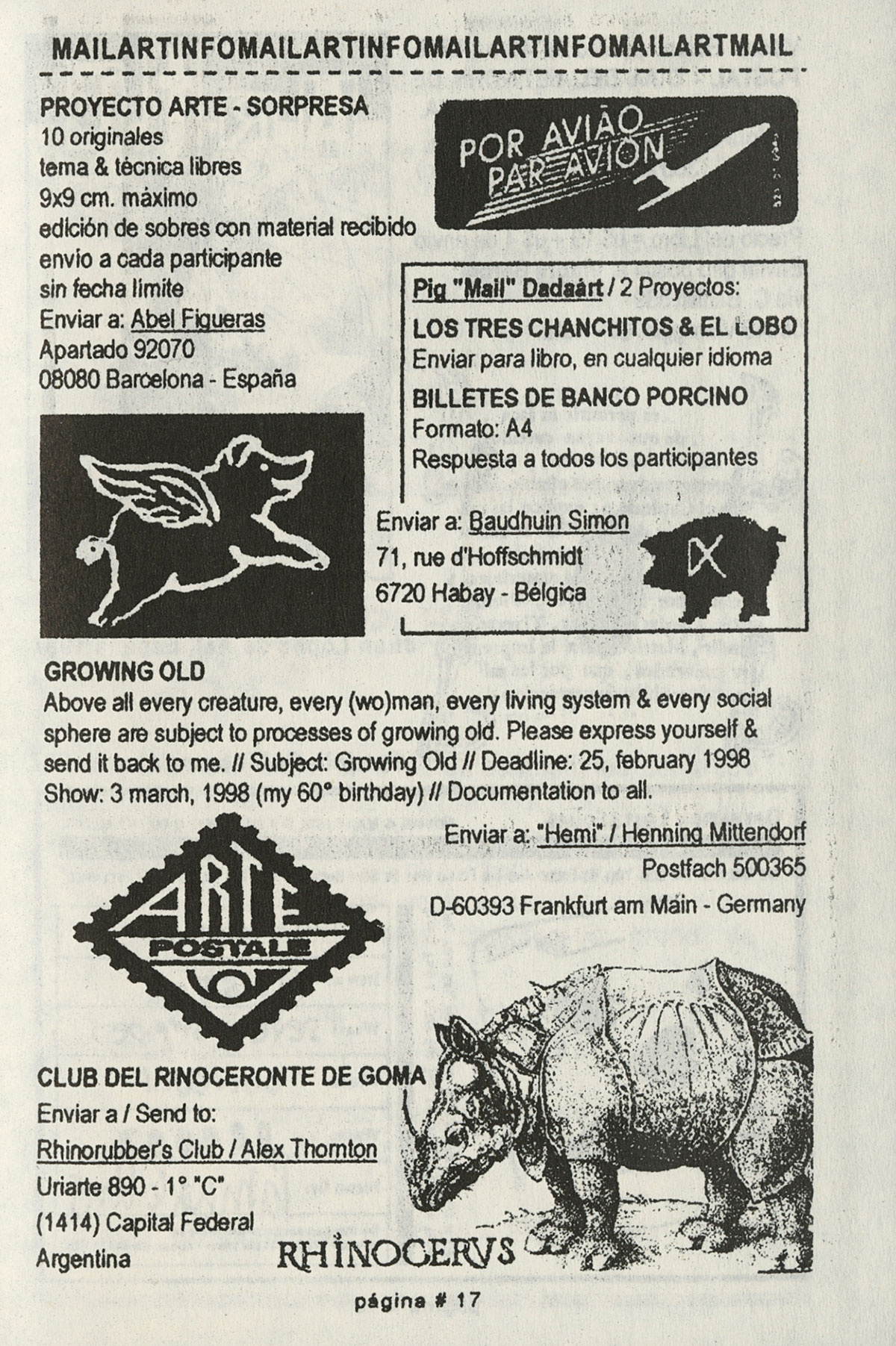
Page 17: "Mailartinfomailartinfomailartinfo..." — a Mail Art information page listing three active international calls: (1) "Proyecto Arte-Sorpresa" by Abel Figueras (Barcelona, Spain): 10 originals, free theme and technique, max. 9×9 cm, no deadline; (2) Two projects by Pig "Mail" Dadaart / Baudhuin Simon (Habay, Belgium): "Los Tres Chanchitos & El Lobo" (book project) and "Billetes de Banco Porcino" (A4 format); (3) "Growing Old" by "Hemi" / Henning Mittendorf (Frankfurt am Main, Germany): deadline 25 February 1998, show on 3 March 1998; (4) "Club del Rinoceronte de Goma" / Rhinorubber's Club, Alex Thornton (Buenos Aires, Argentina). Artists/organizers identified: Abel Figueras, Baudhuin Simon, Henning Mittendorf, Alex Thornton.
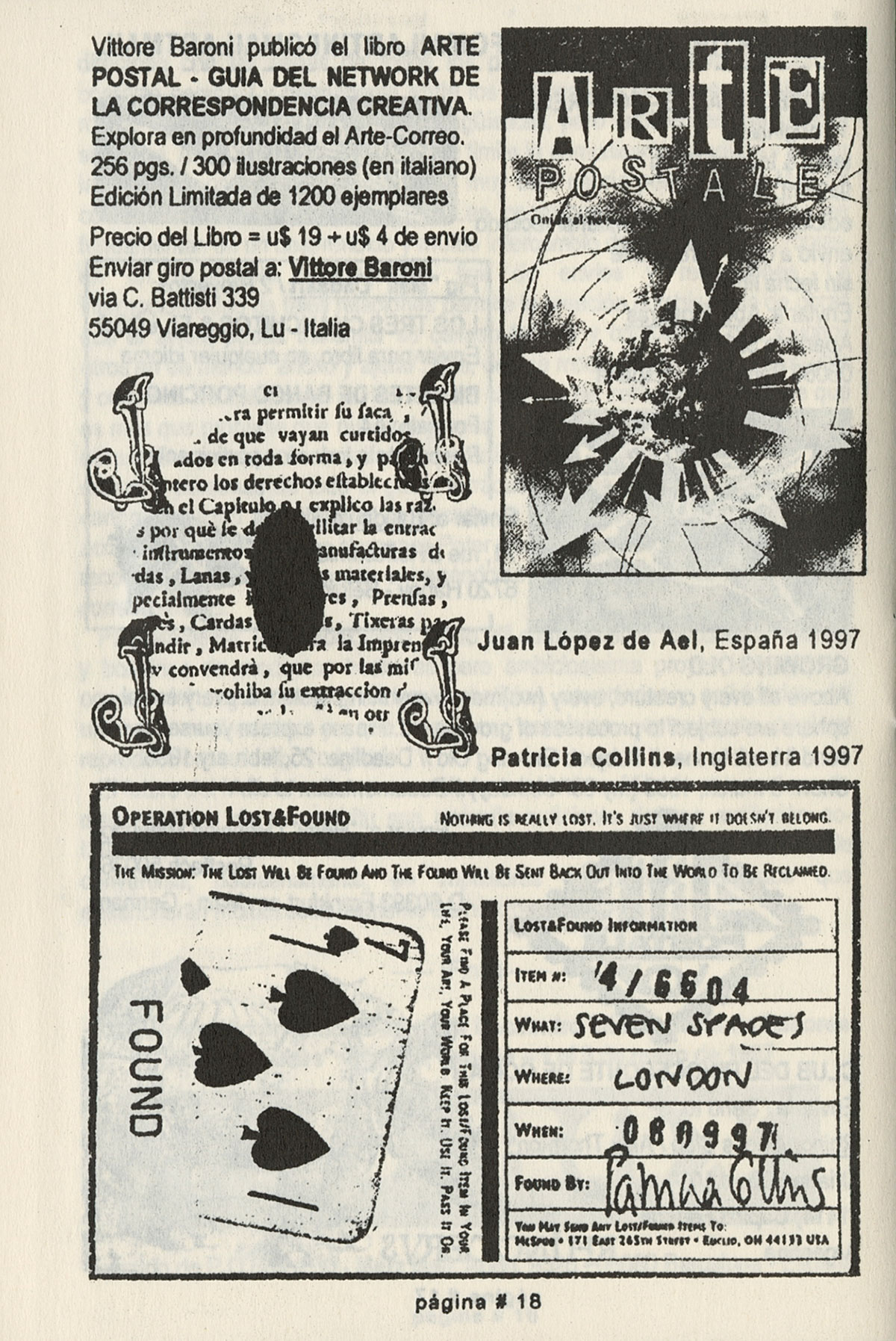
Page 18. Advertisement for Vittore Baroni's book Arte Postale — Guía del Network de la Correspondencia Creativa with the Arte Postale logo. Below: two artworks — one by Juan López de Ael (Spain, 1997): a collage with ornate Baroque typographic borders surrounding a partially censored text; and one by Patricia Collins (England, 1997): a printed "Operation Lost & Found" card with a playing card image, bearing the handwritten inscription: Item #4/6604, "Seven Spades," London, 08.09.97. Artists identified: Juan López de Ael, Patricia Collins.
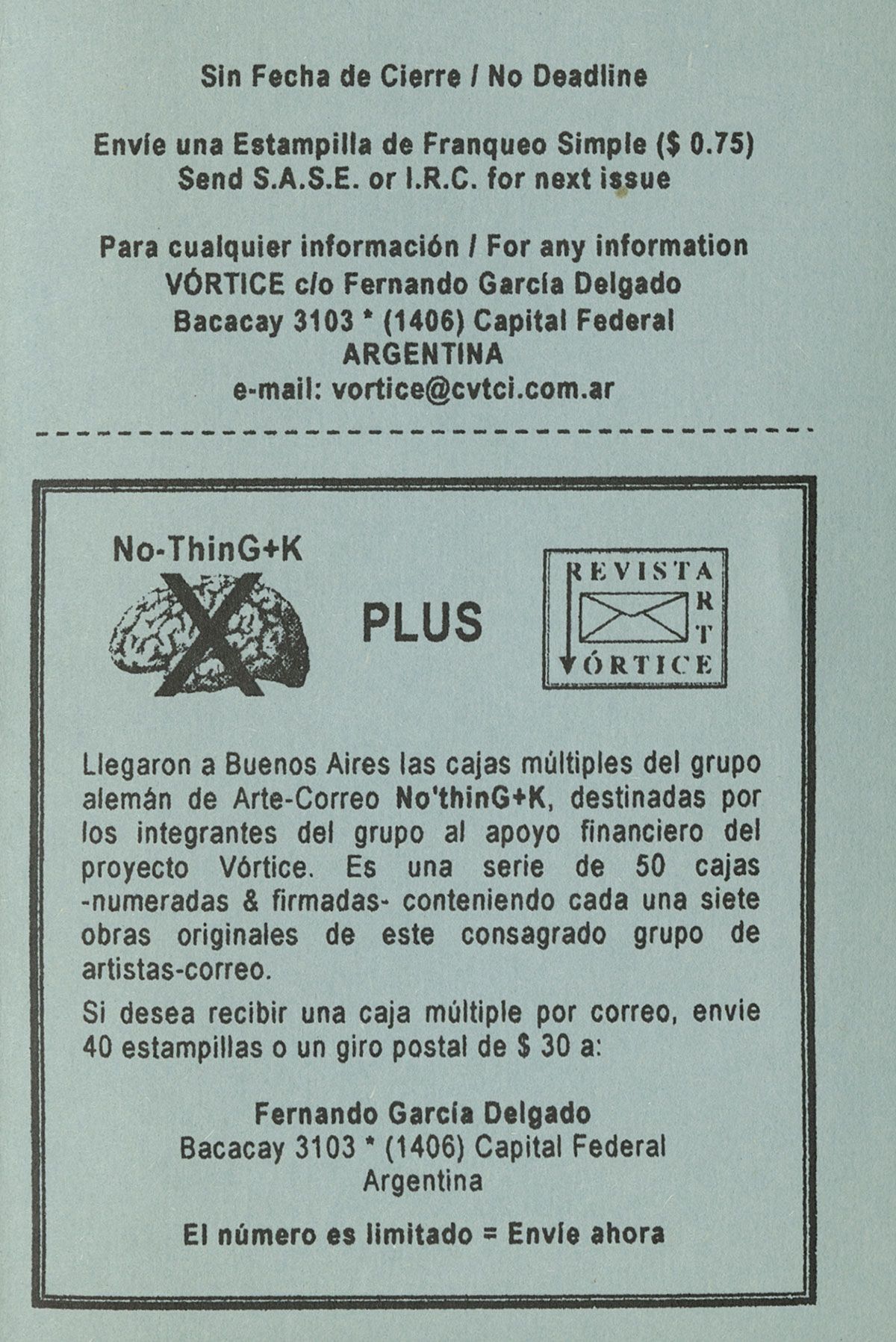
Inner back cover / subscription page. Printed on the same light blue paper as the cover. Bilingual (Spanish/English) information page for Vórtice: "No Deadline / Sin Fecha de Cierre," instructions for sending a stamp or IRC for next issue, contact address (Fernando García Delgado, Bacacay 3103, Capital Federal, Argentina; e-mail: vortice@cvtci.com.ar). Lower half: announcement of the No'thinG+K multiple artwork boxes (series of 50 numbered and signed boxes, each containing 7 original works by the German mail art group) available through Vórtice. Artists/groups identified: Fernando García Delgado (Vórtice), No'thinG+K (German mail art group).
Back cover. With the official stamp/colophon of Vórtice Argentina
