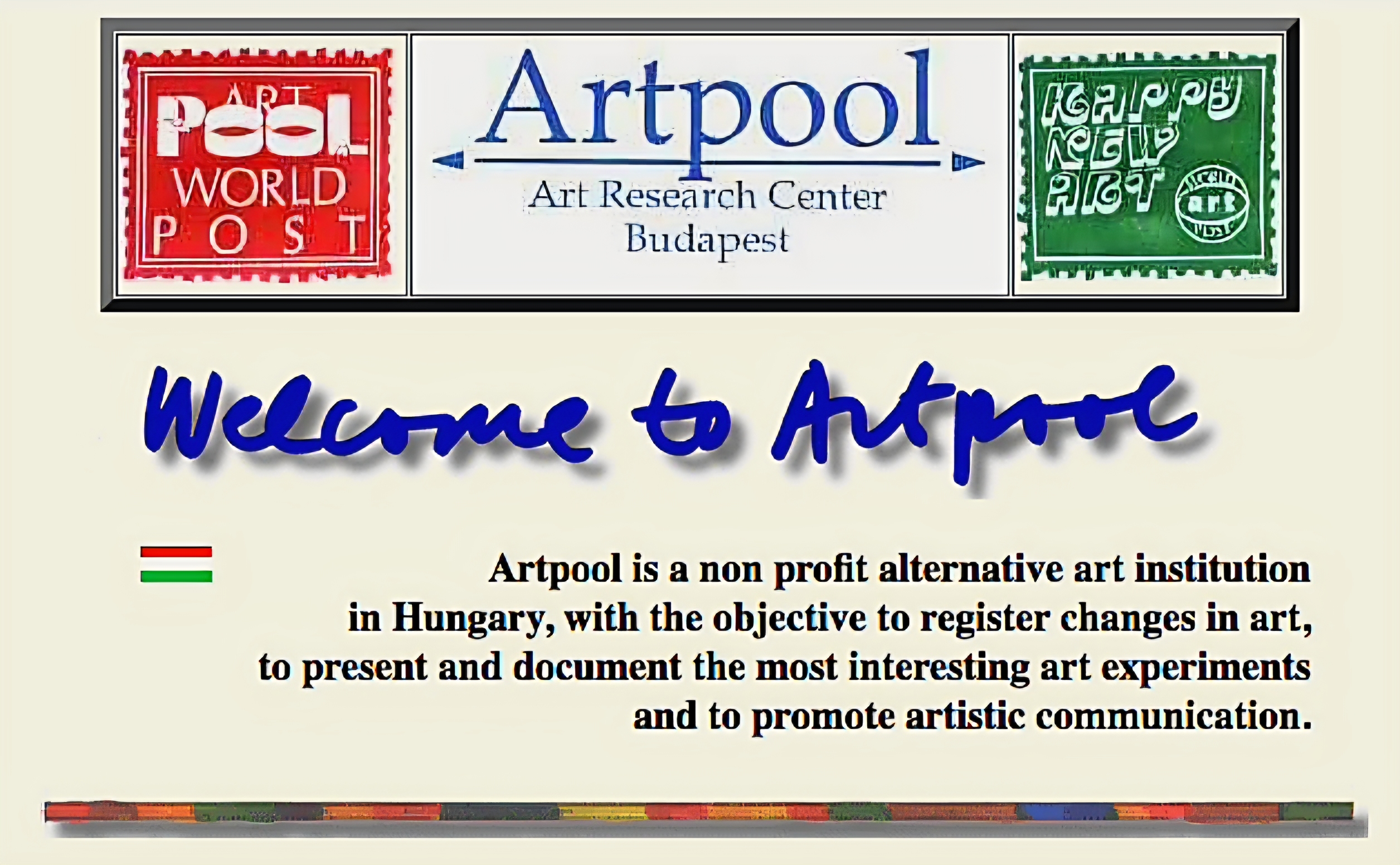
Az artpool.hu nyitóoldala (1996 tavasz)
The website was designed by György Galántai (the welcome text is also in his handwriting); the content was written and edited jointly with Júlia Klaniczay, while the technical implementation and programming were the work of László András Tölgyes.
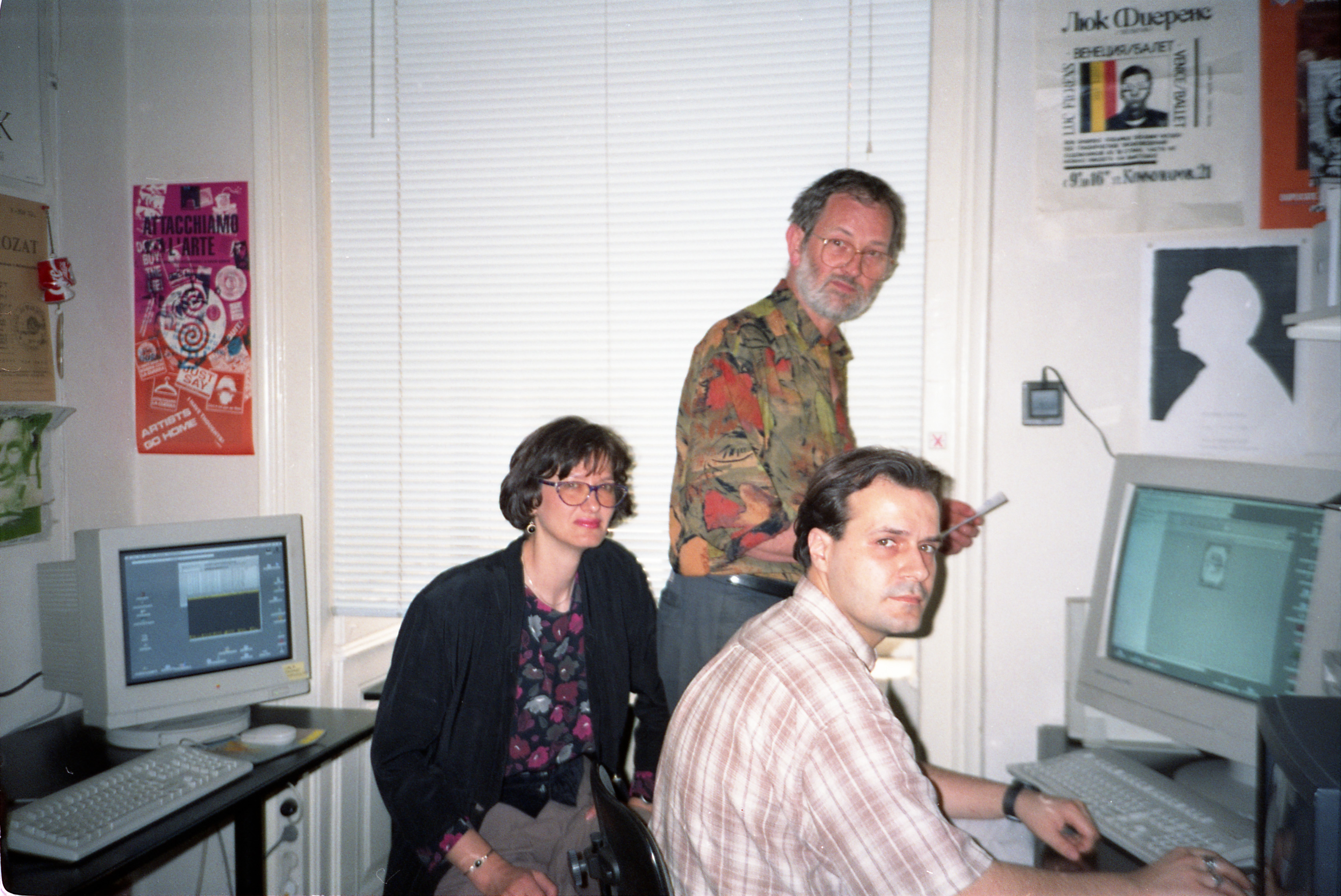
The website development team: Júlia Klaniczay, György Galántai, and László Tölgyes at the Artpool Art Research Center
(on the left: the Macintosh computer running the Artpool web server)
The Internet Archive’s Wayback Machine took its first snapshot of artpool.hu on December 27, 1996; since then, nearly 3,000 captures have documented the evolution and expansion of the Artpool website.
The earlier, initial versions have also been preserved and can be studied in the digital archive of the Artpool Art Research Center.
When Artpool—the first Hungarian cultural institution to establish an online presence—went online, it had already been operating as a network for a long time. It functioned as a system in which information does not exist in isolated units, but rather lives and spreads through connections, references, and links.
Artpool’s entry into the digital worldwide web was a natural extension of its nearly two decades of active participation in the mail art network, and it took the exchange of information among artists to a new level.
From the very beginning, one of artpool.hu’s primary goals has been to make information about the arts accessible—at a time when such information was hardly available in Hungarian at all. The site not only collected but also interpreted this material: it connected the pieces, provided context, and built an alternative knowledge network. Much of the content found here remains available exclusively on Artpool’s platforms to this day.
“Each genuine work can be interpreted on several levels, in fact, this is what ensures its validity over time and amidst changing viewpoints. Each interpretational level constitutes a network on its own, which, in turn, interacts with the other levels, forming complex sets of networks. Each element of such a construction might well be related to another element, and to other constructions as well. Subsequently, the work is but a piece of land to cultivate, e.g. a garden. To preserve the permanence of the work is thus to preserve its alterability.
The task of artists in the future, therefore, is not the creation of so-called works, but the construction and cultivation of territories that are capable of relating to one another. Territories that can be connected to one another have/can have a fertilizing effect on each other. This is the essence of exchange.”
György Galántai: The Garden of Correspondence Art, 1997
(excerpt)
To the delight of researchers in net art and net history, many artpool.hu sites still retain their early-1990s HTML structures. These seemingly simple interfaces were, in fact, experimental spaces—where, despite (or perhaps because of) limited tools, new ways of thinking emerged.
Web technology, through the use of hyperlinks, provided György Galántai with the opportunity to highlight the connections and contexts that were always so important to him, and to make this artistic line of thought accessible to others in the digital space.
A particularly good example of György Galántai’s web design method is the Artpool website created in memory of Ray Johnson, whose structure—as is his custom—is illustrated by the striking diagram below.
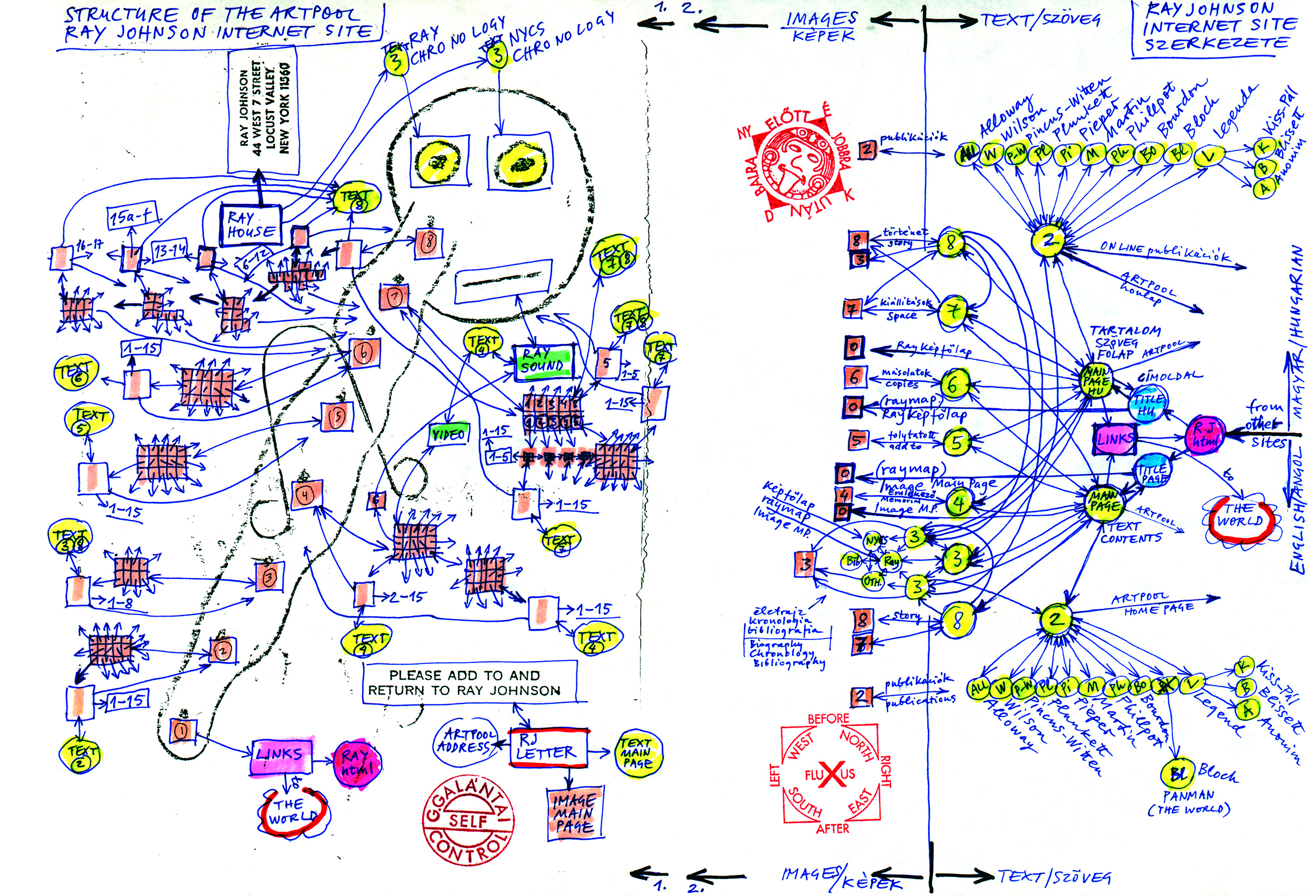
Galántai György: A Ray Johnson website terve, 1997
Júlia Klaniczay announced the launch of artpool.hu, the first Hungarian cultural website, on December 1, 1995, during a presentation on the Artpool Art Research Center at the Ars Acoustica Experts’ Meeting (Budapest, December 1–3, 1995), held at the Hungarian Radio. (The purpose of the meeting was to further develop the highly successful, 24-hour “Horizontal Radio” project, which took place in 1995 and spanned the entire globe; Artpool was one of the Hungarian participants in that project.)
Following the launch of artpool.hu, Artpool’s program for 1996 focused on promoting and popularizing the use of the internet in the arts.
The connection to the World Wide Web was provided by a 4-wire data cable leased from MATÁV, which linked Artpool’s office on Liszt Ferenc Square to the Eötvös Loránd University (ELTE) Information Technology Center, where we connected to the Hungarian section of the European Internet backbone network (then considered cutting-edge technology), the HBONE (Hungarian backBONE).
In 1995, Artpool was admitted as a member of the Hungarnet Association (which brought together academic and other important institutions connected to the World Wide Web), and thus, fortunately, Hungarnet covered most of the monthly data transmission costs (which was a huge help for a nonprofit institution at the time).
Press coverage at the time
Hálózati hírek. Új URL címek, Infopen, February 1996, p. 25 (rövid hír) ■ Dombos Tamás: Kedvenc WWW oldalaim, Infopen, June–July 1996, pp. 36–37. ■ Papp Tibor: Képünk az Interneten. Párizsi levél, Magyar Hírlap, April 13, 1996, p. 13. ■ Demszky Gábor: Hogy szabadon kommunikálhassunk. Megnyitó szavak egy kiállításhoz. Budapest az Interneten, Európai utas, January 1996, p. 6. ■ Török, András: Digital Budapest. Artpool Research Center, Budapest Review of Books, Summer 1996 ■ Artpool Research Center, Inter Art Actuel, No. 65, June 1996, p. 77 (notice) ■ Beke László: Magyar internet: könyvtárak és magyar művészet, in: Magyar Tartalom, Soros Alapítvány Kulturális és Kommunikációs Központ, Budapest, 1997, pp. 61–62. ■ St. Auby Tamás: Szörföl/zni – pórázon, in: Magyar Tartalom, Soros Alapítvány Kulturális és Kommunikációs Központ, Budapest, 1997, p. 92. ■ Bálint Anna: Garden of Communication. Artpool Art Research Center website, Convergence. The Journal of Research into New Media Technology, Vol. 4, No. 2, Summer 1998, pp. 116–118. ■ Sz. T.: Hálózat. Artpool.hu, Magyar Narancs, November 2, 2000, p. 39. ■ Magyar művészetkutató központ, Klick Netlap, December 10, 2002 (notice) ■ Markovits Ferenc: Kortárs művészek völgye a weben, Metro, October 8, 2003, p. 13. ■ Starbuck, Honoria Madelyn Kim: Clashing and Converging: Effects of the Internet on the Correspon- dence Art Network, PhD Dissertation, University of Texas, Austin, 2003, pp. 39–42, 83, 252, 296, 471.
Recent studies available online
■ Barkóczi, Flóra: Az Artpool website mint integrál-projekt. INFORMÁCIÓS TÁRSADALOM: TÁRSADALOMTUDOMÁNYI FOLYÓIRAT 19 : 3 pp. 60-68. , 9 p. (2019)
■ Barkóczi, Flóra: A világháló utópiája: Internet és képzőművészet viszonya a rendszerváltást követő időszakban
ENIGMA 99 : 8 pp. 78-91. , 14 p. (2020) [pdf]
■ Barkóczi, Flóra: Képzőművészet és kollektivitás a korai magyar interneten: Az Artpool, a C3 és az Éjjeli Őrjárat 1990-es évekbeli weblapja és tevékenysége. In: Tófalvy, Tamás (szerk.) A magyar internet történetei Budapest, Magyarország : Typotex Kiadó (2021) pp. 161-173. , 13 p.
[pdf]
■ Barkóczi, Flóra: The “dynamic storage” of an “active archive” – Artpool’s strategies for storing and distributing information on underground art over the past 40 years, Le Temps des Médias, No. 38, 2023. [pdf]
■ Bodor, Judit – Roddy Hunter: artpool.hu: a user’s guide: Remediation, Digitization and the Networked Art Archive. In: Emese Kürti, Zsuzsa László (eds.): What Will Be Already Exists. Bielefeld: Transcript, 2021, pp. 171-190.