Only what is taken care of will remain
artpool.hu: Thirty Years from the Garden to the Greenhouse
Background Study for the Exhibition “Archivuminternetwork—30 Years of artpool.hu”
LÁSZLÓ ANDRÁS TÖLGYES
Thirty Years of a Garden
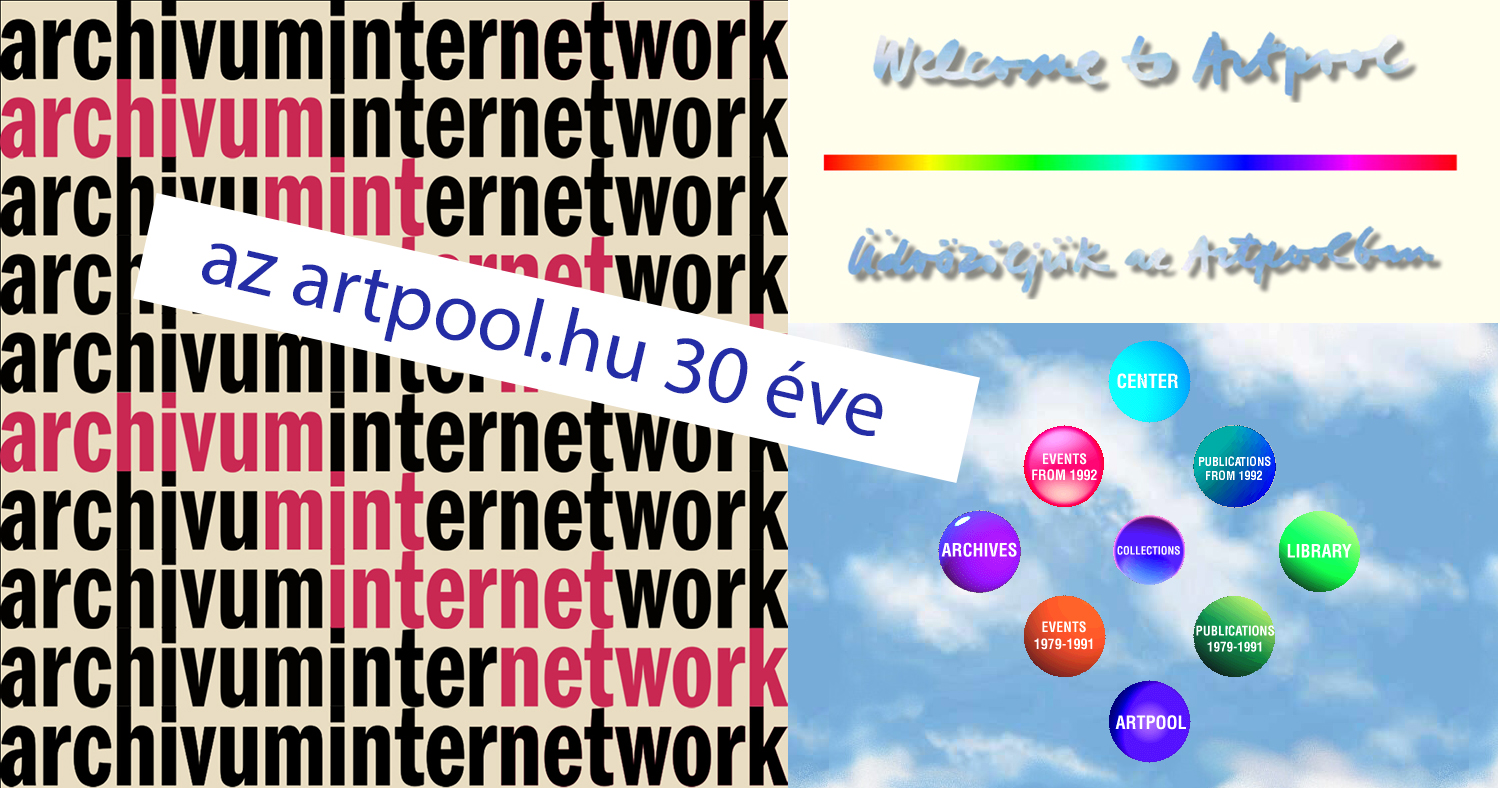
In December 1995, when the first pages of artpool.hu went live, the web in Hungary was more of a promise than an infrastructure. Few people knew what a web browser was, and even fewer thought that an art archive belonged on the web. The site was designed by György Galántai, edited jointly with Júlia Klaniczay, and I handled the programming. Thirty years later, artpool.hu is still up and running: it is the first Hungarian cultural institution website and has been continuously accessible since 1995. The exhibition titled “archivuminternetwork,” curated by Judit Bodor and Roddy Hunter, celebrates these thirty years.
However, the anniversary is not just a celebration but also a question. As the exhibition itself puts it: what new ways of thinking can artists, archivists, and curators develop in the age of automation and emerging superintelligence? This essay seeks an answer from both an internal and an external perspective. Internal, because I wrote the code back then. External, because from the perspective of thirty years, I can see what the web has become in the meantime and what it will become now in the age of artificial intelligence.
This text is not a history of technology, but a history of thought. Its central thesis is simple: organicity is not a matter of form, but of care. At first glance, artpool.hu still looks like a 1997 website, yet it is organic because it grows, is maintained, and thinks in terms of connections. That is precisely why (as we will see) even a machine cannot fully “harvest” it.
The Network Before the Website
To understand artpool.hu, we must first recognize that Artpool was a network before it became a website. Artpool Radio, which aired between 1983 and 1987, was a pseudo-radio: it spread via cassette, mail, and in-person meetings because it had no access to radio waves. The 1983 Budapest–Vienna–Berlin telephone concert connected both sides of the Iron Curtain through simple telephone lines. The Budapest session of the 1992 Decentralized Network World Congress was a fax and copy art workshop with eighty-six participants. The 1993 Danube Connection used two telephone lines and a picturephone to ask: why should we communicate? And in June 1995, Horizontal Radio connected radio stations around the world and the internet for twenty-four hours.
The web, therefore, was not the arrival of a new tool, but a new medium for an old idea. Artpool approached the web not from a technological perspective, but through the lens of the art of connection, which is why it treated the website from the start as a form of thought rather than an advertising space or a digital business card.
Background: Hypertext and the Web as Art
The idea of the web predates the web itself. In his 1945 essay “As We May Think,” Vannevar Bush described the Memex, an associative knowledge machine that organizes information along connections, much like human thought. Ted Nelson coined the term “hypertext” in the mid-1960s, and in his Xanadu project, he envisioned a system with bidirectional links and every citation leading back to its source. Nelson later sharply criticized the World Wide Web—proposed by Tim Berners-Lee in 1989 and made public in 1991—because its links are one-way: the linked page has no way of knowing who is linking to it.
From this perspective, György Galántai’s hand-drawn relationship maps are closer to Nelson’s ideal than to how the Web actually functions. These drawings are not site maps but rather relationship maps: they show how the various areas of Artpool’s activities are connected. The link structure of artpool.hu is the technical manifestation of this idea.
The other prehistory is that of art. As early as the beginning of the 1980s, Roy Ascott, using the concept of telematic art, described the computer network as a collective creative space; in his 1983 project “La Plissure du Texte”, participants collaboratively wrote a story over the network. Robert Adrian X, a key figure in Vienna’s telecommunications art scene, partnered in both the telephone concert and the Danube Connection. Robert Filliou’s concept of the “Eternal Network” defined art as continuous, never-ending communication; Art’s Birthday, which he initiated on January 17, is still celebrated today as a commemoration of this concept. On the Hungarian side, Miklós Erdély’s ideas on autopoietic systems provide the key: in 1998, Anna Bálint used this text precisely as a metaphor for the structure of artpool.hu.
The Garden (1995–2000)
Technical Reality
Early web content was simple. We wrote static HTML pages by hand, one file at a time, and uploaded them via FTP. The server often ran on our own computers; at Artpool, it was a Macintosh running WebSTAR server software. Style sheets were virtually nonexistent, and JavaScript, databases, and mobile views didn’t exist. Connections were slow, every image cost money, and text reigned supreme.
There was something instructive about this “poverty.” Without a database, you had to create every link by hand. Every link was a decision: this page links to that one because their content is related. Navigation, therefore, wasn’t a structure superimposed on the content; it was content itself. For anyone exploring the site, their path was also an interpretation.
What was the web good for?
First and foremost, for the free flow of information. For Artpool—which endured for two decades, operating within a semi-illegal framework, and only became a public institution after the fall of communism—boundless access was not a matter of technical convenience but a matter of principle. The web adaptation of “World x Art x Post”, on view at the exhibition, illustrates this in a particularly poignant way. The secret police seized some of the works submitted to the 1982 international artist stamp project; György Galántai created a commemorative stamp in memory of these friends. On the 1998 website, the missing works are also marked; here, the web provides space even for those the postal service denied.
Second, for the personal touch. Every page was handcrafted, and it showed György Galántai’s drawings, handwriting, and original icons. Third, for transparency: the structure itself was a work of art, as illustrated by the map of Ray Johnson’s website. Fourth, for slowness. Visitors took the time to explore, followed the links, got lost, and rediscovered something. The garden could be explored
A fifth, rarely mentioned aspect is public education. Artpool was among the first in Hungary to let visitors use the internet freely. For the “Art on the Internet—Wandering the Web” event, held as part of the 1996 Budapest Spring Festival, György Galántai compiled a list of bookmarks—a sort of guided tour through this still-unknown landscape. Artpool was therefore not only present on the web but also served as a gateway to it.
The Garden of Connection Art
The key text behind the philosophy of artpool.hu is György Galántai’s 1997 essay, “The Garden of Correspondence Art,” which was written as an accompanying text for the Ray Johnson website. Here, he describes the artwork as a space to be cultivated—a garden—and sees the artist’s task not in creating finished works, but in constructing and cultivating territories that can relate to one another.
The significance of this metaphor was most clearly recognized by Anna Bálint, Artpool’s archivist at the time. In her 1998 article “Garden of Communication,” published in the journal “Convergence”, she contrasted Artpool’s garden with the urban network metaphors that were fashionable at the time—and which she considered, even then, to be overused: the digital city, the coffeehouse, the salon, and the electronic agora. This observation is particularly acute today. The juxtaposition of the garden and the city (which I will use in the following chapters to describe the eras of the web) is therefore not a retrospective construct. It was already articulated this way in 1998, in reference to artpool.hu.
Anna Bálint found signs of the garden at every level of the site. The two entrances on the home page symbolized day and night, which she linked to the transcendent gateways of the Gnostic tradition. The event list was “pinned up” with virtual thumbtacks, as if it were a bulletin board; on the page displaying Artpool’s address, the building appeared against a spring backdrop. Analogies to the material world thus counterbalanced the immateriality of the digital medium—the very same “counterbalance” that György Galántai’s contemporary notes describe as the coexistence of the most immaterial and the most material concepts. A man digging in a garden appeared as a recurring icon on the page, symbolizing the website’s constant change, breakdown, and rebuilding. Anna Bálint’s most important observation, however, was structural: on artpool.hu. Every element is connected to others on multiple levels, and as a result, the mass of information coalesces into a value system that offers the user multiple interpretations.
Remediation: From Bookworks to a Website
One of the most interesting trends of artpool.hu’s early period was its web adaptations. György Galántai transferred bookworks of connection art to the web, and these were not mere digitizations. In the 1988 UNI/vers (;) anthology, readers could arrange the unnumbered pages in any order they chose; the 1998 web version translated this non-linear reading experience into pages navigable by clicking on images. The 1994 NETWORKER BRIDGE became a 64-card virtual tarot deck in 1998, in which each card turn also triggered a sound piece, creating new connections among the archive's materials. The Ray Johnson website combined the book, the exhibition catalog, and the museum tour, while the Robert Filliou memorial site (completed on January 17, 1999—Filliou’s birthday and also Art’s Birthday) linked the archive’s materials with information available online.
In 1999, Jay David Bolter and Richard Grusin used the concept of “remediation” to describe how a new medium reworks older ones. Artpool’s adaptations are conscious, artistic examples of this process: they do not simply imitate the book on the screen, but rather explore what the network can do that the book cannot. The curators refer to them as “ideal copies,” and Judit Bodor and Roddy Hunter’s 2021 book, “artpool.hu. a user’s guide,” examines precisely the connections between remediation, digitization, and the online art archive.
Garden, Rhizome, Holarchy
It would be tempting to describe the early web using Deleuze and Guattari’s concept of the rhizome: not a hierarchical library, but a network of connections in which any point can be linked to any other. However, this image is inaccurate. The rhizome is wild and sprawling, whereas the garden is cultivated. A garden has intention, choice, pruning, and tending—yet it is not a rigid, tree-like structure. Arthur Koestler’s concept of the holon better describes this intermediate state: a holon is a part that is itself a whole, while a holarchy is an order in which levels are nested within one another without being subordinate to one another. It is no coincidence that Artpool refers to the period beginning in 2010 as the era of “holarchization” in its own history. The garden is a third way between the rhizome and the tree.
It is also worth noting a coincidence. Jacques Derrida’s book Mal d’archive (Archive Fever) was published in 1995, the same year that artpool.hu was launched. Derrida describes the desire and anxiety of archiving—that duality which (as we shall see) also appears thirty years later in the exhibition’s central performance. And one more thing: Ward Cunningham also launched the first wiki in 1995, inspired by Christopher Alexander’s architectural pattern language. The idea of a “collaboratively maintained knowledge space” emerged in several places that same year.
Artpool’s metaphor was not an isolated one. In 1998—the same year as Anna Bálint’s article—Mark Bernstein wrote an essay titled Hypertext Gardens arguing that hypertext should be designed as a garden: neither as a disordered wilderness nor as a geometric park, but as a place where visitors can get lost and stumble upon something.
Plantation and City (approx. 2000–2012)
The turn of the next decade began not with a technology, but with a search engine. Google launched in 1998, and its PageRank algorithm, ironically, derived value precisely from links: the more other sites linked to a page, the more important it was deemed. Manually created links thus became the raw material for a machine-generated ranking. From then on, visitors no longer explored the site; instead, they jumped to a specific point through search. Navigation shifted from exploration to jumping.
Meanwhile, the technology behind website creation also changed. Dynamic pages (PHP, ASP, databases) appeared, followed by content management systems. Content and form separated: authors no longer wrote pages but filled out fields, with templates determining the appearance. By the middle of the decade, Web 2.0 (a term that gained widespread use starting in 2004, following Tim O’Reilly) turned users into content creators, but this shift also moved power to the platforms. This same decade was also the era of Flash: spectacular, animated pages built on a closed, patented plug-in.
During this era, the urban metaphor—which Anna Bálint had rejected in 1998—prevailed. The web became a space of efficiency, scale, and traffic. The garden turned into a plantation: an optimized, measurable, monetizable area where everything is planted with an eye toward yield.
At the same time, another ambitious vision was born. In 2001, Tim Berners-Lee and his co-authors wrote in Scientific American about the Semantic Web: a network whose content machines could interpret, and in which meaning is constructed from relationships. That dream remained largely unfulfilled at the time: I’ll return to it in Chapter 6, because now, in an unexpected and distorted form, it seems to be coming true.
This era lost the author’s personal touch, nonlinear, exploratory navigation, and counterpoint. What emerged was scalability, personalization, performance, and measurability. Artpool.hu observed all of this from the outside: it remained a hand-built website, which may have seemed anachronistic at the time. Today, it seems more like foresight.
Stream and Platform (approx. 2012–2022)
With the rise of smartphones, the web has transformed once again. In the age of responsive design, single-page applications, and the cloud, websites have increasingly become like apps, and content has become a stream: an endlessly scrollable timeline, a news feed, a feed. Mike Caulfield’s 2015 lecture, The Garden and the Stream, described this very shift. The garden is a coherent, cultivated, timeless space of knowledge, where things gain meaning in relation to one another. The stream is chronological, momentary, and the latest element is always the most important. Social media marked the stream's triumph over the garden.
The title of the exhibition’s accompanying event (From the Garden of Communication to the Dark Forest of the Internet) refers to this era, and it is worth understanding precisely. The image of the “dark forest” was popularized by Yancey Strickler’s 2019 essay, The Dark Forest Theory of the Internet, inspired by Liu Cixin’s “Three-Body” trilogy. In the novel, the universe appears silent because it is full of hidden civilizations that are afraid to reveal themselves. According to Strickler, the open web has become just like this: due to trolls, advertising, and the battle for attention, it has turned into a dangerous place, which is why live human communication is retreating into private spaces: newsletters, closed groups, and messaging apps. The forest seems quiet, yet it is full of life; everyone’s just hiding. The dark forest, then, is not simply the realm of algorithms, but their consequence: the abandonment of the public garden.
At the end of the decade, Cory Doctorow described the decline of platforms using a term that has since become widely used: “enshittification” refers to the process in which a platform first serves its users, then its business partners, and finally only itself. In the garden-plantation-river sequence, this is the point where the space no longer exists for the harvest, but for ownership.
Decay and Durability
This era also brought digital decay. Flash was discontinued on December 31, 2020, and with it, a whole decade’s worth of spectacular web content became inaccessible. Browser extensions vanished, links broke, and services were discontinued. Artpool.hu was not spared either: the exhibition curator notes that some pages of NETWORKER BRIDGE no longer function today.
However, a noteworthy counterpoint remains. The plain HTML hand-coded in 1996 still displays correctly in any browser today, while much later content built with “more advanced” technologies is now defunct. Simplicity endures. What is built on few assumptions has few points of failure. This is not a nostalgic argument in favor of the old web, but an engineering observation: longevity is a design decision.
Greenhouse or Ecosystem? (2022–2026)
New opportunities
The emergence of generative artificial intelligence is transforming every layer of website development. Generative interfaces assemble the page in real time, adapting to the user and the situation: the website literally “grows” with the visitor. AI-assisted development has radically changed how we write code. In early 2025, Andrej Karpathy coined the term “vibe coding” to describe a method in which the developer articulates an “intent” in natural language, after which the machine writes the code, while the human merely checks and guides the process. When I think back to 1995, when I had to type every single link by hand, this difference is almost inconceivable.
The web’s audience is also changing. In the machine-first approach, pages are no longer created just for humans, but also for artificial intelligence agents: semantic markup, structured data, and summaries for machine readers (the llms.txt proposal) signal this shift. The ideal of intent-driven design is that the best interface is one that doesn’t exist: the user articulates their intent, and the system carries it out. All of this is a real possibility: faster prototyping, better accessibility, and the breaking down of language barriers.
Shadows
Behind these possibilities, however, trends from earlier eras are coming to fruition. The first is mediation. The search engine made it possible to jump into the garden; the AI-based response engine doesn’t even let you jump anymore. It summarizes the page, and the user never even gets there. The website thus becomes raw material for a machine—a set of text from which the answer is generated. The author’s imprint is not only blurred but becomes invisible.
The second issue is that of harvesting. One of the exhibition’s most important insights is that the Wayback Machine’s bots struggle with artpool.hu: the site is large, has a complex link structure, and contains many “orphan” pages that the bots cannot find. The bots that collect training data for language models, however, have crawled much of the open web. So who is reaping the harvest in this garden, and with whose consent? The debates surrounding robots.txt and llms.txt touch only on the technical surface of this issue. The deeper question is that the openness of a cultural archive—which in 1995 represented the promise of the free flow of information—today also presents the possibility of machine appropriation.
The third issue is the inability to archive. If every visitor sees a different, real-time-generated page, then no common object can be preserved. The 1997 artpool.hu could be saved, photographed, and printed: in fact, it was printed out for the present exhibition. A generative interface from 2026, in theory, cannot be, because it does not exist before or after the visit. This also eliminates the common point of reference: what are we talking about if everyone saw something different?
The fourth is the end of exploration. The ideal of an interface-less user interface eliminates precisely what was essential in Galántai’s work: navigation as content, exploration as cognition. If an agent carries out the intention, no one is walking in the garden anymore. The image of the “dead internet” (the fear that most of the network’s traffic is now communication between machines) is the endpoint of this.
In 2023, Maggie Appleton expanded on Strickler’s idea, writing that generative AI darkens the forest even further: machine-generated content floods the open web, and it becomes increasingly difficult to distinguish the human voice from simulation. The forest thus becomes not only dangerous but also eerie.
Finally, it’s worth returning to the Semantic Web. In a sense, the machine-first web is the belated realization of what Berners-Lee envisioned in 2001: machines truly interpreting the web’s content, except that the goal has been reversed along the way. The Semantic Web was meant to be a tool for enriching meaning among people; today’s machine-driven web is largely about “feeding” machines. This is the point where, instead of a garden, an automated greenhouse emerges: a controlled climate, rapid growth, optimized yield—and no gardener. This phenomenon is part of the broader problem of mechanization, which I examine in greater detail in my study titled The Mechanized Human: The Role of AI and Language in the Reproduction of Inhumanity.
The Exhibition’s Response
The exhibition offers not a theoretical but a practical response to this situation. Roddy Hunter’s work, titled capturing (artpool.hu), manually saved one randomly selected artpool.hu page per day—each of which had not yet been archived by the Wayback Machine—over the course of the exhibition’s eighty-six days. Since the site was built by hand, it can only be preserved by hand. A machine cannot fully harvest what was created by hand.
In the performance presented at the opening (c a p t u r i n g {a r t p o o l . h u}), Hunter patrolled the museum as its “insecurity guard,” focusing his attention on a video in which an invisible hand scrolled through web pages. The curators describe the work as a gesture of care and anxiety. This duality echoes Derrida’s “archive fever,” but it also suggests something else: that preservation itself is a form of care, and that care cannot be fully automated. Gardening also applies to preservation.
Can a website be organic?
Yes, but only if we define what we mean by “organic.” In today’s design vocabulary, “organic” is mostly a descriptive term referring to form: wavy lines, fluid layouts, asymmetry, anti-grid compositions, and biomimetic patterns drawn from nature. This is formal organicity, and for the most part, it’s a trend. A website with wavy, generative forms can be entirely mechanical: it’s built from a template, no one maintains it, and it will disappear with the next redesign.
Structural organicity is different. Its characteristics mirror living systems: growth, maintenance, feedback, metabolism, and decline. At first glance, artpool.hu looks like a website from 1997; it is neither wavy nor fluid. Yet it is organic because it has grown for thirty years, is maintained, new parts sprout, old parts wither, and its internal connections remain intact throughout.
Several theoretical frameworks address this organic nature. Humberto Maturana and Francisco Varela, through the concept of autopoiesis, defined the living as a system that creates and sustains itself; in Miklós Erdély’s work, this same idea manifests at the level of art. Koestler’s holarchy describes the interlocking of parts and wholes. In his book The Nature of Order, Christopher Alexander speaks of a “living structure” that arises not through design but through gradual, cumulative transformations: and Alexander’s pattern language, as I mentioned, directly inspired the creation of the wiki. An organic website, therefore, does not merely look like a living organism—it functions like one.
Decline is also part of this. The garden has its seasons, and what withers away is also part of the system. The non-functioning pages on artpool.hu are not simply errors, but signs of the digital garden’s natural decay, which make it clear that the garden needs tending. And tending can never happen without people.
This raises the question of how artificial intelligence relates to the organic web. In his 1973 book Tools for Conviviality, Ivan Illich contrasted “convivial,” human-scale tools with industrial tools. The convivial tool expands human capabilities, while the industrial tool adapts humans to its own logic. AI can be a gardener’s assistant: it can help save web pages, restore lost links, catalog archival materials, and suggest connections. But it can also replace the gardener, and then the garden becomes a greenhouse.
The web’s thirty years can thus be described in four images. The garden is a space of care, connection, and slowness. The plantation or city is one of efficiency and scale. The stream belongs to the feed and the platform. What comes next could be an ecosystem (if we consciously tend to it) or simulated nature (if we merely automate it).
Trends Around 2026
Current trends are situated within this tension. On one side are vibe coding, the web optimized for machine reading, generative and intent-driven interfaces, and hyper-personalization—along with an increasingly strong demand for privacy protection. This also includes formal organicity, which is currently the hottest trend in the world of design.
Meanwhile, a quieter but noteworthy counter-movement is emerging. The Digital Garden movement (whose history and ethos Maggie Appleton summarized in 2020) builds personal, continuously maintained, non-chronological websites in which entries cross-reference one another, mature slowly, and are never “finished.” This is almost a literal description of György Galántai’s 1997 program. From this perspective, Artpool is not a relic of a bygone era, but an early, conscious, artistic realization of a movement that is still alive today. Alongside it, the indie web and small web philosophies are gaining strength, along with a reevaluation of the hand-coded aesthetic and the return of independent, personal sites.
A third trend is decentralization. The AT Protocol, which powers the Fediverse (Mastodon) and Bluesky, is building networks not owned by a single platform. Here, a thirty-year-old echo can be heard: in 1992, Artpool organized the Budapest session of the Decentralized World Wide Networker Congress. The same word, thirty years apart, and the same desire: for the network to belong to its participants.
Finally, preservation. Alongside the Wayback Machine, tools such as Webrecorder—developed by Rhizome—have emerged, enabling the faithful archiving of complex, interactive websites. The exhibition’s question (how are archives themselves archived?) is, at this point, both a technical and a cultural one.
Culture as Gardening
The power of the garden metaphor ultimately stems from the fact that it is not a metaphor at all. The Latin word cultura derives from the verb colere, which means to cultivate, to inhabit, to care for, and to honor. Culture, therefore, in its original sense, is gardening: the unity of cultivating the land, dwelling there, and caring for it. The word cultus also stems from the same root. When György Galántai called a work of art a field to be cultivated, he returned to the word’s oldest meaning.
The garden also holds a prominent place in the history of philosophy. Epicurus’s school in Athens was called “The Garden” (Kēpos): it was a community in which philosophy was a way of life, not a subject of study. The word “paradise” traces back, via the Greek paradeisos, to the Old Iranian word pairidaēza, which means “enclosed place.” The garden was originally a bounded area, a hortus conclusus, whereas the web is open. This tension is sharper than ever: is the garden still open if that openness also implies the possibility of machine appropriation? The inhabitants of Strickler’s dark forest, who retreat into closed groups, are in effect rebuilding a wall around the garden. The closing line of Voltaire’s Candide—“We must cultivate our garden”—is, in this context, not advice to withdraw from the world, but a call to the responsibility of care.
Bernard Stiegler referred to technology as a “pharmakon,” a Greek word with a dual meaning: both poison and medicine. In his later works, care became the focus of his thinking: the realization that technology is not inherently good or bad, but depends on the practices of care that surround it. In his 2018 book Lob der Erde (In Praise of the Earth), Byung-Chul Han writes about how he began gardening and how the garden taught him the antidote to digital smoothness: slowness, waiting, resistance, and respect for the other (the earth, the plant, the season). Heidegger’s philosophy of technology, meanwhile, identifies the distinction that lies between the greenhouse and the garden: the Gestell, the setting of the world as a stock, as opposed to poiesis, the bringing-forth, which allows things to manifest in their own way.
The garden, therefore, is not an idyllic image, but a philosophy of work. It involves care, time, attention, and responsibility: things that a machine cannot take over, but at most assist with.
Can we still be gardeners?
For thirty years, artpool.hu has been not a history of technology, but a history of thought: the story of how to turn information into a living, interconnected, freely flowing system. György Galántai knew from the beginning what the mainstream web is only now beginning to rediscover: that a website is not a product but a space, and that the quality of connections matters more than the volume of traffic.
The question today is not whether the web is “better” than it was thirty years ago. Technologically, it can do incomparably more. The question is whether we can still be “gardeners” in the age of artificial intelligence. The web is organic when technology serves connections, and not the other way around.
The exhibition itself answers this question. Roddy Hunter worked by hand; György Galántai draws by hand; and back then, I coded by hand. This isn’t nostalgia—it’s a method. You can still practice it alongside artificial intelligence, as long as the machine remains a tool in the service of connections and doesn't become a substitute for them. AI can be the gardener’s assistant, but a garden is a garden precisely because someone takes responsibility for it.
I wrote the code in 1995. Now I am witnessing this garden continue to thrive. According to Artpool’s motto, “nature does not create separate rules; rather, it has great, unified rules.” If this is true, then the same rule applies to the digital garden as to any garden: only what is tended to will remain. The question is whether someone will still tend it over the next thirty years.
Related exhibition:
archivuminternetwork – 30 years of artpool.hu
Artpool Művészetkutató Központ
(1135 Budapest, Szabolcs utca 33–35., D épület, 1. emelet)
Related event:
“Can We Still Be Gardeners?”
Roundtable Discussion
October 7, 2026, 5:00 p.m., Artpool
Participants: László András Tölgyes, futurist, journalist, and the first webmaster of artpool.hu,
as well as György Galántai and Júlia Klaniczay
Moderator: György Cséka
Original publication of the article:
László András Tölgyes: Az artpool.hu harminc éve a kerttől az üvegházig, linkedin.com, 02.10.2026
László András Tölgyes: Csak az marad meg, amit gondoznak / Az artpool.hu harminc éve a kerttől az üvegházig, substack.com, 02.10.2026
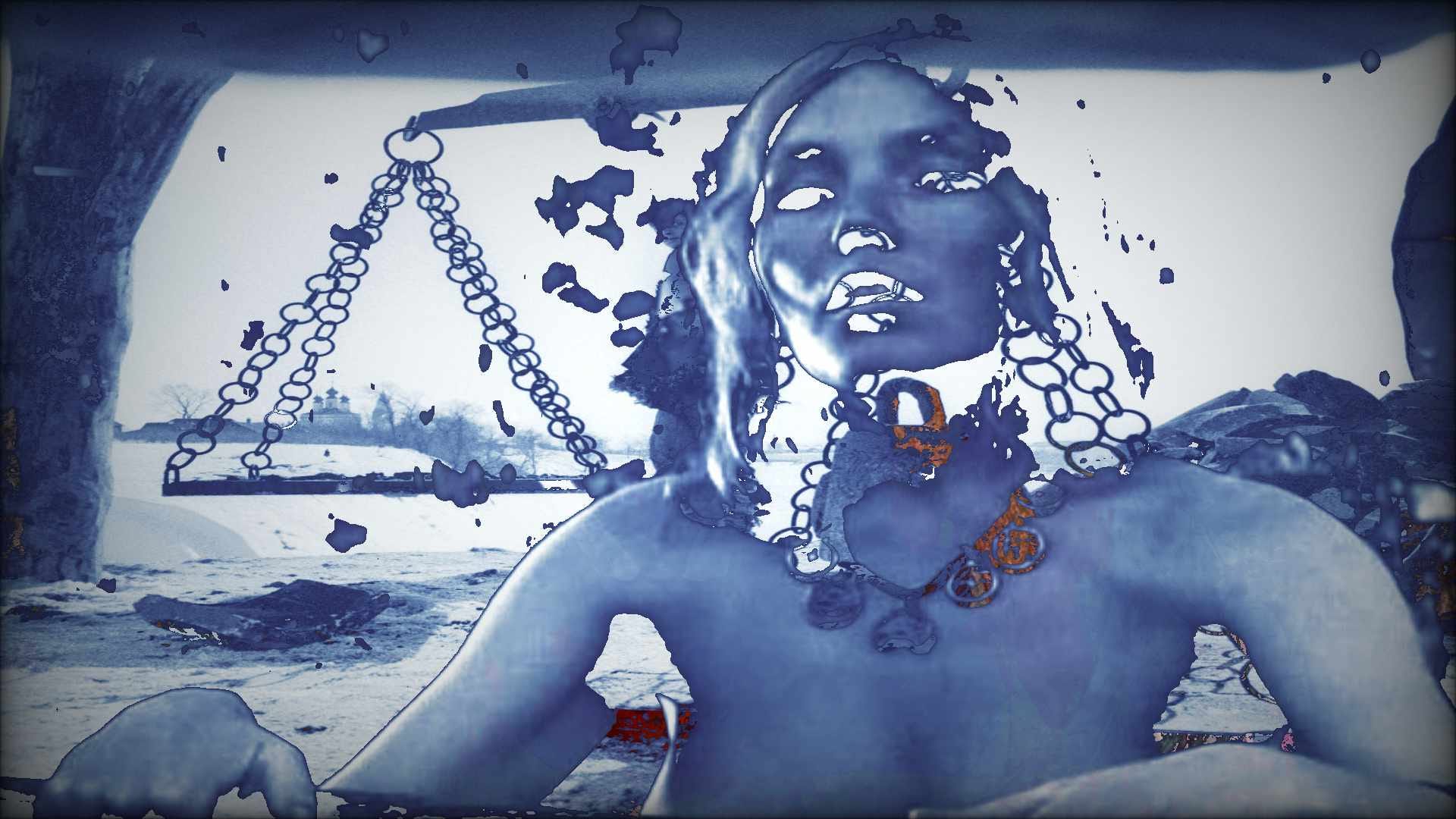
STALKER's visuals are created using Fragment:Flow, TIXL, and TouchDesigner.